



Author: Konstantine Ioseliani, UGSPN Research Fellow
The international political environment of 2026 is undergoing significant transformation amid the shifting global balance of power and the intensification of regional conflicts. In U.S. foreign policy, a prominent place is occupied by a strict strategy toward authoritarian regimes, which has been particularly evident in the active policies implemented in the Middle East and Latin America. In this context, notable attention is drawn to statements made by the President of the United States, according to which, following the conclusion of the Iran conflict, the focus of American foreign policy will shift to Cuba. A few days after this statement, on March 14, demonstrators in the Cuban city of Morón stormed the local office of the Communist Party and set it on fire. This incident is viewed as a clear manifestation of growing social discontent in Cuba and a symptom of increased pressure on the country’s internal political system.
U.S. – Cuba relations represent one of the longest-standing examples of political confrontation in international politics since the second half of the twentieth century. Following the Cuban Revolution of 1959, the country adopted a socialist political system, which significantly deteriorated its relations with Washington. In 1962, in the aftermath of the Cuban Missile Crisis, the United States imposed a full economic embargo on Cuba, which remains one of the longest-standing sanctions regimes in U.S. history.
During the Cold War, Cuba became an important strategic partner of the Soviet Union. After the collapse of the Soviet Union, Cuba entered a severe economic crisis, as a large portion of its foreign trade had depended on the Soviet bloc. Since that period, several gradual changes have occurred in U.S.-Cuba relations; however, full normalization has not been achieved.
From a historical perspective, Cuba has for decades represented both an ideological and strategic challenge for the United States. For this reason, in recent years, the U.S. administration has significantly intensified economic sanctions and political pressure on the Cuban government.
The Economic and Energy Crisis in Cuba – 2026
The ongoing economic crisis in Cuba, in 2026 has had a significant impact on the country’s internal political stability. The primary cause of the crisis has been the shortage of energy resources, which is linked to the cessation of oil supplies from Venezuela following the special operation that resulted in the arrest of former President Maduro. Venezuela had long served as the main guarantor of Cuba’s energy security. As a result of U.S. political and economic pressure on Venezuela, Cuba lost its principal source of oil, leading to an energy crisis and widespread electricity outages.
Regional and Global Implications
Political transformation in Cuba would have significant implications both for the regional geopolitical system of Latin America and for the dynamics of global power competition. Historically, Cuba has served as one of the main symbols of anti-American political projects in the Western Hemisphere and as an important ideological center for leftist movements.
Cuba’s influence has been particularly evident through political and ideological support, security and intelligence cooperation, as well as medical and humanitarian programs, which were often used as instruments of regional influence. Accordingly, political or economic transformation in Cuba would significantly weaken this network and reduce the symbolic support of the leftist ideological bloc in the region.
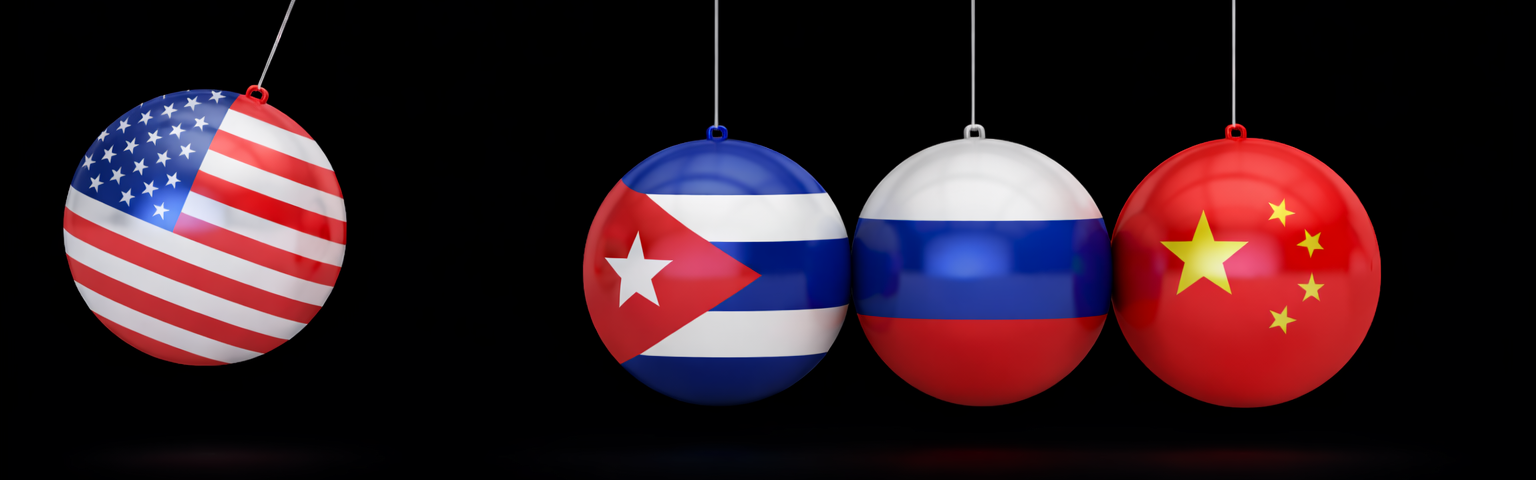
In the context of global power competition, Cuba also represents an important strategic platform, particularly for China. In recent years, China has actively expanded its economic and technological influence in Latin America, with Cuba serving as one of the key directions of this expansion. China’s interests in Cuba primarily include infrastructure projects, telecommunications and digital technology development, energy cooperation, and the expansion of logistical infrastructure in the Caribbean region. In the event of political transformation in Cuba, Beijing will likely attempt to preserve its economic influence, especially if the country transitions toward a more open economic model for foreign investment.
For Russia, Cuba has historically been an important military and political partner in the Western Hemisphere. Although Russia’s economic capabilities are relatively limited, Moscow continues to seek to maintain political and strategic influence in Cuba. Russia’s interests primarily include military cooperation, energy projects, the preservation of intelligence infrastructure, and symbolic geopolitical partnership. In the event of political and economic transformation in Cuba, Russia’s influence will likely decline, particularly if the country becomes more actively integrated into Western economic and political systems.
The Trump Administration’s Policy Toward Cuba
In 2026, the U.S. administration significantly tightened its policy toward Cuba. On January 29, the President signed an executive order declaring the actions of the Cuban government an unusual and extraordinary threat to U.S. national security. Under this order:
- The United States was granted the authority to impose sanctions on countries supplying oil to Cuba;
- Economic pressure on the Cuban government was intensified;
- A policy supporting democratic transformation in Cuba was officially declared.
The Trump administration refers to this policy as a strategy of maximum pressure, aimed at transforming Cuba’s political system through economic and political coercion.
The Impact of the Iran Conflict on U.S. Policy Toward Cuba
According to analysts, the military actions carried out in Iran are part of a new strategy of the Trump administration aimed at the rapid destabilization of authoritarian regimes. President Trump publicly stated that following the end of the Iran conflict, regime change in Cuba is only a matter of time.
Some analysts argue that the Trump administration is attempting to establish a new model that involves the rapid removal of a regime’s leadership followed by support for internal political transition.
Possible Scenarios for the Development of U.S.-Cuba Relations
Assessing the prospects for the development of U.S.-Cuba relations requires consideration of several possible scenarios, which differ both in political dynamics and international factors.
The most realistic scenario is often considered to be an internal transformation of Cuba’s political system, potentially driven by the deepening economic crisis. For many years, Cuba’s economy has suffered from structural problems related to energy shortages, rising inflation, low production efficiency, and the reduction of external economic partners. If the crisis deepens further, the risk of economic collapse is likely to increase, which may in turn lead to intensified social discontent. Under such conditions, street protests may emerge, political activity among various social groups may intensify, and critical attitudes may arise even within the ruling elite. Divisions within political elites often represent a key precondition for the transformation of authoritarian systems. As a result, the government may be compelled to initiate certain political or economic reforms aimed at stabilizing the economy and reducing social tensions. Such a process may develop gradually and manifest in the form of economic liberalization, expansion of the private sector, and partial reduction of administrative control over it.
The second possible scenario involves reaching a political compromise between Washington and Havana. Although U.S.-Cuba relations have been strained for decades, historical experience demonstrates that at certain stages both sides have been willing to engage in diplomatic dialogue. A political agreement could serve as a solution both for Cuba, which requires economic stabilization and broader integration into the international economic system, and for the United States, which is interested in ensuring regional stability and strengthening its influence. Such an agreement would likely include several key components. First, Cuba might agree to initiate economic reforms, including expanding private business and improving conditions for foreign investment. Second, the government might release political prisoners and undertake certain humanitarian measures that would be positively received by the international community. In response, the United States might consider partially lifting sanctions or gradually easing them, which would serve as a significant stimulus for Cuba’s economic development. In this case, relations could transition into a more pragmatic and cooperation-oriented phase.
The third scenario is associated with the continuation of a hybrid pressure policy. Within this approach, the United States may continue a multidimensional strategy of economic and political pressure, combining several instruments. One of the main elements would be the maintenance or tightening of economic sanctions aimed at increasing pressure on the Cuban government. At the same time, information and cyber operations may be actively employed to shape public opinion and expose government shortcomings, thereby influencing societal attitudes. Regional diplomatic isolation would also play an important role, aiming to weaken Cuba’s international standing and limit its economic partnerships. Such a hybrid strategy is particularly relevant in contemporary international politics, as it allows states to achieve strategic objectives without direct military intervention.
Considering the examples of Venezuela and Iran, direct and rapid coercive intervention can be regarded as the least probable scenario. On the one hand, military intervention involves a high level of legal, political, and military risk, making it an extreme option. Nevertheless, in a crisis situation, the United States may consider limited military actions. Possible instruments in this case could include targeted military operations directed against specific military or security facilities. Additionally, support for opposition political or social groups may be utilized to promote internal destabilization. Furthermore, localized special operations targeting strategic infrastructure or political leadership could also be carried out.
Conclusion
The contemporary international environment demonstrates that U.S. foreign policy is entering a more active and highly pragmatic phase, characterized by the use of strict political and economic pressure against authoritarian regimes. The ongoing military operations in Iran and political developments in Venezuela create a new geopolitical context in which U.S. strategic interests in the Western Hemisphere are becoming more clearly defined. Under these conditions, Cuba may become one of the key directions of American foreign policy, particularly as Washington seeks to strengthen its political and security influence in the region.
Considering existing trends, the most realistic scenario may be rapid political change driven by economic pressure, potentially manifested in economic reforms, internal political transformations, and a reassessment of international relations. At the same time, in the event of escalation of regional crises or internal political destabilization, a rapid and forceful scenario—encompassing both direct and indirect actions in Cuba’s political processes—remains plausible.
Thus, the political future of Cuba and the further development of U.S.–Cuba relations will largely be determined both by the dynamics of internal transformation within the country and by the redistribution of power within the international system, making this issue one of the key directions in the geopolitics of the Western Hemisphere.
This article was translated from the original language with the assistance of AI tools and revised by the author.