



Author: Khatia Davlianidze, UGSPN Research Fellow
The parliamentary elections of April 12, 2026 represent one of the consequential political events in Hungary’s recent history since the democratic transition of 1989 and the first multi-party elections. Citizens will have to make a choice not only between political parties and their programs, but also between different political courses and values that will determine Hungary’s place and role in both the European and the global political space.
Particular attention should be paid to the fact that Viktor Orbán and his party, “Fidesz,” who governs the country for 16 years, are for the first time so close to losing political power. This fact further increases the significance of the elections and strengthens the potential scale of both their domestic and foreign policy consequences.
The April 12 elections are a kind of test of the country’s democratic development, institutional resilience, and compliance with European values. Moreover, they go beyond the framework of national politics and affect the future of the European Union – under Viktor Orbán’s rule, Hungary’s foreign policy has repeatedly become a subject of confrontation around such critical issues as the migration crisis, the policy of sanctions against Russia, and military support for Ukraine. Accordingly, the election results will have a significant impact not only on Hungary’s foreign policy course, but also on the consolidation of the European Union’s position regarding the ongoing geopolitical challenges.
Orbán’s 16-Year Rule
In the 2010 parliamentary elections, the alliance of “Fidesz” and the “Christian Democratic People’s Party” won a constitutional majority, and Viktor Orbán became prime minister. In 2011, Orbán’s government adopted a new constitution, under which political institutions, including branches of government, administrative bodies, the constitution, and electoral legislation, were subjected to strong governmental control, which gradually weakened the rule of law in the country.
In the following years, the political and institutional changes that were implemented significantly weakened the mechanisms of democratic oversight. Viktor Orbán used the constitutional majority by limiting judicial independence, silencing critical media outlets, obstructing the activities of non-governmental organizations, redrawing electoral district boundaries in favor of the ruling party, strengthening a business elite sympathetic to “Fidesz,” and persecuting individuals holding critical positions toward the government – to secure victory again in 2014, for the third time in 2018, and for the fourth time in 2022.
During Orbán’s rule, Hungary became embroiled in a number of major corruption scandals, including allegations of the embezzlement and misuse of financial resources received from European Union funds. These factors significantly damaged the country’s institutional credibility and intensified tensions with Brussels.
Viktor Orbán’s “nationalist” economic policy and the sharp political confrontation with the European Union have had a significant impact on Hungary’s financial stability and the socio-economic situation of the population. Over the past two years, the country has recorded the highest inflation rate in the European Union, which has had a particularly severe impact on the daily lives of citizens. For Hungarians, the main economic challenges are the rising cost of living and the catastrophic increase in food prices. In an attempt to “manage” the crisis, the government periodically sets price caps on certain products, which creates shortages in the market and leads to even further price increases. The economic situation is further aggravated by the fact that a significant part of the country’s economy is controlled by business groups close to the government, which restricts free competition, reduces market efficiency, and contributes to further price growth.
For the European Union, Hungary’s energy dependence on Russian oil and gas remains a serious challenge. The frequently voiced narrative by Viktor Orbán about Russian “cheap gas” has in practice turned out to be merely a populist narrative that failed to protect the country from the energy crisis and left Hungary vulnerable to energy shocks.
Systemic corruption undermines the country’s financial and economic stability. It should be noted that Hungary is the most corrupt state in the European Union. In addition to the elimination of the rule of law, the capture of the judiciary, and violations of fundamental human rights, large-scale corruption is one of the reasons why the country’s access to European funds is restricted. As of March 2026, approximately 21-22 billion euros in financial assistance from Brussels remains frozen.
Confrontation with Brussels
The first serious institutional confrontation between Brussels and Budapest began in 2018, when the European Union started discussing the suspension of Hungary’s voting rights. This mechanism is used when a member state systematically violates the EU’s fundamental values and legal principles. Hungary actively uses its veto power in the Council of the European Union, which not only delays the adoption of important decisions but also undermines European unity and the institutional functioning of the European Union. Budapest blocks or obstructs issues such as the mechanism for the redistribution of migrants within the Union, the policy of sanctions against Russia (including the 20th sanctions package, February 2026), and financial and military assistance packages for Ukraine. It is important to note that Hungary still retains its voting rights, since restricting this right requires the consent of all member states of the Union. Due to the support of Viktor Orbán by Slovak Prime Minister Robert Fico, consensus has not yet been reached. Accordingly, the veto power remains a kind of leverage for bargaining with Brussels in Orbán’s hands.
The confrontation between the European Union and Hungary intensified further in 2024, when the European Commission initiated legal proceedings against Hungary over the “Sovereignty Protection Act” adopted by Orbán’s government in December 2023. Based on this law, the “Sovereignty Protection Office” was established, which was granted the authority to investigate any individual or organization suspected of attempting to influence Hungarian politics using foreign financial resources. According to Brussels, this law violates fundamental human rights, including freedom of expression and the right to a fair trial, since the “Sovereignty Protection Act” allows the ruling power to target any non-governmental organization, journalist, or opposition representative critical of the government without judicial oversight.
Migration policy represents another issue of acute disagreement. The European Union’s New Pact on Migration, which is set to take effect in June 2026, envisages a “mandatory solidarity” mechanism. According to this, member states must either accept a certain quota of refugees or pay financial compensation – approximately 20,000 euros for each unaccepted migrant. Viktor Orbán’s government has already stated that it will not implement the aforementioned mechanism; consequently, the Court of Justice of the European Union has already imposed a one-time fine of 200 million euros on Hungary, as well as a daily fine of 1 million euros, due to its restrictive asylum policy.
In addition to the migration issue, a dispute is also ongoing over the Child Protection Act adopted in 2021 (Case C-769/22). The European Union states that until Hungary ensures the protection of minority rights and amends discriminatory laws, the portion of EU Cohesion Funds allocated to Hungary (approximately 2-3 billion euros) will not be released. According to the European Commission, a country that violates the Charter of Fundamental Rights of the European Union cannot receive the money of European taxpayers.
One of the most significant points of confrontation concerns the issue of Ukraine. Currently, Hungary is blocking a financial package worth approximately 90 billion euros intended to support Ukraine’s budget and military needs until 2027. According to Viktor Orbán, these financial resources should be used to strengthen European armies rather than to “prolong the war.” At the same time, Hungary has for years delayed the transfer of tranches intended for the purchase of weapons for Ukraine. Hungary remains the only member state of the European Union bordering Ukraine that refuses to allow the direct transfer of weapons across its territory. In addition to blocking financial and military assistance for Ukraine, Hungary openly opposes Ukraine’s European integration. In March 2026, the Hungarian Parliament adopted an official resolution formally rejecting Ukraine’s membership in the European Union. According to Orbán’s government, admitting a country at war into the European Union would automatically involve the Union in the conflict.
Main Actors and the Election Campaign
The main political forces participating in the 2026 parliamentary elections present sharply different political visions and strategies.
The ruling party Fidesz has been in power for 16 years and is attempting to win the elections for the fifth consecutive time. The party’s leader and incumbent Prime Minister Viktor Orbán traditionally uses a strategy of mobilizing society around a specific “threat” during the election campaign. This “threat” and the “enemy” are sometimes represented by George Soros, who, according to Fidesz, threatens Hungary’s sovereignty and national identity, and sometimes by “Brussels,” which allegedly interferes in the country’s internal affairs and fights against “traditional values.” Currently, Orbán is trying to consolidate voters around the issue of “war and peace.” Government propaganda spreads the narrative that Volodymyr Zelenskyy is trying to drag Hungary into the war. In this context, Orbán presents himself as the “guarantor of peace and stability” in the country and convinces voters that only he can protect Hungary from being drawn into the war and ensure peace in the country. At the same time, shortly before the elections, the government is attempting to win voters’ support by increasing pensions, family benefits, and salaries, as well as by introducing a price cap on fuel (the price of gasoline per liter – 595 forints (approximately 1.75 USD), and diesel – 615 forints (approximately 1.81 USD).
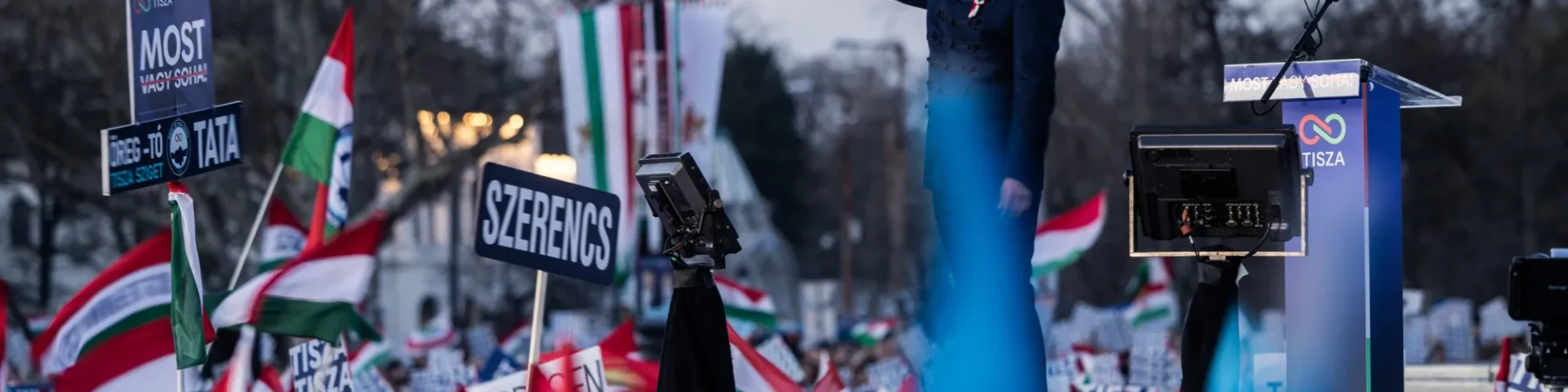
The ruling party’s main competitor is Péter Magyar and his political movement Tisza Party. Magyar himself was previously a member of the ruling party – he joined Fidesz in 2002, when the Hungarian Socialist Party was in power. After Fidesz came to power in 2010, he held several important state positions, including roles in the Ministry of Foreign Affairs, the Prime Minister’s Office, Hungary’s Permanent Representation to the European Union, and the Student Loan Center. Magyar decided to leave Fidesz following the pardon scandal involving President Katalin Novák, in which his former wife, then Minister of Justice Judit Varga, was implicated.
It should be recalled that in February 2024 a severe political crisis began in Hungary after it became known that in 2023 the then President of Hungary, Katalin Novák, had pardoned the former deputy director of a children’s home who had been accused of covering up cases of sexual abuse against minors. Along with Novák, the decision to pardon the individual was also signed by the then Minister of Justice, Judit Varga. Following the scandal, large-scale protests began in Hungary, which ultimately led to the resignation of both the president and the minister of justice. It is noteworthy that Magyar’s former wife, Judit Varga, was considered a rising star of Fidesz.
The main element of Péter Magyar’s political program is the fight against corruption and the peaceful dismantling of the political system established by Orbán. According to him, if he wins the elections, mechanisms of checks and balances will be restored and the government’s influence over state institutions will be reduced. In addition, one of his promises is to ensure the investigation of the misuse of funds from European Union funds by joining Hungary to the European Public Prosecutor’s Office, as well as creating an anti-corruption agency to recover assets illegally appropriated from the state.
Magyar states that if he wins, his government will end Hungary’s international political isolation and return the country to a path of closer cooperation with the European Union and Western partners. Tisza promises voters the restoration of financial assistance frozen by the European Union, the introduction of the euro, and the gradual reduction of dependence on Russian oil.
Magyar’s political strategy is based on the idea of “no cooperation with the old elite.” His main political message is not only the end of Orbán’s rule but also the complete renewal of the political system of the last two decades. For this reason, he has repeatedly stated that he does not intend to form a coalition with representatives of the “old opposition,” as he considers these parties part of the existing political system, and cooperation with them would damage the political credibility of his movement. Within this strategy, Tisza is participating in the elections independently and has nominated its own candidates in all 106 single-member constituencies in the country.
Among the representatives of the “old opposition” is the Democratic Coalition, a left-liberal and strongly pro-European party founded by former Prime Minister Ferenc Gyurcsány. For a large part of Hungarians, this party is associated with the political crises of the 2000s, economic problems, and a prime minister involved in major scandals; therefore, its popularity has been declining every year. According to pre-election polls, there is a possibility that it may fail to cross the 5% electoral threshold in the April 12 elections.
Another significant force in the political spectrum is the ultranationalist, Eurosceptic, and anti-immigration party Our Homeland Movement, which was formed in 2018 by members who split from Jobbik. Representatives of the party support Hungary’s withdrawal from the European Union (Huxit). Currently, support for the Our Homeland Movement fluctuates between 6-8%. If this political group crosses the 5% electoral threshold, due to shared views on a number of issues, it could potentially become a coalition partner for Fidesz at a critical moment.
What Explains Péter Magyar’s Popularity?
Péter Magyar is not a typical opposition figure in the political arena. For many years, he himself was a member of the ruling elite, the head of state companies, and the husband of former Minister of Justice Judit Varga. This background gives him a unique political advantage – many citizens perceive him as a credible political figure because he “knows how the system works from the inside.” Since Magyar was part of the ruling force for years, government propaganda finds it difficult to discredit him using its traditional methods, including labeling him a “foreign agent.” The publication of secret audio recordings by Magyar, which confirmed cases of political interference in the judiciary, dealt a significant blow to the government and strengthened Magyar’s image as a system “insider.”
One of the central elements of his political strategy is offering voters a so-called “third way.” A large part of Hungarians are disappointed and dissatisfied both with the ruling force and the “old opposition.” Magyar is attempting to fill this “political vacuum.” His rhetoric deliberately avoids clear ideological categories, an approach that attracts both Fidesz voters and centrist electorates.
Since Hungarian state television channels are under the control of the ruling party and opposition candidates are not given the opportunity to share their views and promises, Péter Magyar tries to attract voters through social media, particularly Facebook and TikTok, where his live broadcasts gather hundreds of thousands of views. In addition, during the election campaign he actively traveled across the country and moved his campaign “from the cabinet to the streets.” Magyar held meetings with citizens in regions, small towns, and villages where previously only the voice of the ruling party had been heard.
Magyar’s campaign focuses primarily on socio-economic problems rather than ideological issues. He draws attention to the severe condition of the healthcare system, low wages, and problems related to the education sector. Magyar emphasizes that the state’s resources and financial assistance from the European Union have served the interests of the ruling elite, while citizens face serious social problems in their daily lives.
Magyar supports deepening cooperation with the European Union and states that reforms should enable Hungary to regain the frozen financial resources. At the same time, however, he emphasizes the importance of national sovereignty and avoids rhetoric that could be perceived as “kneeling before” the European Union. This approach is particularly attractive to voters who simultaneously support European prosperity but also fear the loss of national identity – a concern that Orbán frequently emphasizes.
The Specific Features of Hungary’s Electoral System
The Fidesz party has created an electoral system in Hungary in such a way that opposition parties need significantly more votes than the ruling force to obtain a “simple majority” in parliament (100 seats out of 199).
Hungary’s parliamentary elections are conducted under a mixed electoral system. The legislative body consists of 199 members, of which 106 are elected from single-member majoritarian districts and 93 are elected proportionally from party lists. Political parties must cross a 5% electoral threshold to enter parliament.
To gain a majority in the legislature, the opposition needs approximately 51-53% of the vote nationally, while around 45% may be sufficient for Fidesz. Moreover, the opposition requires at least a 3-5% lead over the ruling force, because in the case of a small difference the distribution of mandates often still favors the ruling party. For example, if the opposition receives 46% and Fidesz 44%, the ruling force may still obtain more parliamentary mandates.
This is due to several important features of Hungary’s electoral system: single-member districts – there are 106 such districts across the country, which are “tailored” to benefit the winning party. Fidesz enjoys strong support in small towns and rural areas, while opposition voters are mainly concentrated in large cities, particularly the capital Budapest. In single-member districts the First Past the Post principle applies, meaning that the candidate who receives the most votes wins the entire mandate, regardless of how small the difference in votes is. As a result, the opposition may win by a large margin in big cities (for example, 70–80%), but this only results in winning a few districts; meanwhile, Fidesz wins many rural and small-town districts by a small margin (for example, 50-55%) but secures a larger number of mandates. Since only one mandate is distributed in each district, winning many districts by a small margin ultimately yields more parliamentary seats than winning a few large cities by a large margin.
Another feature is The Winner Takes It All compensation mechanism – winning a single-member district requires just one more vote than the candidate in second place. The “extra” votes exceeding the minimum needed for victory are not lost and are added to the party’s national list, which then translates into additional parliamentary mandates. As a result, if a party wins many single-member districts (as is often the case with Fidesz), it receives not only the district mandates themselves but also a large number of “extra” votes, which ultimately increases its representation in the proportional tier.
Electoral district boundaries (gerrymandering) are also significant. Following the 2011 electoral reform, district boundaries were drawn in such a way that opposition parties need significantly more votes to win a district compared to the ruling party. The conversion of opposition votes into mandates is hindered by both the “concentration of votes” and the “dispersion of votes.” Opposition voters are concentrated in large cities, particularly Budapest, meaning the opposition often wins these districts by a large margin but gains only a few mandates. At the same time, in regional districts opposition votes are dispersed across multiple constituencies, making it difficult to secure a majority. In such districts the ruling party often wins by a small margin, but because the winner takes the entire mandate, this ensures many additional seats for the ruling party. As a result, a situation emerges in which the opposition needs a much larger advantage to win a district than the ruling party. Such a configuration of electoral districts strengthens the position of the ruling party and reduces the effectiveness of opposition votes in the process of converting them into parliamentary mandates.
Conclusion
For the first time in the last 16 years, pre-election polls show an opposition force ahead of the ruling party, with a difference of approximately 10-12%. In the past, a difference of this magnitude was always recorded in favor of Fidesz, which allowed the ruling party to obtain a constitutional majority.
In addition, it should be noted that between January and March 2026, Viktor Orbán’s popularity fell to its lowest level since 2010.
The noticeable decline in support for Viktor Orbán and the 10-12% advantage of Tisza over the ruling party indicate that the parliamentary elections scheduled for April 12, 2026, may mark the beginning of the end of the “illiberal triumph” in Hungary.
This article was translated from the original language with the assistance of AI tools and revised by the author.