



Author: Khatia Davlianidze, UGSPN Research Fellow
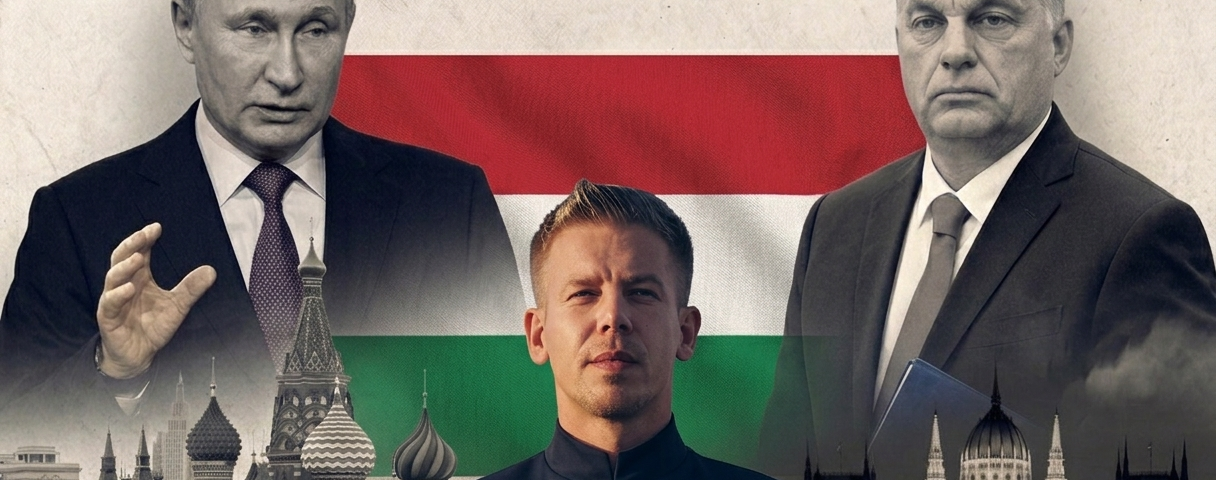
In early March 2026, the investigative platform “Vsquare” and the Financial Times released information regarding Russian interference in Hungary’s upcoming parliamentary elections. According to their reports, the Kremlin sent a special group to the Russian Embassy in Budapest to support Viktor Orbán, with the main task of managing manipulative campaigns on social networks. The group members are officers of the Russian Military Intelligence (GRU) who have been granted diplomatic passports to protect them from expulsion from the country.
As expected, Moscow denies the fact of interference in the Hungarian parliamentary elections and calls this disseminated information “fake.” Despite the fact that Western intelligence services confirm the presence of Russian military intelligence officers in Budapest and their conduct of disinformation campaigns, the Hungarian government claims that the information spread by “Vsquare” and the Financial Times is part of a “leftist conspiracy” aimed at diverting attention from threats coming from Ukraine.
“Social Design Agency” and Disinformation Campaigns
The information component of the operation supporting Viktor Orbán is carried out by the “Social Design Agency (SDA),” which has close ties to the Kremlin and was founded by Ilya Gambashidze. It is noteworthy that the agency’s operations are directly supervised by the First Deputy Chief of Staff of Putin’s Administration, Sergey Kiriyenko.
Kiriyenko, the main architect of Russia’s foreign policy influence operations, used the same scheme in Moldova in 2024 that he is currently employing in Hungary aimed at interfering in the presidential elections and discrediting Maia Sandu’s candidacy.
The “Social Design Agency” became known to the general public through the “Doppelganger” campaign, the goal of which, following Russia’s invasion of Ukraine and the start of the full-scale war in February 2022, was to weaken and eliminate Western support for Ukraine. Disinformation campaigns conducted by the agency also include the cloning of websites of authoritative Western publications and the dissemination of AI-generated fake news. Due to its involvement in influence operations conducted by the Russian government, the “Social Design Agency” and its head, Ilya Gambashidze, are sanctioned by the US and European states.
Ukraine – The Main Theme of Orbán’s Election Campaign
Although Hungarian citizens are currently most concerned about high inflation, systemic corruption, and billions of euros in financial aid frozen by the European Union, Viktor Orbán is trying to gain voter support primarily by presenting Ukraine and Volodymyr Zelenskyy as existential threats. The “war and peace” narrative is actively spread by pro-government media outlets, according to which, if the opposition wins the April 12 parliamentary election, Hungary will be involved in the war; therefore, the “only guarantor of stability and peace” in the country is Viktor Orbán.
One of the strategies of his election campaign is emotional manipulation. To psychologically influence voters, the Prime Minister actively uses the technique of “playing” with sensitive topics during meetings. The clearest example of this strategy is his message: “Our children will not die for Ukraine,” which serves to fuel fear among voters and consolidate them around the government against the backdrop of this fear.
Viktor Orbán divides Hungarian citizens into two opposing camps, thereby artificially creating a polarized environment: on one side are “Fidesz” voters who, according to him, want to protect Hungary’s sovereignty and national interests, while on the other side are opposition-minded citizens whom he refers to as supporters of the “war party” and defenders of Ukrainian interests. With such rhetoric, the government tries to discredit the opposition and place voters before a moral dilemma where the choice is not between political parties and their programs but between “maintaining sovereignty” and “serving foreign interests.”
Taking into account the fact that the ruling party “Fidesz” controls about 80% of Hungarian media outlets, Orbán’s and his team’s anti-Ukrainian narratives are actively spread throughout the country. In addition, the “Social Design Agency,” which has close ties to the Kremlin, particularly helps the Hungarian government in conducting disinformation campaigns by distributing content created in Russia through local pro-government influencers in Hungarian social media.
According to content created by Hungarian pro-government media and the group embedded by Moscow in the Russian Embassy in Budapest, in the upcoming parliamentary elections, Viktor Orbán is not facing the opposition, but a “war party.” To “scare” voters, AI-generated videos are circulated showing Hungarian soldiers dying in war after an opposition victory in the elections.
Furthermore, to discredit Péter Magyar and his party, the pro-government propaganda machine spreads information that the opposition is financed from “outside,” using suspicious incidents for this purpose. For example, on March 5, employees of the Hungarian Counter-Terrorism Center detained couriers of the Ukrainian “Oschadbank” who were transporting gold and cash in armored vehicles from Austria to Ukraine via Hungarian territory. By Orbán’s order, the seized cargo ($40 million, €35 million, and 9 kilograms of gold) will remain in Hungary until the completion of an investigation launched on charges of money laundering. According to the government, Ukraine is financing the opposition “Tisza” party with the aforementioned funds.
Following this incident, edited footage of armed special forces, blocked armored vehicles, and handcuffed individuals was quickly disseminated by pro-government media, creating the illusion for the population of preventing a “dangerous international crime.” In addition, social networks were flooded with graphic videos showing the exact route of how Ukrainian money reaches the “Tisza” office.
At the same time, edited videos are circulated where Ukrainian politicians supposedly threaten Viktor Orbán’s family members, including his grandchildren. Orbán published a video discussing the need for security measures with his children. Against opposition leader Péter Magyar, Russian-style “kompromat” about his personal life was prepared, to which he responded with a preemptive confession.
Ultimately, Viktor Orbán’s election campaign largely relies on emotional manipulation of voters, intimidating the public with non-existent existential threats, and creating deep political polarization in the country. To achieve this goal, the government actively uses coordinated disinformation campaigns, AI-generated propaganda content, and the discrediting of opponents with suspicious “kompromat.”
Why Does the Kremlin Want Viktor Orbán to Win?
In early March of this year, “Vsquare” reported that in the event of a radical increase in the percentage difference between Orbán and Magyar in pre-election polls, the Russian side is ready for even more aggressive disinformation attacks. Against the backdrop of a sharp drop in Orbán’s rating (according to the latest polls, the difference reaches up to 20%), The Washington Post reports that Russian intelligence officers presented a plan to the Kremlin, code-named “Gamechanger,” which involves staging an assassination attempt on the Prime Minister.
In Russia’s view, an attack on Viktor Orbán will cause a sense of fear among voters, which will put the issue of state security on the agenda. Such a crisis scenario would present Orbán as the only guarantor of stability, which would facilitate public consolidation around him and significantly increase his chances of winning the elections.
Russia’s interference in the elections of sovereign states is not new. The Kremlin always tries to interfere in the internal political processes of countries that, in Moscow’s view, pose a threat to its strategic interests and sphere of influence.
Viktor Orbán, who has subjected the branches of government and administrative bodies to strong government control, changed the electoral legislation in favor of the ruling party, restricted critical media outlets and non-governmental organizations, strengthened the business elite sympathetic to “Fidesz,” and allowed systemic corruption to flourish in the country (See more in the article: “The End of The Illiberal Triumph in Hungary?”), can be said to represent Vladimir Putin’s ideological ally.
In order to violate the principles of liberal democracy and consolidate political power, dictators cross national borders, cooperate with each other, and create an interconnected network worldwide; therefore, 21st-century autocratic regimes are no longer isolated phenomena (Applebaum, 2024).
Hungary actively uses its veto power, thereby not only delaying important decisions (imposing sanctions against Russia, financial and military aid to Ukraine, etc.) for a long time but also undermining EU unity and institutional functioning, which plays into Russia’s hands. It can be said that the current Prime Minister of Hungary is helping the Kremlin, which perceives the expansion of Western military-political blocs and alliances as a threat to its national interests, in achieving its geopolitical goals. Consequently, for Russia, Orbán plays the role of a “Trojan horse” in NATO and the European Union.
Furthermore, the presence of “Fidesz,” which has a “friendly” attitude toward Russia, at the head of the Hungarian government allows the Kremlin to have advance information about the West’s political steps. Notably, the Hungarian foreign minister himself confirmed the information spread by The Washington Post that Péter Szijjártó regularly contacts Russian Foreign Minister Sergey Lavrov during closed meetings of the European Union. A “loyal” attitude toward Russian diplomats is also confirmed by the fact that after Russia’s invasion of Ukraine in February 2022, Hungary was the only state in NATO and the European Union that refused to expel Russian diplomats from the country. The “Vsquare” article notes that Hungary shows special “hospitality” toward Russian military diplomats. Officers contact Hungarian government media outlets and pro-Orbán propagandists.
The current Prime Minister of Hungary, who virtually daily violates democratic principles with his actions, strengthens Putin’s narrative that Western liberal democracy is destined for failure.
In the event of a victory in the April 12 parliamentary elections by opposition leader Péter Magyar, who has strong anti-Russian sentiments, Russia will lose an ideological ally, a reliable partner, and a disruptor of European unity in the European Union; therefore, Moscow will do everything (including a staged attack) to keep the “architect of illiberal democracy” and his party “Fidesz” at the head of the Hungarian government.
This article was translated from the original language with the assistance of AI tools and revised by the author.