



Author: Revaz Topuria, Research Fellow
In March 2026, during China’s annual “Two Sessions,” Beijing officially approved its 15th Five-Year Plan, setting the country’s strategic direction for 2026–2030. The National People’s Congress endorsed the final document, largely confirming earlier recommendations while refining implementation priorities and targets.
At first glance, the plan reads like a technical policy document. But behind the language lies a strategic roadmap that will shape not only China’s future, but also global supply chains, technological competition, and climate policy.
The new plan outlines a broad vision: achieving “basic socialist modernization,” strengthening China’s manufacturing base, and accelerating independence in critical technologies. These include semiconductors, artificial intelligence, robotics, biotechnology, quantum computing, and 6G. The plan also introduces a new economic benchmark — the digital economy should reach 12.5% of GDP by 2030. Climate goals are also included, such as reducing carbon intensity by 17% and increasing the share of non-fossil energy to 25% by 2030.
These targets may sound technical, but together they signal a strategic shift. China is no longer simply planning for growth – it is planning for technological leadership, and long-term competition.
Why China’s Five-Year Plans Matter
China’s Five-Year Plans are among the most consequential policy instruments in the modern world, yet they often receive limited attention outside specialist circles. Since 1953, these plans have guided the country’s economic and social transformation, playing its role into turning China from a largely agrarian society into the world’s largest manufacturing powerhouse. Over time, they have evolved from rigid central planning tools into strategic roadmaps that coordinate government agencies, provincial authorities, banks, and companies around shared priorities.
This coordination gives Beijing a powerful advantage. When priorities are set at the national level, they cascade throughout the system. Investment flows follow policy signals, industries align with national goals, and local governments compete to implement central directives. Few countries possess this level of coordinated economic governance.
The global implications are significant. China now accounts for roughly one-sixth of the global economy and more than 30 percent of global manufacturing growth. Decisions taken in Beijing affect supply chains, commodity markets, and technological development worldwide.
The 15th Five-Year Plan arrives at a particularly important moment. China faces slowing economic growth, demographic decline, and intensifying geopolitical rivalry with the United States. At the same time, global uncertainty — from technological decoupling to climate change — is reshaping the international environment. The new plan therefore represents more than routine planning. It reflects China’s attempt to adapt to a changing world.
Slower Growth, Strategic Transition
One of the most striking elements of the 15th Five-Year Plan is the relatively modest growth target of around 4.5 to 5 percent. This represents a significant slowdown compared to previous decades. Yet the lower growth target is not necessarily a sign of weakness. Rather, it reflects a deliberate shift in China’s development model.
For decades, China’s growth was driven by infrastructure investment, real estate, and export-oriented manufacturing. These engines are now losing momentum. Instead, Beijing is focusing on improving productivity, boosting domestic consumption, and moving up the technological value chain. Growth is expected to be slower, but more sustainable and more resilient.
This shift reflects a broader transformation. China is moving from rapid industrial expansion toward technological sophistication and economic maturity. The 15th Plan is therefore less about accelerating growth and more about reshaping how growth happens.
Industrial Modernization
If earlier plans focused heavily on technological innovation, the 15th Plan places industrial modernization at the center. Innovation alone is not enough; China now wants to scale new technologies across its entire industrial system.
The plan emphasizes upgrading traditional industries — including machinery, metals, and textiles — through automation, digitalization, and green technologies. At the same time, Beijing is expanding investment in emerging sectors such as aerospace, advanced materials, drones, and new energy technologies. This reflects a strategy aimed at transforming China from the “world’s factory” into a high-value manufacturing powerhouse.
This transformation is closely tied to China’s technological ambitions, which remain at the heart of the plan.
Beyond the Chip War
For years, discussions about China’s technological strategy have focused on semiconductors and the ongoing technology competition with the United States. But the 15th Five-Year Plan suggests that Beijing is now thinking beyond chips.
Rather than focusing solely on semiconductor production, the plan emphasizes building entire computing ecosystems. Artificial intelligence, cloud infrastructure, and industrial applications receive increased attention. In fact, references to artificial intelligence significantly outnumber mentions of semiconductors, and computing infrastructure is given dedicated attention in the plan.
Perhaps most telling is what has been quietly removed. The earlier goal of achieving 70 percent semiconductor self-sufficiency — a central element of Made in China 2025 — has disappeared. In its place is the broader target of expanding the digital economy to 12.5 percent of GDP by 2030. The shift suggests that Beijing is measuring success less by how many chips it produces, and more by how deeply digital technologies are integrated into the economy.
This reflects a more sophisticated technological strategy. China is not only trying to catch up in individual technologies — it is trying to shape entire technological ecosystems.
Robotics and the Automation Push
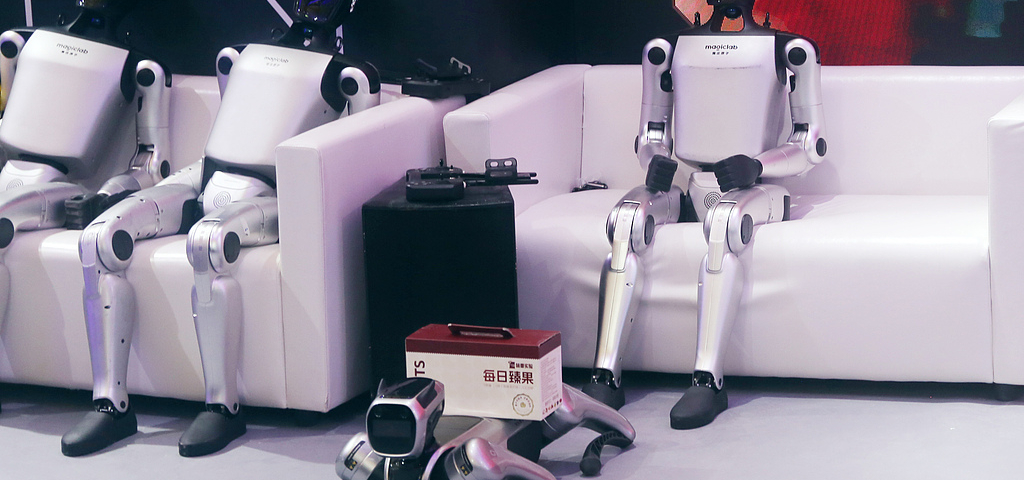
Another striking feature of the 15th Plan is the emphasis on robotics and what Chinese policymakers increasingly describe as “embodied intelligence.” Humanoid robots and AI-driven physical systems are now listed among the country’s strategic future industries, alongside quantum computing and nuclear fusion.
This emphasis is driven partly by economic necessity. China’s population is aging, and the workforce is shrinking. Automation offers a solution. By integrating robotics into manufacturing, logistics, and services, Beijing hopes to offset demographic pressures and maintain productivity growth.
The plan also encourages local governments to deploy AI and robotics across public services, industry, and infrastructure. This creates large-scale domestic demand and accelerates technological adoption. Over time, such policies could help China build a significant advantage in robotics and automation technologies.
Artificial Intelligence as National Strategy
Artificial intelligence sits at the center of China’s long-term ambitions. The 15th Five-Year Plan treats AI not simply as a technology sector, but as a foundational tool for economic transformation and national power.
China aims to integrate AI into manufacturing, logistics, governance, and defense. The “AI Plus” initiative seeks to embed artificial intelligence across industries and public services. At the same time, Beijing is investing in computing infrastructure, talent development, and research.
The implications extend beyond China’s borders. Artificial intelligence is becoming a domain of geopolitical competition, and China is positioning itself as a major global player. The plan suggests that Beijing intends not only to adopt AI technologies, but also to shape global standards and governance frameworks.
Green Development
China’s climate ambitions are another key component of the 15th Plan. The country remains the world’s largest investor in renewable energy and dominates global production of solar panels, wind turbines, and electric vehicle batteries. At the same time, China is still the world’s largest emitter of greenhouse gases.
The new plan sets a target of reducing carbon intensity by 17 percent and increasing the share of non-fossil energy to 25 percent by 2030. These goals reflect continued investment in clean energy, nuclear power, and electrification.
However, the plan stops short of committing to rapid coal reduction. Critics argue that the targets allow overall emissions to continue rising, highlighting the tension between economic growth and environmental goals. China’s climate strategy therefore reflects a balancing act: pursuing decarbonization while maintaining industrial expansion.
Demographics and Domestic Stability
Beneath the technological ambitions lies a more fundamental challenge: demographics. China’s population is aging, birth rates are declining, and the workforce is shrinking. These trends pose long-term risks to economic growth.
The 15th Five-Year Plan addresses these issues through policies aimed at supporting families, improving healthcare, and expanding education. At the same time, Beijing is attempting to boost domestic consumption and reduce reliance on exports. These measures are intended to stabilize growth and maintain social stability.
A Strategy Built Around Resilience
Running through the entire document is a focus on resilience. China is seeking to strengthen domestic supply chains, reduce technological dependence, and increase financial autonomy. The plan also emphasizes expanding China’s global economic influence, particularly in developing countries.
These goals reflect a world increasingly shaped by geopolitical competition. The 15th Five-Year Plan therefore reads not only as an economic blueprint, but also as a strategic document for navigating global uncertainty.
A Country Reengineering Itself
China’s 15th Five-Year Plan is not a document of rapid expansion or short-term growth. It is a blueprint for transformation. China is attempting to move from scale to sophistication, from manufacturing to intelligent industry, and from economic growth to technological leadership.
For the rest of the world, the plan is both a signal and a challenge. China is no longer simply the world’s factory. It is positioning itself as a technology leader, a clean-energy powerhouse, and a major geopolitical competitor.
Like many of China’s Five-Year Plans before it, the full impact of this strategy may only become clear over time. But one thing is already evident: the next five years will not only shape China’s future — they will help define the global economic and technological landscape of the coming decade.