



Author: Khatia Davlianidze, UGSPN Research Fellow
April 19 Parliamentary Elections
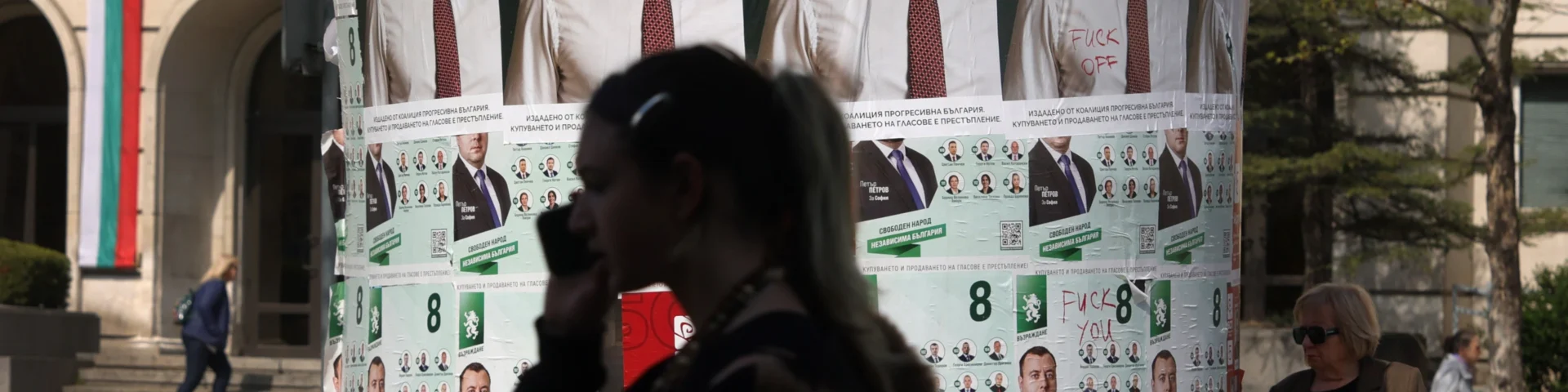
On April 19, parliamentary elections were held in Bulgaria, in which the majority of votes (131 out of 240 seats) were won by the coalition of former president Rumen Radev, “Progressive Bulgaria.”
In addition to Radev’s left-wing union, four parties managed to obtain parliamentary seats: former Prime Minister Boyko Borisov’s “GERB-SDS,” Nikolai Denkov’s pro-European coalition “We Continue the Change – PP – Democratic Bulgaria – DB,” Delyan Peevski’s “Movement for Rights and Freedoms – DPS,” and Kostadin Kostadinov’s ultra-right, extremist, pro-Russian party – “Revival.”
In Bulgaria, over the last five years, parliamentary elections have been held 8 times, while political parties managed to form a coalition government only 3 times (see “Bulgaria’s Political Crisis and the Former President as a New Player”). After the 2009 parliamentary elections and the formation of Boyko Borisov’s first cabinet, this will be the first case where creating a coalition will not be necessary for the formation of a government.
Due to the formation of fragile and unsustainable governing coalitions and their frequent collapse within a matter of months the country has experienced a prolonged political crisis. Stable governments have proven difficult to establish, as widespread disillusionment with the Bulgarian political elite and deep-seated distrust toward political parties have prevented any single party from securing a sufficient electoral mandate to govern independently. Consequently, parties with ideologically incompatible platforms were entering into coalitions, failing to achieve effective and coherent cooperation, and ultimately dissolving due to irreconcilable contradictions.
The Former President as the Future Head of Government
Last December, when Bulgarian Prime Minister Rosen Zhelyazkov resigned amid anti-government protests, it was widely expected that President Rumen Radev would assemble a caretaker government and call parliamentary elections. However, in January 2026, he instead announced his resignation from the presidency.
According to him, the cause of the problems existing in Bulgaria is a harmful model of governance, which requires radical change and the offering of a new alternative to disillusioned citizens. Soon, he announced the creation of a coalition consisting of three left-wing parties – “Progressive Bulgaria” which he headed.
The acquisition of 131 seats by Radev’s union in the April 19 parliamentary elections and the possibility of forming a government independently means that Bulgaria’s prolonged political crisis will end.
Radev states that his primary goal is the elimination of systemic corruption in the country and the influence of the old political elite (especially Boyko Borisov and Delyan Peevski). In this direction, the pro-European coalition “We Continue the Change – PP – Democratic Bulgaria – DB” declares full support for him. Although Radev’s union does not have a constitutional majority, in the case of cooperation with the aforementioned coalition, he will have a sufficient number of seats to introduce changes to the constitution. Most likely, on internal political issues, “Progressive Bulgaria” and “PP-DB” will find a common language, though they will not be able to agree on foreign policy topics (including military aid to Ukraine).
Out of the five parties holding parliamentary seats, three (“PP-DB,” “GERB,” and “DPS”) are firm supporters of Bulgaria’s integration into the Eurozone. Radev, however, openly opposed joining the Eurozone due to the country’s economic “unpreparedness” and inflation. According to him, replacing the Bulgarian lev with the euro causes a sharp increase in prices for products and services, which further impoverishes the low-income population. It is noteworthy that Radev supported holding a referendum regarding the introduction of the euro, because in his opinion, changes of such importance should not be implemented without the involvement and consent of citizens.
Regarding the issue of Ukraine, Radev is against sending weapons to Ukraine. According to his view, the Russia-Ukraine war must end through diplomatic means, and military aid only contributes to the escalation of the conflict. Providing aid to Ukraine is supported by “PP-DB,” “GERB,” and “DPS.” Currently, the only party in the Bulgarian legislative body that opposes supporting Kyiv is the pro-Russian “Revival.” This party calls Radev “insufficiently radical” and demands the cancellation of the 10-year cooperation agreement with Ukraine.
Regarding economic sanctions, Radev thinks that they damage European countries more than Russia and states that Bulgaria’s economy should not be sacrificed to global geopolitical games. Furthermore, he speaks openly about the necessity of restoring the flows of “cheap” Russian gas and oil (as a reminder, in April 2022, Russia cut off gas supplies to Bulgaria due to its refusal to pay in rubles, after which the country completely diversified its natural gas imports).
Based on Radev’s declared goals, which involve the elimination of corruption and oligarchic influences, it is unlikely that “Progressive Bulgaria” will cooperate with the party of Boyko Borisov (“GERB”) or Delyan Peevski (“Movement for Rights and Freedoms – DPS”). Delyan Peevski’s influence is not limited only to the leadership of “DPS”; he holds levers of influence over the judiciary, media outlets, large businesses, and state procurement. In Radev’s opinion, the state is precisely “captured” by Delyan Peevski and former Prime Minister Boyko Borisov, who govern Bulgaria from the sidelines through corruption schemes. As a reminder, Peevski is sanctioned by the US and Great Britain for participation in corruption schemes, bribing public officials, money laundering, and interference with the functioning of state institutions.
Bulgarian Orban?
Despite the fact that Rumen Radev won 131 seats and has the possibility of forming a government independently, there are a number of reasons why he cannot become a “Bulgarian Orban” and will not be able to offer Brussels the same resistance that the Hungarian Prime Minister has offered for years.
During his 16 years in power, Viktor Orban constantly held a constitutional majority; accordingly, his political decisions could not be resisted by the weakly represented opposition parties in the legislative body. Rumen Radev’s union holds only 131 out of 240 seats; therefore, for the implementation of any fundamental reform or constitutional change, he will be forced to cooperate with other parties and make certain concessions. Unlike Orban, most likely, he will never be able to make unilateral decisions.
Bulgaria is the poorest member state of the European Union, which is critically dependent on European funds. If Hungary’s economy withstood years of Viktor Orban’s “disobedience,” confrontation with Brussels, and the freezing of billions of euros, Bulgaria’s economy would quickly collapse without EU financial support, because this country’s economic progress is stimulated precisely by funds allocated from European Union funds. Furthermore, Hungary, in the conditions of a larger and more diversified economy compared to Bulgaria, tried to replace EU financial aid by promoting Russian-Chinese investments, while Bulgaria lacks alternative sources for attracting financial flows.
With Orban’s defeat in the Hungarian parliamentary elections, Europe’s “illiberal democracy” club has weakened. Radev understands that if he becomes a second Orban, he will be left without allies, and political isolation would prove disastrous for him as the ruler of the European Union’s poorest country.
Viktor Orban essentially fully subordinated the branches of government, administrative bodies, media outlets, educational institutions, business, etc. In Bulgaria, the lever of control over all this is not in the hands of one person; spheres of influence are distributed among several individuals (including Boyko Borisov and Delyan Peevski). Currently, Rumen Radev does not have the resources to unilaterally subdue the system. Even if the resources existed, it would take years to create an “Orban model.”
Due to the lack of a “super-majority” and Bulgaria’s difficult economic situation, it is unlikely that Radev will show Orban-like “disobedience” and openly confront the European Union. Most likely, he will choose a path similar to Slovak Prime Minister Robert Fico. Inside the country, he will state a radical position and try to score political points by talking about Bulgaria’s sovereignty, national identity, peace, the flaws of the European Union, and being “captive to the West’s moral ambitions,” but when sitting at the negotiation table in Brussels, he will be compliant and will not use the right of veto.