


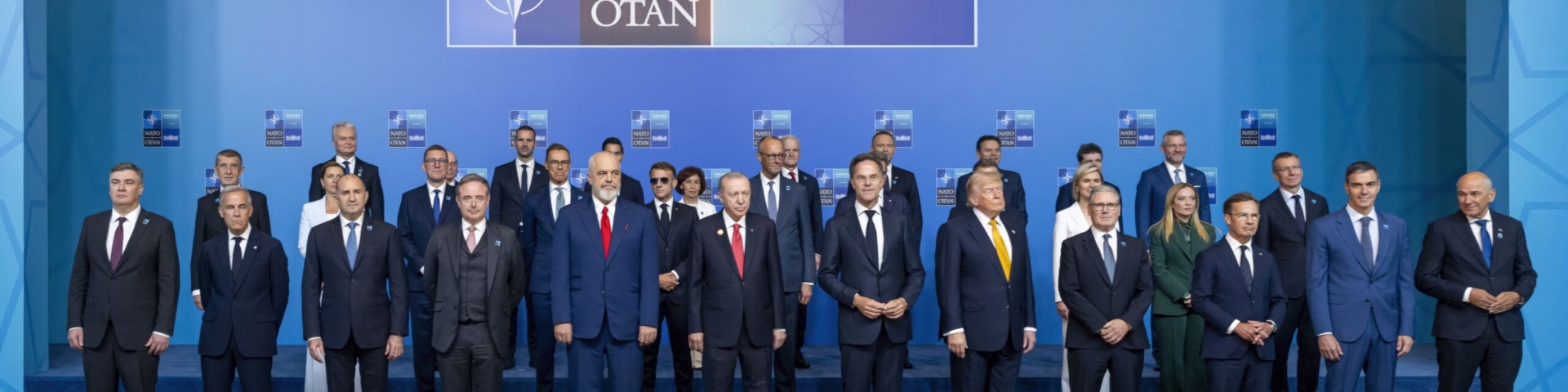

Author: Nata Koridze, UGSPN Senior Research Fellow
The NATO Summit in Ankara, held on July 7–8, was expected to be a test of Alliance unity amid strains in transatlantic relations and outstanding security challenges. The Summit showed that rumors of the Alliance’s death are very much exaggerated. Despite all the challenges, NATO stands strong.
The participation of the president of NATO’s key ally, the United States was itself important, although also challenging given strained transatlantic relations. While the Summit was not without awkward moments and controversial statements, pundits and international relations experts generally assessed it positively. As NATO Secretary General Mark Rutte said, the message from Ankara was clear: NATO delivers.
Probably drawing on the experience of previous summits, Rutte put considerable effort into convincing the U.S. president ahead of the meeting that Allies were serious about increasing defense spending and that Europe and Canada were making progress towards the new 5 percent target agreed at the Hague Summit. His visit to Washington, D.C., shortly before the Ankara meeting served precisely this purpose. The task was not simply to demonstrate higher spending but to reassure Washington that the balance of responsibilities within NATO is beginning to shift and that European Allies are responding to longstanding U.S. demands.
The Ankara Summit had, as many expected, its rocky moments. For starters, U.S. President Donald Trump once again raised the seemingly forgotten issue of Greenland, revisiting his desire to take it over. He also attacked several NATO countries, including Spain, criticizing them for failing to support the United States in its war against Iran. Trump said he wanted to cut off all trade relations with Spain and called the European ally a “wasted cause” and a “terrible partner in NATO.”
The Allies, however, seem to have developed a degree of immunity to such inflammatory rhetoric and were more focused than ever on avoiding distractions from the Summit’s ultimate objectives: demonstrating unity and achieving consensus on its main priorities. Both Spain and Denmark responded to President Trump’s remarks in a measured manner. This approach paid off, as the Summit ended on a much more positive note, with President Trump saying at a news conference: “We’ve had a tremendous time and I think a great success.” Moreover, anonymous sources revealed that inside the closed-door meeting President Trump was much more cordial and business-like, then in front of the journalists while making public statements. He himself noted that “there as a lot of love” and “a lot of unity” and called the summit “phenomenal.”
The ability to contain political disagreements without allowing them to derail the meeting was, in itself, one of Ankara’s important outcomes. The Summit showed an Alliance increasingly aware that internal differences are unavoidable, but that managing them is essential at a time of heightened external threats.
The Final Document
The succinct Summit declaration states from the outset that Article 5 of the Washington Treaty is ironclad and that the Alliance remains committed to the transatlantic bond. The reiteration of Article 5 may be viewed both as a reinforced message of commitment to collective defense at a critical time and as a reflection of underlying concerns amid announcedვ U.S. troop withdrawals and cuts in Europe and disagreements over spending, Greenland, and Iran. The need to restate the commitment may reflect the times of political uncertainty surrounding the Alliance, even as the declaration seeks to dispel doubts about its unity.
Russia is unequivocally described in the final declaration as a “long-term threat” to Euro-Atlantic security and stability. A stronger Europe within a stronger NATO and a modernized Alliance are identified as key objectives for the future, hence the unity around increased defense investment and innovation. Russia’s war against Ukraine remains the number one concern for the Allies, who reaffirmed their “unwavering support” for Ukraine in defending its freedom, sovereignty, and territorial integrity.
These priorities also indicate the direction in which NATO is moving: towards a stronger European pillar without weakening the transatlantic bond, greater military and industrial capacity, and continued support for Ukraine as an integral part of Euro-Atlantic security.
The Deliverables
The Allies were able to agree and make progress on the Summit’s three declared priorities: defense spending, industry and innovation and continued support for Ukraine. The Summit delivered on all three.
First, Allies came prepared to demonstrate progress towards the goal, agreed at last year’s Hague Summit, of spending 5 percent of GDP on defense by 2035. Mark Rutte estimated that European Allies and Canada would spend almost $300 billion more on defense over the last two years. However, there is still a long way to go even towards the 3.5 percent core defense spending target: only five of NATO’s 32 members are expected to reach this level in 2026.
The political debate over whether European Allies should spend more on defense has largely been settled. The question now is how quickly higher spending can be translated into actual military capabilities. In this respect, Ankara demonstrated progress but also highlighted the gap between long-term commitments and immediate security needs.
Second, Allies committed around USD 50 billion in defense industry deals and partnerships, announcing new multinational initiatives in long-range fires, command and control, air platforms, submarines, and, of course, a massive drone and counter-drone marketplace. Rutte also unveiled NATO’s new Front Door to Industry, NATO Engine-a network of factories- a program for critical materials and supply chains, and $217 billion in additional financing commitments from banking institutions.
These initiatives reflect one of the main lessons of the war in Ukraine: defense spending alone is not enough if the industrial base cannot produce weapons, ammunition, and new technologies at the required speed and scale. In the new era of warfare, NATO must overcome fragmentation, build and sustain industrial depth, adapt faster, and advance its artificial intelligence models. Given the speed of global innovation and the changing character of warfare, progress must be achieved not in years, but in months.
Third, the Allies reiterated their continued support for Ukraine and, more importantly, agreed on a USD 80 billion (70 billion Euros) package of military support for 2026 and 2027. The figure includes 30 billion Euros each year from a European Union loan program for Ukraine, plus 40 billion Euros from NATO Allies. The Trump administration has all but stopped U.S. spending on Ukraine, and the United States will not participate.
The package also reflects a changing balance of responsibility for Ukraine’s defense. European Allies are increasingly expected to carry a greater share of the financial burden, making their ability to sustain long-term support a test of both European defense policy and NATO’s credibility.
Ukraine itself is a major contributor to this success. Its successful drone strikes against Russian infrastructure, including oil refineries and military production sites, set the tone and created a positive backdrop for Summit discussions on Ukraine. The country is increasingly seen as a substantial contributor to Euro-Atlantic security, changing both the mood and the calculations within the Alliance. Ukraine is no longer viewed only as a recipient of Western military assistance. Its experience of modern warfare, particularly its use of drones and rapidly evolving technologies, is increasingly relevant to NATO’s own adaptation and defense planning.
President Trump’s remark that the ongoing escalation (referring to the Ukrainian military drone strikes against Russian oil industry infrastructure) may help lead to an end” of the conflict, marks a decisive departure from his previous stance that Ukraine “did not have the cards” and should therefore accommodate Russia’s demands. Moreover, in a distinct change of tone, Donald Trump praised the Ukrainian president saying he had “done an amazing job” and had “been very effective” in the war. He also said he wants to buy Ukrainian drones, a further change in tone after previously dismissing the Ukrainian drone capabilities. Furthermore, Trump’s announcement at the Summit that he would grant Ukraine a license to produce Patriot interceptor missiles, regarded as one of the world’s best and most expensive air defense systems, with a single battery and missiles worth around $1 billion, can be viewed as an important success for Kyiv at the Summit. The Patriot is the only weapon capable of stopping Russian ballistic missiles. Ukraine would become only the third nation after Germany and Japan to be granted the license to produce Patriot missiles.
This is viewed as a watershed development in addressing one of Ukraine’s greatest vulnerabilities in the war with Russia: insufficient air defense against Russian ballistic missiles. Although Patriot missiles are technically complex and will take at last a year to produce, Ukraine’s engineering capacity creates an expectation that it will make effective use of this opportunity as quickly as possible. This should allow Ukraine to better protect its cities and increase pressure on the Kremlin. More broadly, the decision points towards a model in which Ukraine develops greater domestic defense production capacity rather than depending exclusively on limited Western stockpiles.
Next Summit?
There is no indication in the final declaration of where or when the next summit will take place, which confirms media reports that some Allies would prefer not to hold a meeting at the highest level annually, in order to avoid the unpredictability and potential divisiveness that President Trump’s participation could cause. The final document makes no reference to the date or venue of the next NATO summit. In fact, there are reports that the venue may also present somewhat of a challenge, as some Allies are apparently unhappy about holding a NATO Summit in a member state with a low defense spending rate.
While the Summit produced tangible outcomes, this fact indicates the complex environment in which the Alliance must operate, both internally and externally, and suggests that greater coherence and unity must be achieved in future.
Other Issues
Turkey and F-35s
President Trump considers Turkish President Recep Tayyip Erdoğan a good friend and repeatedly stated that he was attending the Summit because Erdoğan was hosting it. Turkey appears to have emerged from the Summit with positive results, with Trump signaling that he is considering providing F-35s to the country.
However, any transfer would be subject to official confirmation that Turkey no longer possesses the Russian S-400 system, given the legislative restrictions contained in the 2020 National Defense Authorization Act (NDAA). Objections from U.S. allies Israel and Greece could present another obstacle to the deal. The issue nevertheless underlines Turkey’s particular position within the Alliance and its ability to keep important bilateral issues on the agenda despite complicated relations with Washington.
The Iran War
The war with Iran, although not explicitly on the Summit agenda, was widely expected to feature in discussions. It did, most visibly in President Trump’s bitter criticism of Allies for failing to support the U.S. war effort.
However, this was overshadowed by Trump’s announcement that the ceasefire with Iran was over, as the US resumed bombing Iran. In his closing remarks that day, he stated that he did not anticipate a resumption of hostilities and that the United States was “not looking” for long-term conflict.
The Allies also addressed Iran in the Summit declaration, reiterating that “Iran must never have a nuclear weapon” and calling on Tehran “to fully respect freedom of navigation in the Strait of Hormuz.” The issue highlighted a broader challenge for NATO: even when a conflict falls outside the Alliance’s core mission, differences over how Allies respond can affect transatlantic cohesion and complicate cooperation on NATO’s central priorities.
Syria
Another important development at the NATO Summit was President Trump’s statement that his administration would remove Syria from the U.S. list of state sponsors of terrorism. Syria had been on the list since 1979, for almost half a century.
This marked shift would help break Syria’s isolation and allow for broader international engagement with the country, provided its governance remains effective and focused on building state institutions and serving its citizens. The announcement also showed how the Ankara Summit served as a platform for developments extending beyond NATO’s formal agenda and reflected the wider security environment surrounding the Alliance.
What About Georgia?
Georgia was not invited to the Summit. This was not unexpected, but it still caused an outcry among critics of the Georgian Dream government, who point to the near-complete collapse and reversal of Georgia’s NATO integration policy.
Critics, including researchers and former diplomats, noted that the participation of the Georgian Dream foreign minister in an event in Ankara held parallel to the Summit cannot and should not be equated with an official invitation to the Summit, which Georgia routinely received in previous years.
They argue that, given Georgia’s past contribution to Euro-Atlantic security, its status as a NATO aspirant, and the growing importance of the Black Sea region, the country’s absence from NATO’s agenda points to its growing international isolation following its U-turn on democracy and foreign policy’s Euro-Atlantic vector. Georgia’s absence is therefore significant not simply because the country was not represented at the Summit. It also reflects how far Georgia has moved from the position it once occupied in NATO discussions and how domestic political and foreign policy developments have affected its place on the Euro-Atlantic agenda.