



Author: Khatia Davlianidze, UGSPN Research Fellow
What happened?
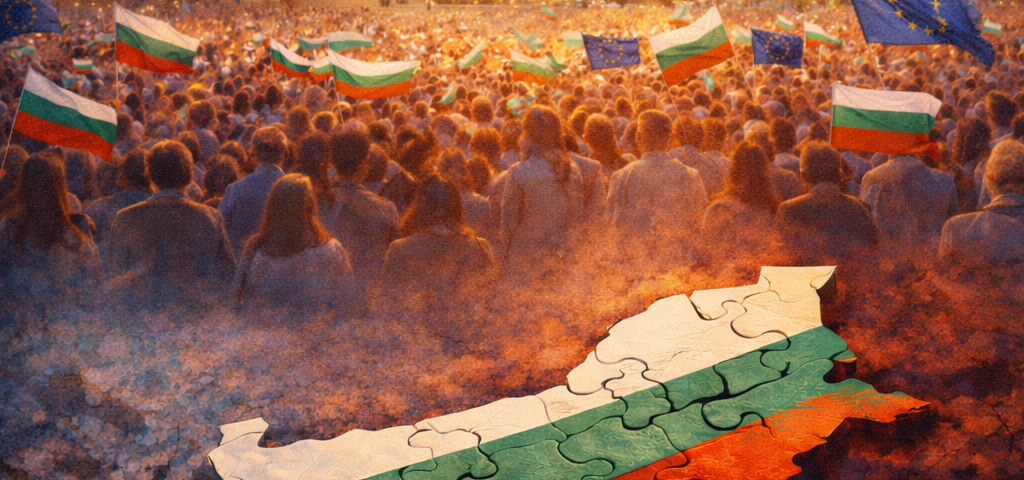
Last December, amid anti-government protests, Rosen Zhelyazkov, the Prime Minister of Bulgaria, resigned.
The protests were initially triggered by the draft 2026 state budget, which proposed tax increases. However, the anti-government wave soon spread across the entire country, and demonstrators demanded the resignation of Zhelyazkov’s government due to its failure to effectively combat widespread corruption.
It should be noted that his cabinet had been approved in January 2025, after the October 2024 parliamentary elections, when “GERB”, the Socialist Party, and the political alliance “There Is Such a People” formed a governing coalition.
Never-Ending Political Crisis
The political chaos caused by the formation of unstable governing coalitions and their collapse within just a few months is nothing new for Bulgaria. Since April 2021, the country has held seven parliamentary elections (April 2021, July 2021, November 2021, October 2022, April 2023, June 2024, and October 2024).
Over the past five years, political parties have managed to reach an agreement and form a coalition only three times – and even those governments quickly fell apart:
- The coalition government of Rosen Zhelyazkov resigned voluntarily in December 2025;
- The four-party coalition government of Kiril Petkov (“We Continue the Change” + “Bulgarian Socialist Party – BSP” + “There Is Such a People – ITN” + “Democratic Bulgaria”), approved in December 2021, collapsed in June 2022 after “ITN” left the coalition, triggering a no-confidence vote initiated by GERB. This marked the first time in modern Bulgarian history that a government lost a confidence vote;
- The three-party coalition government of Nikolai Denkov (“GERB” + “We Continue the Change” + “Democratic Bulgaria”), approved in June 2023, collapsed in March 2024 after the breakdown of an agreement on a “rotational government.”
Bulgaria’s political spectrum can broadly be divided into three camps: Anti-corruption reformist forces (e.g., “We Continue the Change”, “Democratic Bulgaria”); Traditional political groupings (e.g., “GERB”, “the Bulgarian Socialist Party”); Pro-Russian and/or ultranationalist parties (e.g., “Revival” and “Morality, Unity, Honour – MECh”).
Forming a stable and viable government is difficult for two main reasons: 1. Due to large-scale corruption, lack of transparency in the electoral process, systemic rule-of-law problems, and high public distrust toward political institutions, no political party receives enough votes in parliamentary elections to govern alone; 2. Because of the proportional electoral system and the fragmentation of voter preferences, many parties with radically different ideologies enter the legislature, making it difficult to find common ground and form a governing majority.
The Political Ambitions of Bulgaria’s Former President
Shortly after the resignation of Rosen Zhelyazkov, in January 2026, Rumen Radev, the President of Bulgaria, announced his resignation. He had been expected to remain in office until January 2027. However, after stepping down and the Constitutional Court formally terminating his mandate, the position of head of state was assumed by Iliana Iotova.
A former commander of the Bulgarian Air Force, Rumen Radev won the presidential elections in both 2016 and 2021. Although the Bulgarian president holds largely ceremonial powers under the constitution, the head of state appoints parliamentary elections and approves the composition of the government. As a result, since April 2021 – when the country entered a prolonged political crisis – Radev’s role has been at the center of public attention.
While he has not yet made a public announcement about his specific political plans, reports suggest that Radev intends to create his own political party and actively engage in politics.
According to the former president, the country needs a party capable of uniting all democrats – both left and right – regardless of where they stand politically or whether they are currently politically active, because everyone needs fair elections and democratic development. He has identified a “harmful model of governance” as the root cause of poverty, protest, and widespread distrust toward political institutions. It appears that his goal is to radically transform the current political landscape and offer a new alternative to disappointed Bulgarians.
After Zhelyazkov’s resignation, many expected Radev to appoint a caretaker government and announce the date of early parliamentary elections. However, following his decision to resign, the assumption emerged that the former president sought to avoid potential accusations and controversies that could have accompanied the nomination and support of a caretaker prime minister. It seems that, before reappearing on the political stage in a new role, Radev is proceeding with particular caution.
Rumen Radev’s Chances of Success
In Bulgaria, the number of voters who do not support any of the currently existing political parties and are waiting for a new alternative is significant. Amid widespread dissatisfaction and distrust toward political parties and their leaders, Rumen Radev remains one of the most trusted political figures among Bulgarian citizens.
This is confirmed by a survey conducted last December, in which 40% of respondents said they want a new government to be formed around a new political force. Moreover, according to nationwide polling, half of those 40% would support Radev if he launched his own political project.
A January 2026 survey also revealed that 64% of respondents positively assessed his decision to resign from the presidency, indicating broad public sympathy toward him.
If Radev creates a new party and participates in elections, it is highly unlikely that he would win an absolute majority of votes and form a government independently. However, given the high level of public trust in him and strong societal demand for a new political force, his political movement is very likely to play a decisive role in forming Bulgaria’s next coalition government after the spring 2026 parliamentary elections.
Based on his public statements, the party created by the former president would likely focus on combating economic stagnation and eliminating systemic corruption. In foreign policy, however, he holds relatively soft positions toward Russia – openly opposing sanctions against Moscow and military assistance to Ukraine. He also uses rhetoric critical of European Union institutions, frequently emphasizing the need to defend Bulgaria’s “national interests” and maintain “neutrality.” Notably, he has expressed skepticism toward Bulgaria’s entry into the eurozone and supported holding a referendum on adopting the euro.
Eurosceptic and Russia-friendly politicians and parties enjoy considerable popularity among parts of the Bulgarian population. Citizens’ critical attitudes toward Brussels are partly driven by the fact that, despite EU membership, Bulgaria remains one of the poorest and most corruption-affected countries in the bloc.
Among Radev’s potential political partners could be: Pro-European reformist forces, such as “We Continue the Change” and “Democratic Bulgaria”. Radev sees corruption as the key systemic obstacle to democratic development, so he could find common ground with political groups that prioritize anti-corruption reforms. While they share similar views on fighting corruption, they differ on foreign policy; Bulgarian Socialist Party, which supported Radev in the 2016 presidential election, significantly contributing to his victory. Their positions on social policy and anti-corruption measures overlap, increasing the chances of cooperation; Nationalist political parties, including groups that promote Bulgarian nationalism, such as “Morality, Unity, Honour”. Given Radev’s nationalist rhetoric and emphasis on sovereignty and national interests, cooperation cannot be ruled out.
Cooperation between Radev and “GERB” appears unlikely. During his presidency, he openly criticized the governance of Boiko Borissov, accusing his administration of undermining the rule of law, presiding over economic stagnation, and perpetuating systemic corruption. For a newly established party, cooperation with “GERB” would likely be politically damaging.
Ultimately, if Rumen Radev succeeds in gaining political power and becoming prime minister, Robert Fico and Viktor Orbán may gain a new like-minded partner in Europe. However, since he is unlikely to secure an absolute majority and govern alone, he would need to make constant compromises with coalition partners – significantly constraining his nationalist ambitions.