



Author: Revaz Topuria, Research Fellow
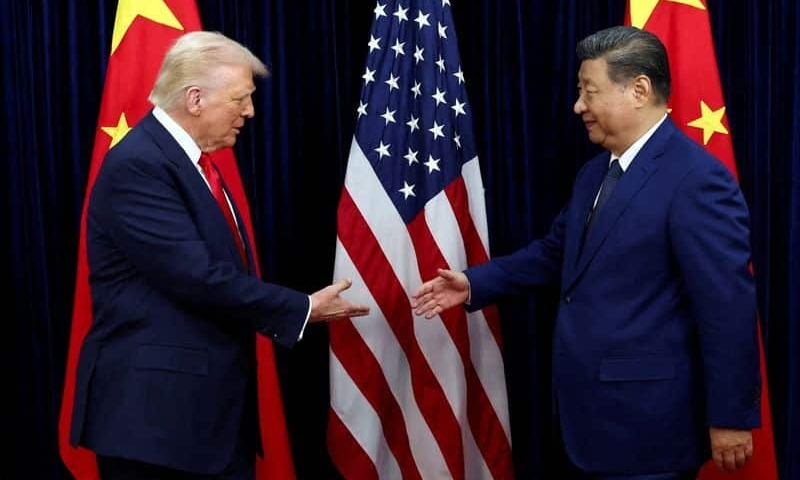
On May 14–15, 2026, U.S. President Donald Trump will pay an official visit to Beijing. This will be the first visit by a sitting U.S. president since 2017. Over the intervening years, relations between the world’s two largest economies have become highly strained due to the trade war, the global pandemic, the spy balloon crisis, semiconductor export wars, and tensions surrounding Taiwan. The summit was originally scheduled for March 2026, but was postponed because of the U.S. military operation launched in Iran.
It is noteworthy that during his presidency, Joe Biden never visited China, becoming the first American president since Jimmy Carter to complete a presidency without traveling there. This is not an insignificant detail, but rather one of the clearest indicators that diplomatic relations between Washington and Beijing at the leadership level had been quietly weakening for years. According to data compiled by the Asia Society Policy Institute’s Center for China Analysis, leaders of the two countries met an average of 2.5 times per year during this decade, compared to 4.6 meetings annually in the 2010s and 5.6 in the 2000s. Consequently, summits of this kind have become rarer and, precisely because of this rarity, attract even greater attention.
The Context Before the Summit
To understand the significance of the summit, it is first necessary to understand the trajectory that brought both sides to this moment. Trump’s second presidential term began with increased economic pressure on China, and soon afterward the United States imposed tariffs of up to 145 percent on Chinese imports. Beijing responded with retaliatory tariffs, export controls on rare earth minerals, and boycotts of American agricultural goods, including soybeans. The resulting confrontation shook global markets and accelerated the fragmentation of supply chains on both sides.
A turning point came in October 2025, when Trump and Xi Jinping met in the South Korean city of Busan on the sidelines of the APEC summit. As a result of that meeting, the parties agreed to a one-year tariff truce and established a framework of guiding principles aimed at stabilizing mutually beneficial economic relations. That truce expires in November 2026, and the Beijing summit is essentially an attempt to define its next phase.
It is also important to note that the global environment has changed significantly since the Busan meeting. The Iran war disrupted energy markets to such an extent that the consequences reached both Washington and Beijing. China is heavily dependent on Persian Gulf oil, and the effective blockade of the Strait of Hormuz increased the cost of Chinese energy imports, forcing Beijing to increase coal consumption. At the same time, in February 2026, the U.S. Supreme Court struck down many of the tariffs on which the Trump administration relied, ruling that their legal basis — the International Emergency Economic Powers Act (IEEPA) — was insufficient, thereby weakening one of Washington’s most important foreign policy tools.
These factors make the upcoming summit even more interesting, although setting realistic expectations is essential. Based on five decades of history of U.S.–China presidential summits, it can be said with confidence that such meetings rarely transform bilateral relations in a radical way. However, they can make the potentially dangerous rivalry between the United States and China less unstable. Given developments in recent years, both sides understand that they possess instruments capable of harming one another, but they also recognize the costs of retaliation. This shared vulnerability now creates a mutual incentive to preserve the truce, even though neither side is fully satisfied. As a result, experts agree that the summit is aimed more at preventing a collapse in relations than at achieving any major breakthrough.
The 2026 study by the CSIS China Power Project reflects the broader expert mood well: 57 percent of American analysts do not see stabilization in the relationship, only 26 percent hope for improvement, and just 3 percent expect full implementation of bilateral commitments. On the one hand, this reflects deep mistrust; on the other, it also points to a shared expectation that limited cooperation will continue because the alternative would be worse for everyone.
The Agenda – What Will Be on the Negotiating Table?
Trade and Tariff Architecture
Trade will likely be one of Trump’s top priorities, especially as the November midterm elections increase domestic pressure in this area. The summit will likely produce announcements of Chinese plans to purchase American products. There is also speculation about the creation of a bilateral trade council mechanism intended to define procurement commitments and tariff adjustments in non-sensitive sectors.
However, the tariff architecture remains unstable. The Supreme Court’s ruling on IEEPA-based tariffs has forced the Trump administration to redesign its legal framework. Beijing may argue that restoring tariffs to their previous levels would violate the Busan truce, potentially triggering a renewed cycle of escalation. Since the Busan truce expires in November 2026, time is running short for the two countries to define a new tariff policy.
Iran, Energy, and the Strait of Hormuz
The Iran conflict will likely occupy a substantial part of the agenda, especially given reports from multiple sources that Chinese companies continue to supply Iran with dual-use goods necessary for drone production despite American sanctions. According to these reports, Trump wants to persuade Beijing to use its influence to pressure Tehran toward a ceasefire and the reopening of the Strait of Hormuz.
The Iran conflict is also problematic for China. Rising import costs and increased dependence on coal are creating challenges for Xi. On May 6, in Beijing, Chinese Foreign Minister Wang Yi hosted Iranian Foreign Minister Abbas Araghchi and called for an immediate end to hostilities and the rapid restoration of shipping through the strait. This can be interpreted as a signal that Beijing is attempting to position itself as a responsible mediator ahead of the summit.
Technology and Artificial Intelligence
Technological competition is one of the central issues in the structural rivalry between the United States and China. The Beijing summit may become the first summit where artificial intelligence formally enters the presidential-level agenda.
Relations in this sphere are highly tense. In April 2026, the White House publicly accused China of large-scale theft of intellectual property related to American AI models, while Beijing blocked Meta from acquiring the Chinese AI startup Manus. Nevertheless, despite these tensions, the United States and China remain the two leading technological and AI powers, making cooperation in this field both necessary and inevitable.
China wants the United States to ease semiconductor export restrictions; the United States wants Beijing to relax export controls on rare earth minerals. Neither side is likely to make full concessions, but both recognize their mutual dependence.
Other Issues: Fentanyl and Taiwan
Other major issues will also appear on the agenda. Taiwan will almost certainly be discussed. For Beijing, even the slightest rhetorical change by the United States regarding Taiwan would carry enormous geopolitical significance.
Trump’s electoral campaign heavily emphasized fentanyl imported from China, but recently Washington appears to have lost leverage over Beijing on this issue. During the tariff confrontation of October 2025, Trump obtained what Beijing had already offered Biden in 2024: the classification of certain precursor chemicals that were already under some degree of control.
The “Stop Chinese Fentanyl Act” (H.R.747), a new U.S. bill proposing visa bans and other sanctions against Chinese officials and other actors if China fails to cooperate against the flow of synthetic narcotics, stalled in the Senate. Against the backdrop of the court ruling on tariffs, it is unlikely that Trump will achieve a major victory on this issue at the summit.
What Would Count as a Successful Outcome for the United States?
Given these factors, the natural question is what would constitute a successful outcome for Trump.
As already noted, the summit should not be expected to usher in a new phase in bilateral relations or produce major breakthroughs. However, it would still be important to preserve even a modestly positive tone while maintaining firm positions on specific issues such as military assistance to Russia, support for Iran and North Korea, and intellectual property theft.
Since the Busan truce expires in November, the significance of this summit lies not in transforming the relationship but in maintaining a minimum level of predictability — a signal that competition will continue, but within defined boundaries.
As a result, the summit would largely be considered successful for the United States if the parties agree on joint commitments to extend or improve the Busan trade truce, expand Chinese purchases of American goods, and establish an official dialogue mechanism on artificial intelligence — all while the United States avoids any shift in its position regarding Taiwan. Beijing, meanwhile, would view it as a success if it manages to strengthen China’s image as a responsible global actor.
For the rest of the world, the Beijing summit matters because it will demonstrate whether the world’s two largest economies can preserve a functional framework for managed strategic competition.
This article was translated from the original language with the assistance of AI tools and revised by the author.