



Author: Nata Koridze, UGSPN Senior Research Fellow
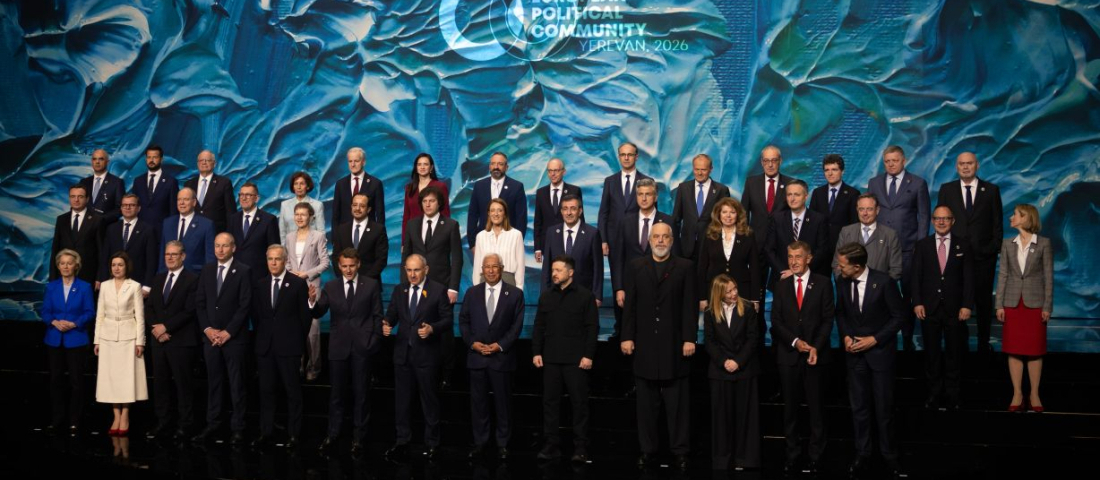
On May 4-5 Yerevan hosted the European Political Community (EPC) 8th Summit bringing together the heads of state and government from nearly 50 countries. Established in 2022 the EPC is an intergovernmental forum designed to facilitate political and strategic dialogue on Europe’s future and aims to strengthen cohesion, cooperation and dialogue between all countries on the European continent. The EU and Armenia also held the first ever EU-Armenia Summit, resulting in a number of concrete decisions.
The Armenian capital also hosted a state visit by French President Emmanuel Macron on May 5. And finally, Yerevan hosted Yerevan Dialogue international forum on May 5–6, a platform for political discussions on international affairs established by the Armenian government in 2024. It convened senior government representatives, the private sector, NGOs, academia, youth, and other stakeholders to advance discussions on shared challenges facing Europe and its wider neighborhood.
The EPC Summit
Many of the observers both within and outside Armenia described the Summit as historic, and not without a reason. The EPC Summit was by far the largest political event ever hosted by not only Armenia, but any South Caucasus country. It brought together the leaders from all EU member states, British Prime Minister Sir Keir Starmer, NATO Secretary General, Mark Rutte, the Secretary General of the Council of Europe, Alain Berset, Turkish Vice President Cevdet Yılmaz, President of Ukraine Volodymyr Zelenskyy. The Prime Minister of Canada Mark Carney attended as a guest (the first time that a non-European country took part in the event). The Summit was co-chaired by António Costa, the President of the European Council, and Nikol Pashinyan, Prime Minister of the Republic of Armenia.
The Summit focused on four strategic topics: strengthening of democratic resilience, advancing connectivity, reinforcing economic and energy security and addressing emerging security dynamics and regional challenges.
The meeting happened against the backdrop of ongoing Russia’s war against Ukraine, war in Iran and the strategic retreat of the US from Europe, spurred further by the recently stated intention to withdraw 5,000 US soldiers from Germany. There is a lot on EU’s plate, and security issues are number one priority as the bloc has to step up, both militarily and politically, to take the lion’s share of responsibility for its security. Hence, it is only logical that the discussions at the Summit were largely focused on the capabilities of the EU to defend and protect itself.
The symbolism of the location did not escape the attention of pundits, as the EPC Summit took place in a country that is a member of the Eurasian Economic Union and still hosts a Russian military base. Until very recently, Armenia was viewed as a close ally of Russia, but it has now made a decisive U-turn towards Europe.
Importantly, while Azerbaijani President Ilham Aliyev did not attend, he addressed the Summit in Yerevan remotely with a speech via video link. This fact further underscores, just how the relations between the two countries have changed.
EU-Armenia Summit
The first ever EU-Armenia Summit took place alongside the EPC Summit on May 5. While the event did not attract as much attention as the EPC Summit, it was no less politically important for Armenia. It provided an opportunity to discuss ways of strengthening bilateral relations, particularly with regard to connectivity, economic security and energy security, as well as to discuss global challenges and developments in the wider region, such as the wars in Ukraine and Iran. Progress made in ensuring peace, security and connectivity in the South Caucasus was also discussed, and a joint declaration was adopted. The declaration describes the summit as a historic milestone in EU–Armenia relations. It reiterates support for Armenia’s sovereignty, democratic reforms, resilience, and adoption of the EU acquis, and outlines the main directions of future cooperation.
The EU Commission President Ursula von der Leyen in her remarks following the Summit called the partnership with Armenia “unique” and outlined the four main priorities of future cooperation.
The first priority is connectivity. The connectivity priority includes transport, energy and digital aspects. On transport issue von der Leyen noted that “few countries are as uniquely positioned as Armenia” adding that Armenia’s Crossroad of Peace initiative (initiated by PM Pashinyan in 2023) could link Europe with the South Caucasus and Central Asia, turning Armenia into a key regional transport hub. The EU pledged support for Armenia’s integration into the Middle Corridor and announced the launch of a High-Level Dialogue on Connectivity and High-Level Dialogue on Transport with Yerevan. In the energy sector, the EU committed support aimed at strengthening Armenia’s energy independence, including €25 million for Caucasus transmission networks and investment in energy storage infrastructure to improve Armenia’s energy security. Regarding digital connectivity, von der Leyen highlighted Armenia’s “amazing emerging AI and engineering ecosystem” and announced the signing of several letters of intent with leading technology companies. She also noted that the EU encourages European businesses to increase investment in Armenia.
The second priority concerns security cooperation, including under the European Peace Facility. This includes support for Armenia’s armed forces and efforts to counter hybrid threats. The recently established EU Partnership Mission in Armenia (EUPM Armenia), tasked with helping the country address foreign information manipulation and interference (FIMI), cyberattacks, and illicit financial flows, forms part of this broader effort. This is particularly pertinent in view of the upcoming presidential elections in Armenia.
The third priority relates to visa policy and home affairs. Von der Leyen stressed that visa liberalization with Armenia remains a priority and welcomed a “very positive” first progress report as part of that process. She also announced deeper cooperation on border management and migration policy.
The fourth priority focuses on economic support and social resilience. Two years ago, the EU launched a 270 million Euros Resilience and Growth Plan for Armenia. The EU now plans to mobilize up to 2.5 billion Euros in investments to support Armenian businesses, skills development, employment, and housing for displaced persons from Karabakh, among other priorities.
State Visit of French President Emmanuel Macron
Another major event that took place in parallel to the EPC Summit was state visit of the President of France Emmanuel Macron during which Armenia and France formalized their strategic partnership. Macron’s visit was not only diplomatically significant but also a major public relations success. He was greeted warmly by the Armenian public as he walked through central Yerevan alongside Prime Minister Pashinyan, listened to crowds singing La Marseillaise, himself sang Charles Aznavour song, accompanied by the Armenian PM, and engaged directly with citizens. But, perhaps the most symbolic moment of the visit was Macron’s trip to Gyumri, home to Russia’s largest military base in the South Caucasus.
During the visit the French President Macron praised Armenian Prime Minister for “very impressive” work and noted: “”Eight years ago nobody would come here, because this country was seen by many as a sort of de facto satellite of Russia. Nikol organized his Velvet Revolution and decided to derisk his country from Russia. He decided both peace and Europe”.
The significance of the EPC Summit in Armenia
The scale and level of participation of the event reflect the geopolitical breakthrough Armenia has experienced in recent years. Hosting such a major international gathering is significant for several reasons.
First, it firmly places the South Caucasus on the European political map. The summit demonstrated that the European Union increasingly views the region as an important interlocutor and potentially a future part of the broader European political space. It also showed a growing willingness by the EU to play a more proactive role in the region and do more to support its integration.
Second, the Summit underscored how close Armenia and the EU have become- closer than at any previous point, as EU Enlargement Commissioner Marta Kos noted during her March visit to Yerevan. Armenia, long dependent on Russia for security, energy, and trade, has increasingly pivoted toward Europe and the broader West.
This stance was enabled, among other factors, by the conclusion of the TRIPP (Trump Route for Peace and Security) project initiated during the August, 2025 meeting in Washington between Prime Minister Pashinyan, Azerbaijani President Ilham Aliyev, and U.S. President Donald Trump, and later finalized during U.S. Vice President JD Vance’s visit to Yerevan in February this year. Following the Karabakh war Armenia has found freedom to act and room for maneuver, following the peace deal with Azerbaijan, which was brokered by Washington. Yerevan has since has embarked on a pro-European course, seeking benefits in trade, mobility, and security cooperation. This shift has become even more pronounced as Russia remains consumed by the war in Ukraine, while Iran – another important Armenian partner for trade, energy, and transit- faces growing isolation amid its conflict with the United States and Israel. Together, these dynamics are pushing Armenia further toward the European Union.
Since 2024 the EU has allocated 30 mln Euros through the European Peace Facility instrument to support the Armenian armed forces, enhance their logistical capabilities and contribute to improving civilian protection during crises and emergencies.
On April 21 this year, the EU established a civilian European Union partnership mission (EUPM Armenia) under the Union’s Common Security and Defense Policy to enhance Armenia’s resilience and ability to manage crises. The upcoming elections in Armenia will test both the resilience of the nation towards the hybrid threats and its will to follow the European path. After all, Georgia serves as a cautionary example in this regard. Once widely regarded as a leading pro-European state firmly committed to Euro-Atlantic integration, Georgia has gradually drifted away from that trajectory under pressure from Russian information manipulation and political interference.
Third, the Yerevan Summit reveals just how rapidly geo-political landscape of the South Caucasus is changing. Only a few years ago, it would have been difficult to imagine Yerevan- once a strategic ally of Russia at the time- hosting all leaders of EU member states alongside Putin’s number one enemy, the Ukrainian President Volodymir Zelenskyy.
Although at the recent meeting of Putin and Pashinyan in Moscow on April 1, Putin said that Russia treats “absolutely calmly” the development of Armenia’s relations with the EU, this remark was immediately followed by not-so veiled threat disguised as a reminder by Putin of how cheap, compared to the European states, Armenia pays for the Russian gas.
The events in Yerevan prompted anger in Moscow. The Ukrainian president’s visit and his meeting with Pashinyan were met with particular ire. On the day of the EPC Summit, Margarita Simonian (ironically herself of Armenian origin)- one of Russia’s leading propaganda figures and the Director General of the Russia Today pro-Kremlin TV channel, sharply criticized Zelenskyy’s visit to Yerevan, calling it an “ungrateful step” by Armenia,” which “we have saved so many times”. She suggested that Russia should begin “protecting its population and interests” in the country. Similar reactions were echoed across pro-Kremlin media. The Russian Ministry of Foreign Affairs, accused Armenia of breaching its promise “not to act against Russia”.
Fourth, the Summit in Yerevan provided a significant and so needed boost for Nikol Pashinyan ahead of Armenia’s June 7 consequential parliamentary elections. He succeeded in presenting Armenia as the region’s most reliable, predictable, and reform-oriented state capable not only of overcoming decades of isolation, but also of becoming a key EU partner and, eventually, a member state.
Fifth, the Summit indicates that Georgia is no longer the main interlocutor in the South Caucasus for the EU, despite its EU candidate status. Instead, Yerevan is emerging as the region’s political hub, hosting high-level EU summits and senior Western officials.
This fast rapprochement stands in sharp contrast to the current state of EU-Georgia relations. Ignoring the Europeans’ concerns about democracy, human rights and Tbilisi’s foreign policy orientation, the Georgian Dream government has sought to promote the connectivity agenda in practical terms. Despite official rhetoric of the Georgian officials promoting Georgia as a regional hub, the Georgian Dream government has been unable to arrange high-level meetings in Tbilisi, Brussels or other major European capitals that could advance this vision. Recent events in Yerevan have demonstrated this once again. On 5 May, EU Foreign Policy Chief Kaja Kallas visited Azerbaijan and met with President Aliyev immediately after the EPC Summit. Despite recent tensions between Brussels and Baku due to the European Parliament’s recent critical resolution (which he criticized during his address to the EPC Summit participants), the visit highlights the dynamism of relations between the EU and Azerbaijan. Tbilisi, however, was not on the EU’s foreign policy chief’s itinerary.