



Author: Nata Koridze, UGSPN Senior Research Fellow
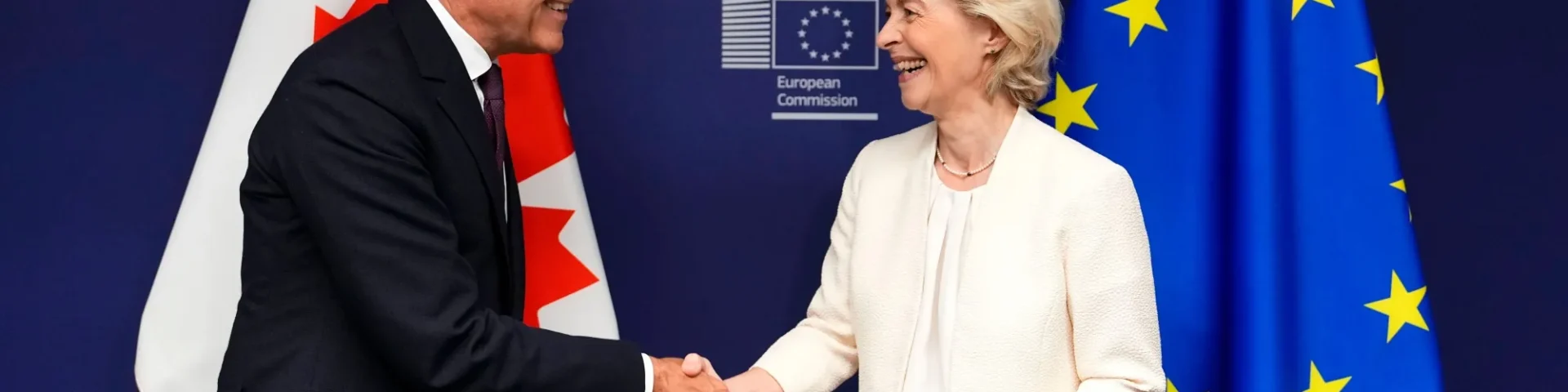
The unexpected initiative by the EU Commission President Ursula von der Leyen to make Canada its first “associate member” is significant not simply because of what it might mean for EU-Canada relations, but because of what it reveals about the changing security environment in the Euro-Atlantic area. As von der Leyen said the initiative is a response to the “fracture in the international rules-based system.” Announced during her State of the Union address on 16 September 2026, the initiative has no precedent in EU institutional practice: “associate membership” is not an existing status under the EU treaties.
The proposal was met with a standing ovation by the MEPs, but appears to have taken EU member states by surprise. Apparently, the idea was not discussed with the EU member states’ capitals beforehand and was not reflected in the copy of von der Leyen’s speech which the member state governments received in advance.
When considered within the context of the changing configuration of transatlantic relations, the proposal can be seen as driven by the desire to forge closer alliances with like-minded international actors and reduce dependencies. It is an attempt to explore a form of EU external relations for which there is currently no established institutional template. More broadly, it reflects the evolving Western system, in which both Europe and Canada are seeking greater flexibility against the backdrop of shifting relations with the US, and the challenges posed by Russia and China.
Context: A transatlantic relationship under pressure
The proposal has emerged against the backdrop of increasingly complex relations between Washington and both Brussels and Ottawa. The United States has been indispensable to the European security and has been Canada’s overwhelmingly important economic partner. Yet under President Donald Trump, disputes over tariffs, trade, defense spending and the distribution of responsibilities within NATO, as well as an ambivalent rhetoric regarding the NATO Art. 5 commitment and Ukraine have made both relationships more uncertain.
For Canada, the problem is especially acute because of its extraordinary economic dependence on the United States (roughly 70% of Canadian exports go to the US, with only 4% to Europe). The recent breakdown of bilateral trade negotiations and continuing tariff disputes have strengthened Ottawa’s determination to diversify its economic relationships. Prime Minister Mark Carney has pledged to double Canada’s non-US trade over the coming decade. (Reuters) The shift in relations seems to be quite significant, as it also influenced public mood in Canada. The remarks by President Trump pertaining to Canada becoming a “51st state” of the US and calling Mark Carney a “governor” did not go well with the Canadians, who started boycotting the American goods and refusing to visit the US as tourists. POLITICO quoted a “senior Canadian official” describing the Canada- US relations’ moment in rather dramatic terms as an “existential crisis for Canada”. POLITICO also quotes the unnamed official, who says that waiting out the Trump administration isn’t an option for Canada, as what’s happening in the United States reflects a “generational shift, not a temporary disruption.”
Europe faces a somewhat similar challenge. Although the EU and the United States are closely linked economically, Washington’s changed tariff policy has reinforced the Europeans’ concerns about strategic and economic dependence. Tensions over Greenland, coupled with ambiguous messages from the US regarding its commitment to NATO Art. 5 and its support for Ukraine, have triggered unease in European capitals. As a result, Europe has developed a newfound appreciation of the need to become more self-reliant and to diversify and strengthen its economy, particularly given the unpredictability of American policy. While the transatlantic bond remains, it is clear that it is much more nuanced and complex now than it has been since WWII. As such closer cooperation is becoming an increasingly important form of strategic insurance for Canada and Europe.
European diplomats’ immediate reaction to the proposal varied. Ireland, which holds the rotating EU Council presidency, has welcomed exploring associate membership. The overwhelming reaction has been that of a restrained stance, calling for the exploration and consultations, as to what the status might mean and entail.
Although Carney avoided presenting the emerging relationship as an anti-American project and Ursula von der Leyen also made a point of underlining just that, President Trump described the possibility of Canadian associate membership as potentially a “hostile act” and threatened serious tariffs against Europe if the initiative proceeded for what he regarded as negative reasons. He also dismissed the proposal as “laughable.”
“Unique Alliance”
Prime Minister Mark Carney is leading Canada in times of the “rupture” of an international rules-based order and the multilateral organizations, as he himself described them. As a result, countries, and especially middle powers strive to “develop greater strategic autonomy, in energy, food, critical minerals, in finance and supply chains”, he noted at Davos World Economic Forum earlier this year. In a rather memorable speech, he reaffirmed his country’s commitment to liberal values and to NATO collective defense commitment. He also stressed that “the old order is not coming back” and that “the middle powers must act together, because if we’re not at the table, we’re on the menu.” This seems to be the driving force and a credo for Canada’s foreign policy. In addition to new agreements with the EU, Canada signed 12 new trade and security deals in recent months, and is negotiating free trade agreements with India, ASEAN, Mercosur, Thailand and Philippines.
But perhaps the most consequential are the pacts signed with the EU, which are driven by both the economic feasibility and shared values. In his address to the European Parliament in Strasbourg, a day after von der Leyen voiced the associated membership idea, he welcomed the ambition behind the proposal. He was careful not to make the terminology central, underlying the substance of the relationship as the key issue and stressing that “Europe and Canada are stronger together”, and that they should ally to protect democracy, their markets and the rule of law. He argued that the international system was undergoing a profound disruption and presented Canada and Europe as natural partners that could combine complementary strengths. Carney emphasized cooperation in various areas including critical minerals, defense, artificial intelligence, energy, space, digital infrastructure and research. Importantly he underlined that opportunities that can be created by an alliance, are “most fundamentally, the product of our common values, our compatible systems, and our complementary strengths.”
Canada and the EU already enjoy a very close relationship. The EU is Canada’s second largest trade partner and the two have concluded the Comprehensive Economic and Trade Agreement (CETA), which however still must be ratified by 10 EU member states. The EU and Canada have also concluded a Strategic Partnership Agreement in 2017, which provides a framework for cooperation and dialogue on a range issues, such ass economy, sustainable development, freedom, justice and security. The two sides have concluded Security and Defense Partnership last year, allowing for closer cooperation on pressing issues such as Ukraine, cyber and maritime security, hybrid threats and crisis management. Defense is another area where cooperation has deepened as Canada became the first non-EU participant in the EU’s Security Action for Europe (SAFE) instrument in 2025, providing an institutional basis for deeper cooperation in the defense-industrial sphere. This marked the first time a non-EU country will formally participate in the bloc’s flagship joint procurement initiative.
The poll ahead of Carney’s Strasbourg visit showed that 4 in 5 Canadians support stronger relationship with the EU and 49% of Canadians support full-fledged EU membership. The poll also revealed that 56%Canadians believe their country has more in common with the European Union countries (in terms of values, way of life and outlook on the world) than with their neighbor to the south.
Europe’s attraction to Canada’s, in addition to it being a like-minded liberal democracy, is very practical in nature as well: Canada is a G7 and NATO member, a major producer of energy and critical minerals, a technologically advanced economy and an Arctic power. As Commission President Ursula von der Leyen stated following the deal: “When like-minded partners join forces on security and defense in a turbulent world, our countries grow stronger, our industries benefit and our citizens are safer.” Canada’s special relations with the bloc have also been reflected in the fact that it became the first non-European actor invited to the European Political Community Summit in May this year.
What might the initiative entail?
The “associate membership”itself is not a defined category with an established procedure. The EuropeanUnion has indeed developed numerous forms of association and partnership with third countries in accordance with the Article 217 of the Treaty on the Functioning of the European Union, which provides a legal basis for association agreements. This clause has been used to conclude association agreements with Georgia, Moldova, Türkiye and Ukraine, which all seek an EU membership, as opposed to Canada. The agreements require extensive approximation to EU laws and regulations- not a scenario feasible in Canada’s case.
Meanwhile, the term “associate membership” may be confusing also because Germany has already proposed to grant an associate membership for Ukraine in May 2006, as a transitional status before it joins the EU. The offer ideally referred to the observer status in EU decision-making bodies, no voting rights, gradual access to EU programmes and mutual assistance in case of future attacks. The proposal was subsequently rejected by Ukraine, seeking a full membership in the Union.
Some contend that the new status of Canada might require the EU treaty reform, although this will be quite a cumbersome task, which Brussels will try to avoid. Brussels has suggested that this might not be necessary. It is still unclear, what route the EU will find most expedient. It is possible that whatever configuration emerges, it will formalize the deepest form of political alignment available to non-European countries. Whatever the label (or nomenclature), one thing is certain: the modalities of the new status, will have to be negotiated between Ottawa and Brussels, and will need to be endorsed unanimously by all EU member states. The EU will have to determine what a new category would actually entail: which programmes Canada could participate in, which rights and obligations would follow, and what institutional and legal framework would support the relationship.
An expanded framework could deepen cooperation in precisely those areas where the two sides have complementary capabilities: Canadian energy and resources with European industrial capacity; critical minerals and technology; defense production; AI and advanced computing; space; research and education; raw materials and supply chains, Arctic and digital trade. Indeed, these areas were named by von der Leyen and Mark Carney.
Allowing Canada to participate more deeply in selected EU programmes and policies without becoming a member state would effectively create a new layer between partnership and membership within the Union. This could have implications that extend beyond Canada. Other non-European democracies could seek similar agreements. Australia and New Zealand, for example, could in the future, become relevant in a debate about a wider circle of differentiated European partnerships. Even if the term ‘associate membership’ itself disappears, the Canadian proposal could therefore become a precedent.
The Significance of the Proposal
The EU-Canada Summit in Montreal on 29–30 October will be the first major opportunity to turn this political initiative into a concrete agenda. It is unlikely that a fully formed new institutional status will emerge immediately. A more important question will be whether EU member states can agree on the substance of the relationship and areas in which to deepen integration.
While Canada is too strategically important to be treated as just another third country, it is neither European nor seeking EU membership. If the initiative ultimately produces a durable institutional arrangement, this could point towards a more flexible structure, in which formal membership and strategic integration are no longer synonymous. Therefore, if a new model is developed for Canada, it could become a mechanism for the EU to connect more closely with other strategically important partners that have no intention of becoming members, such as New Zealand and Australia.
The significance of the initiative, however, extends beyond its immediate bilateral outcome. The Western order that emerged after the Second World War was based on clear institutional roles and predictability. NATO provided the main security framework, the United States supplied much of the strategic weight, European states progressively integrated through the EU to create a vast common market, and Canada remained primarily anchored in the North American system. While these structures remain in place, the underlying assumptions have changed. Technology, energy, supply chains, and access to critical resources are now closely linked to national security. Consequently, economic dependence is now perceived as a strategic vulnerability. At the same time, predictability has diminished: uncertainty over the future direction of US policy, coupled with pressure from China, is prompting European governments and Canada to explore alternative options. As von der Leyen said the initiative is a response to the “fracture in the international rules-based system.” The proposal to Canada can therefore be seen as an attempt to reimagine the Western cooperation through the creation of as close a community of like-minded democracies, as possible.
Conclusion
The EU-Canada relationship may become a test case for a wider question confronting the West: can the transatlantic order survive by becoming less dependent on any single center of power while remaining sufficiently integrated to preserve its common security and political values grounded in the rule of law and liberalism? The answer will depend on Europe’s member states’ ability to translate an ambitious political idea into a practical institutional reality.
Experience shows that strong political will in the EU goes a long way towards achieving its goals. If the initiative materializes, despite the legal hurdles and regardless of the label, it will be one of the EU’s most unconventional and boldest decisions since the Union’s founding. And will serve as a testament to the saying that “drastic times call for drastic measures”.