



Author: Konstantine Ioseliani, UGSPN Research Fellow
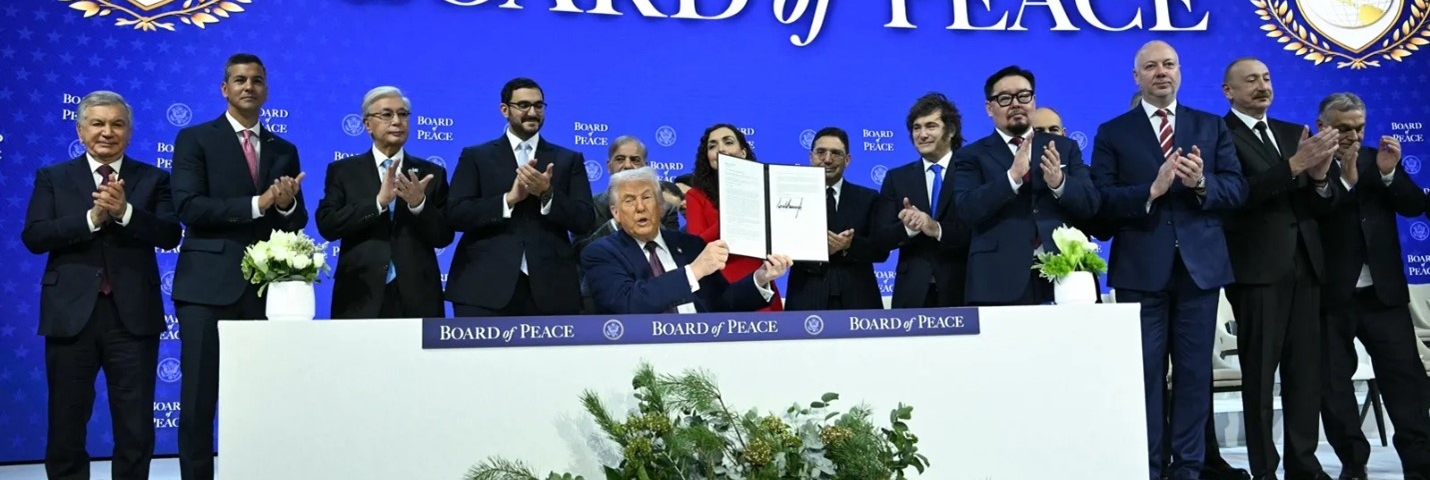
On 22 January 2026, within the framework of the World Economic Forum in Davos, the “Board of Peace” was officially established at the initiative of U.S. President Donald Trump. From the moment of its creation, the initiative became one of the most controversial projects in the contemporary international political arena. It simultaneously presents itself as a platform aimed at ensuring global peace while raising fundamental questions regarding the existing international order, the role of the United Nations, and the future of established mechanisms of multilateral cooperation.
The idea of the Board of Peace emerged as a response to the crises afflicting the modern international system, particularly ongoing armed conflicts in the Middle East and the perceived decline in the effectiveness of the United Nations and other traditional international mechanisms. It should be noted that the final form and scope of the Board extend far beyond its initial concept, which was presented to the UN Security Council in February 2025 and was primarily focused on addressing the crisis in the Gaza Strip. Specifically, Donald Trump’s personal political vision is grounded in a pragmatic, power-based, and bilateral approach that views classical multilateralism with skepticism.
Conceptually, the Board of Peace is envisioned as a flexible, rapid-response platform capable of facilitating political agreements in situations where traditional institutions prove less effective due to bureaucratic constraints. At the same time, the initiative is strongly shaped by the personal leadership factor, which grants its chair, Donald Trump, significant political and symbolic authority. The Board of Peace is not part of the United Nations system and does not fall under a universal legal framework established by international treaties. Instead, it is founded on an independent charter that defines the Board’s objectives, institutional structure, and decision-making procedures. The Board’s institutional architecture is characterized by a high degree of centralization. The chair’s powers are extensive, encompassing both the setting of the agenda and the invitation of member states, as well as the overall direction of the Board’s activities. This model differs substantially from international organizations based on collective decision-making principles and may be assessed as an example of leader-centered governance.
From a legal perspective, the Board’s decisions do not carry binding force under international law. Nevertheless, they may exert significant political and diplomatic influence, particularly when supported by powerful states.
Composition of the Board
The composition of the Board of Peace and the states invited to participate reflects an alternative configuration of the global balance of power. A number of countries from the Middle East and the Global South have expressed interest in joining the initiative, including Saudi Arabia, Turkey, Egypt, Jordan, Qatar, the United Arab Emirates, Indonesia, and Pakistan.
States regarded as strategic adversaries of the United States, namely the Russian Federation and the People’s Republic of China, as well as authoritarian Belarus, are also among those invited to participate in the Board of Peace. The initiative includes a membership contribution of one billion U.S. dollars. Invitations were likewise extended to European allies, oil-rich Arab states of the Persian Gulf, former Soviet republics, and even the Pope. However, fewer than twenty countries attended the official signing ceremony held in Davos alongside the World Economic Forum.
The participation of these states is driven by several factors, including regional security interests, the desire to deepen bilateral relations with the United States, and dissatisfaction with existing international mechanisms. At the same time, the restrained or negative stance adopted by leading Western European states indicates a high degree of skepticism toward the initiative.
In this context, the role of Russia has drawn particular attention. Several European states openly declared that Russia’s potential participation or indirect influence within the Board would be unacceptable to them, further underscoring the value-based and political divisions surrounding the initiative.
Objectives and Functional Mandate
According to official statements, the core objectives of the Board of Peace include: facilitating the de-escalation of armed conflicts; creating a platform for political dialogue and negotiations; supporting post-conflict reconstruction and institutional stabilization; and offering alternative security mechanisms in regions where traditional instruments have proven ineffective.
At the political and strategic level, the Board may be interpreted as an attempt by the United States to preserve global influence through new formats while limiting the impact of rival powers, particularly China and Russia on the international peace agenda.
Accordingly, criticism of the Board of Peace is multifaceted. In academic and diplomatic circles, particular attention is paid to issues such as the Board’s deficit of legitimacy under international law, the lack of transparency in its decision-making processes, excessive reliance on personalized leadership, and the risk of functional erosion of the United Nations and other multilateral institutions.
Some scholars view the Board as an attempt to establish a form of “parallel global governance” that may prove effective in the short term but could contribute to the fragmentation of the international order in the long run.
The Georgian Context
For Georgia, the initiative of the Board of Peace is significant from both political and strategic perspectives. Although Georgia is not a member of the Board and did not receive an official invitation, the initiative has direct implications for the country’s security environment. It should also be noted that due to a lack of international legitimacy and the adoption of increasingly isolationist approaches, Georgia was not represented at the 2026 World Economic Forum in Davos, a development that must be regarded as an unequivocally negative signal.
Despite the current Georgian government’s challenges regarding international legitimacy, the state’s interest and one of its core foreign policy priorities remains the preservation of an international order based on international law and the principles of the United Nations, particularly with regard to issues of territorial integrity. In this context, the strengthening of formats that are not grounded in universal legal frameworks may be perceived as a potential risk for a government operating under conditions of limited international legitimacy. In certain cases, this may force the authorities to choose between narrow political interests and the broader interests of the state. One illustrative example is the United States position on the transit of sanctioned goods.
At the same time, it is crucial for Georgia to closely monitor how the Board of Peace may address conflict management and what role it may assume within the future architecture of international security. It is in Georgia’s interest that any new mechanism does not undermine existing international legal norms, which constitute one of the principal instruments for the policy of non-recognition of the occupied territories and for the protection of Georgia’s sovereignty and territorial integrity.
Future Prospects
The future prospects of the Board of Peace will largely depend on several factors: the genuine political will of its member states, the practical outcomes of its activities, and its relationship with the United Nations and other international institutions. Equally important is the stance of post-Trump administrations toward this format and the possibility of its complete dissolution.
If the Board succeeds in achieving tangible results in conflict de-escalation, it may evolve into an influential, albeit unofficial, global platform. Conversely, if the initiative remains confined to political symbolism and personalized governance, its impact will be limited and may further exacerbate the fragmentation of the international system.
Ultimately, Donald Trump’s Board of Peace represents one of the most illustrative examples of transformation in contemporary international politics and may become a pillar of a future security architecture. At the same time, it must be acknowledged that modern international and security policy undeniably requires transformation and a transition to a new stage, both tactically and normatively. From this perspective, the establishment of the Board of Peace clearly reflects the depth and complexity of ongoing challenges related to power, legitimacy, and global governance.
This article was translated from the original language with the assistance of AI tools and revised by the author.