



Author: Khatia Davlianidze, UGSPN Research Fellow
Romania’s Main Political Parties
Following the overthrow of Nicolae Ceaușescu’s communist regime in 1989 and the subsequent first democratic elections in 1990, political entities in Romania have undergone numerous transformations and modifications. However, the political landscape has remained largely dominated by two major forces: the center-left Social Democrats (“PSD”) and the center-right Liberals (“PNL”).
The “Social Democratic Party – PSD” is the successor to the “National Salvation Front – FSN,” which was established after the fall of Ceaușescu and led by the country’s first post-communist president, Ion Iliescu. The “National Liberal Party – PNL” was founded in 1875 and governed the Kingdom of Romania for decades; however, following the establishment of the communist regime in 1947, the party ceased its activities and was re-founded only after the end of Ceaușescu’s rule.
Due to the nature of Romania’s electoral system, it is virtually impossible for a single political party to secure an absolute majority and form a government independently. Consequently, Romania is governed by coalition governments. Typically, coalitions have been divided into two main blocs: left-wing alliances – unions formed by the PSD with smaller satellite parties and center-right alliances – coalitions created by the PNL with other right-wing forces.
A unique phenomenon in Romanian politics is the “Democratic Alliance of Hungarians in Romania – UDMR/RMDSZ,” which, driven by pragmatic goals, enters into coalitions with both the left-wing PSD and the right-wing PNL. Founded in 1989 as an ethnic minority association, the UDMR/RMDSZ protects the rights and interests of the ethnic Hungarian minority living in Romania. This organization has been a member of almost every major governing coalition since 1996.
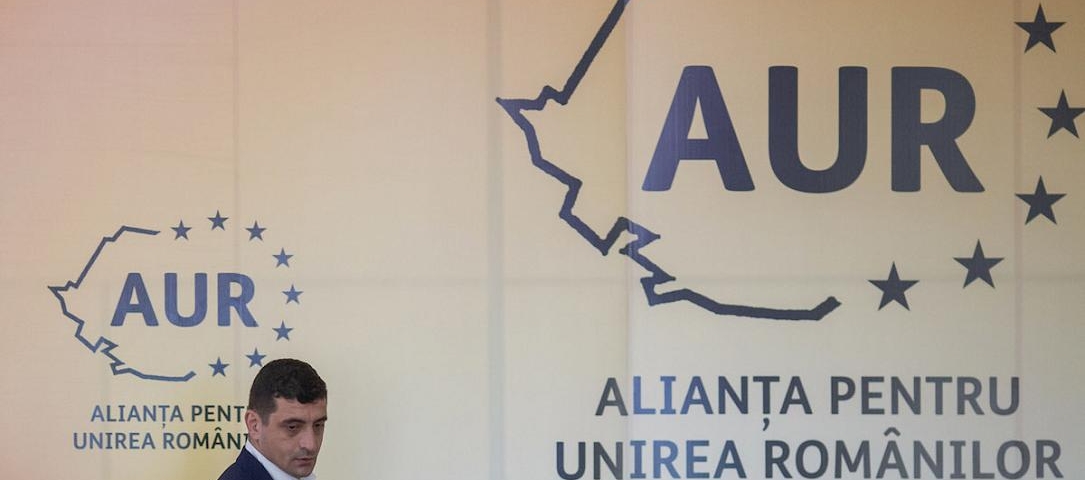
In recent years, two more political parties have come to share dominance on the Romanian political stage: “Save Romania Union – USR,” a centrist, pro-European, and liberal party founded in 2016 by Nicușor Dan, and the “Alliance for the Union of Romanians – AUR,” a right-wing radical, ultra-nationalist, and euroskeptic force established in 2019 by George Simion, which currently stands as the country’s leading opposition alliance.
The “Alliance for the Union of Romanians – AUR” is built upon four fundamental pillars: faith, freedom, family, and homeland. The party’s stated objective is the unification of Romania with Moldova and the reincorporation of the historical region of Bessarabia into the country. Furthermore, AUR advocates for a multi-vector foreign policy. Simion’s alliance does not support Romania’s withdrawal from NATO and the European Union; however, it openly opposes the federalist centralization of the European Union and aims to reform the union from within under the concept of a “Europe of Nations.”
From Ultras to Politician
An analysis of George Simion’s political transformation and AUR’s electoral strategy is impossible without examining his early football and nationalist activism.
In 2003, at the age of 16, Simion founded the fan club “Honor et Patria,” which, alongside supporting the Romanian national football team, became actively involved in socio-political processes and protest marches. In 2013, another fan club he established, “Uniți sub Tricolor,” became embroiled in several international scandals due to anti-Hungarian chants at matches, banners displaying territorial claims (“Bessarabia is Romania”), and provocative posters (“Kosovo is Serbia”), which even led to the disruption of the Romania-Kosovo match in September 2023.
Beyond the stadiums, Simion’s primary political springboard became the non-governmental platform “Action 2012,” which he created in 2011 with the goal of unifying Romania and Moldova. George Simion regularly organized provocative marches at the border, coordinated protests, and actively utilized graffiti in public spaces with the slogan “Bessarabia is Romania.” Due to his radical actions and ultra-nationalist rhetoric, the Moldovan authorities detained him several times and banned him from entering the country in the interest of national security. The politician pragmatically exploited his expulsion from Moldova, portraying himself as a “martyr for the cause” fighting against a corrupt system.
Simion was also declared persona non grata by Ukraine due to territorial claims expressed toward Northern Bukovina and Southern Bessarabia.
The Valea Uzului Incident
The real catalyst for George Simion’s active political career can be traced back to the Valea Uzului incident.
Valea Uzului is a village located in the Transylvania region, where the Austro-Hungarian army established a military cemetery for Hungarian, Austrian, and German soldiers during World War I. Historically, this territory was maintained by a Hungarian municipality; however, in 2019, the Romanian side, without any official authorization, erected concrete crosses at the cemetery. The Hungarian community perceived this action as vandalism and a desecration of their ancestors’ graves, in response to which activists wrapped the concrete crosses in black plastic bags.
The crisis peaked on June 6, 2019, when the official opening of the cemetery by the Romanian side was scheduled. Despite a human chain formed by local ethnic Hungarians, Romanian nationalists led by George Simion breached the police cordon, smashed the cemetery gates, and occupied the territory by force. Simion personally directed the mobilization of radicals and actively incited them to storm the site. He broadcasted the physical confrontations and attacks on Hungarian activists live on social media, earning millions of views and unprecedented nationwide popularity. Against the backdrop of Orthodox priests consecrating the illegally placed crosses, Simion projected himself as a defender of Romanian land and ancestral memory. A few months after this incident, he founded the AUR party. The widespread recognition gained through this acute conflict with ethnic Hungarians, along with the consolidation of radical groups, enabled Simion to convert street nationalist momentum into electoral votes.
Although the court subsequently ruled that the Romanian side had to dismantle the illegal concrete structures, radicals erected wooden crosses at the site, ensuring that the dispute persists to this day.
What Drove the Popularity of the “Alliance for the Union of Romanians – AUR”?
The rise of AUR has been driven by domestic crises, regional populist trends, and the broader geopolitical context.
Domestic Challenges: The growth of populist sentiments in Romania was fostered by deep institutional and economic crises dating back to the post-communist transition period. Decades of systemic corruption, lack of transparency, and clientelism have fostered ingrained public distrust toward state institutions, making the electorate highly receptive to radical “outsiders.” Political nihilism is compounded by severe economic asymmetry and regional imbalances. While major urban centers have thrived through European integration, small towns and rural areas struggle with economic stagnation. This marginalized social layer provides fertile ground for radical populist messages that promise the restoration of dignity and protection from “foreign exploitation.”
The COVID-19 Pandemic and the “Hospitals of Death”: The party founded by George Simion in September 2019 pragmatically capitalized on public skepticism toward the ruling coalition and traditional elites during the pandemic. Against the backdrop of strict state restrictions, the party launched a massive anti-lockdown and anti-vaccination campaign, positioning Simion as the primary face of this movement. A turning point in the party’s populist strategy came with the fatal fires in Romania’s COVID hospitals, which were caused by infrastructural failures. Simion personally broadcasted live from the disaster sites via social media, confronting law enforcement, breaching police cordons, and verbally abusing healthcare officials. Concurrently, the AUR team ran a video campaign titled “Hospitals of Death,” using conspiracy theories and emotionally edited footage to claim that patients were dying due to the criminal actions of the system and doctors, rather than the virus. By framing government restrictions as a “political dictatorship” and discrediting state institutions, the party successfully converted public discontent into political capital.
The “Orthodox Brotherhood” and Regional Network: The “Orthodox Brotherhood” is a religious, far-right, nationalist non-governmental organization founded in 2008, which maintains ideological, structural, and logistical ties with George Simion’s party. When Simion founded AUR in 2019, he needed more than just street activists; he required a broader, organized network. The Orthodox Brotherhood, which boasts tens of thousands of loyal members across the country, allowed AUR to utilize its organizational structures, and the organization’s leader, Dan Ciprian Grăjdeanu, became Simion’s closest ally. During the storming of the Valea Uzului cemetery, it was members of the Brotherhood who mobilized Romanian activists, and the Orthodox priests they brought consecrated the concrete crosses illegally erected at the cemetery. In the 2020 parliamentary elections, AUR secured its seats precisely due to the support mobilized for George Simion by the Orthodox Brotherhood within local parishes, religious groups, and social networks.
The Governing Coalition Crisis: The grand coalition formed by the PSD and the PNL in 2021 effectively eliminated traditional political alternatives in the country, leading to a sharp rise in AUR’s electoral popularity. The “unification” of historical adversaries reinforced the public perception that the ruling elite had united solely to preserve their own privileges, severely undermining trust in traditional parties. George Simion pragmatically exploited this reality, positioning AUR as the only authentic, anti-systemic, and “clean” opposition force fighting against a corrupt political class. Consequently, the party successfully consolidated voters disillusioned with the system and presented itself as the sole defender of the Romanian people’s interests.
Regional Context: The electoral popularity of AUR was further amplified by regional shifts, the geopolitical context, and foreign interference taking place beyond Romania’s borders. The party relies on sovereignist and illiberal models tested in Central and Eastern Europe, directly echoing the anti-Western rhetoric, criticism of the EU, anti-LGBT narratives, and the ideology of defending a “traditional Christian Europe” seen in Hungary (“Fidesz”), Poland (“PiS”), and Robert Fico’s left-wing populist party in Slovakia (“SMER-SD”). These illiberal narratives are particularly amplified by the Kremlin’s hybrid warfare and coordinated cyber campaigns, which artificially boost the dissemination of AUR’s messages through bots and disinformation networks to disrupt European Union unity.
Political Crisis and the Cancellation of Elections: Simion labeled the Constitutional Court’s annulment of the presidential election results a “state coup.” Even though Simion was a competitor to Călin Georgescu, he leveraged this circumstance to deal another blow to the system. Later, when Simion was defeated by the pro-Western Nicușor Dan in the repeated round of elections, he officially demanded the final annulment of the elections, claiming that France and Moldova had interfered with the sovereign will of the Romanian people. Through this move, he successfully rallied Georgescu’s radicalized electorate entirely around himself.
Conclusion
Against the backdrop of Romania’s ongoing political crisis, AUR’s ratings remain stably high, making it the country’s leading nationalist force and a serious contender in parliamentary elections. However, its ascension to power with an absolute majority remains unlikely, as traditional, mainstream parties maintain a political “cordon sanitaire” around it, ruling out any coalition cooperation with Simion.
Furthermore, Simion’s unionist agenda extends beyond Romania’s borders. AUR has established an official branch in Moldova (“AUR Moldova”). This branch seeks to mobilize pro-Romanian voters living in Moldova and secure parliamentary seats, however, it has failed to achieve tangible success so far, as local voters prefer Maia Sandu’s political alliance and perceive AUR as a radical force.
Nevertheless, the growth of George Simion’s popularity in Romania poses a serious challenge to the European Union and the wider region. For Brussels, the strengthening of Simion signifies the emergence of another euroskeptic actor with veto power on the EU’s eastern flank, threatening European unity and hampering key decision-making processes at the institutional level. As for the Black Sea region, where the security environment is already fragile, AUR’s irredentist rhetoric regarding Moldova and its underlying skepticism toward NATO further exacerbate geopolitical instability and weaken Western cohesion against threats emanating from Russia.
This article was translated from the original language with the assistance of AI tools and revised by the author.