



Author: Giorgi Bilanishvili, Senior Fellow at UGSPN
The military operation carried out by the United States and Israel against Iran currently represents the most booming event with the potential looming consequences that may have serious implications for regional and international security and order. It is still premature to fully assess these consequences, as the ultimate outcome of the operation remains uncertain. Despite suffering significant military damage and decapitation of its leadership, Iran continues to carry out retaliatory strikes. So, at this stage, the regime appears weakened but not collapsed.
Nevertheless, the military operation against Iran has already impacted substantially on international trade and markets, creating challenges for many countries. Most notably, the issue of rising energy prices has become particularly acute. This situation, and the broader crisis in the Middle East, naturally affects both Russia and Ukraine. Accordingly, we will attempt to highlight the most relevant issues in the context of Russia and Ukraine and assess their potential impact on these countries.
Crisis in the Energy Market
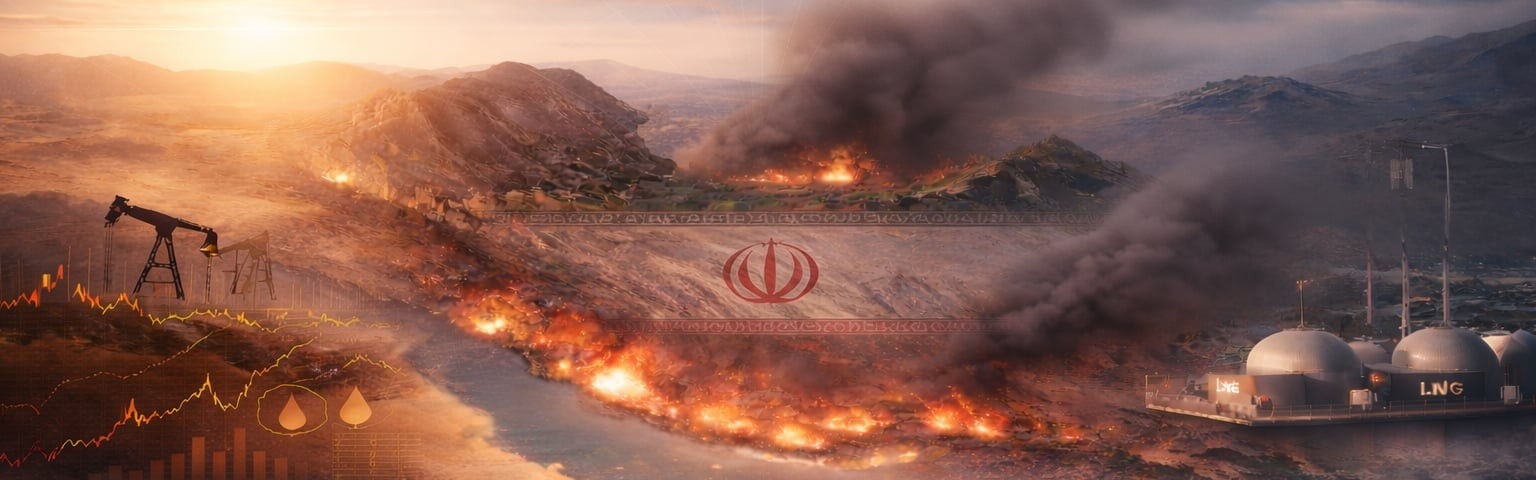
The military operation against Iran has had a serious impact on the international energy market. The Strait of Hormuz through which roughly one‑fifth of the world’s oil consumption passes has become one of the main Iran’s targets. Due to the threat posed by Iran, the number of tankers transiting the strait decreased by 70% after the start of the operation. At the same time, Qatar suspended exports of liquefied natural gas (LNG). As a result, by the third day of the operation, the price of Brent crude oil had risen by 13%, while natural gas prices had surged by 50%.
Asian countries are particularly dependent on energy resources passing through the Strait of Hormuz: China and India by 50%, Japan by 72%, and South Korea by 65%. However, the crisis has affected not only them but virtually every country, including the United States itself, where gasoline prices increased after the operation began. In response to growing demand in the energy market, President Trump’s administration issued a 30‑day license allowing Russia to sell approximately 128 million tons of oil already loaded onto tankers. Equally significant for Moscow was the decision regarding India, which was granted permission by the U.S. to purchase Russian oil and petroleum products for one month, from March 3 to April 4. India had been the largest buyer of Russian oil shipped by tanker, but following the recent deal with Washington, it sharply reduced purchases. Specifically, in January-February, Russian oil deliveries to India fell to 1.15 million barrels per day, 47% lower than the 2025 average. After the Trump administration temporarily lifted restrictions for India, the situation naturally shifted back in Russia’s favor.
Due to the crisis in the energy market, Russia’s budget currently receives about $150 million in additional daily revenue, as demand for Russian oil has increased in both India and China. This is highly significant, given that Russia’s economy had recently faced difficulties. These challenges were partly caused by declining revenues from gas and oil due to low prices and sanctions, with 2025 marking the lowest level in the past five years. In the first two months of 2026, Russia spent $5.4 billion from its reserve funds to compensate for reduced oil revenues.
European leaders expressed critical views regarding the U.S. decision to ease sanctions on Russian oil. The issue was discussed within the G‑7 format, where members agreed that any easing of sanctions on Russia should remain temporary. Although Russia’s budget revenues have increased, but if the rise in energy prices proves short‑lived, the international market conditions for Russian energy companies will not improve. According to former Russian Deputy Energy Minister Vladimir Milov, a one‑ or two‑month price increase cannot save Russia’s economy. In his assessment, high oil prices would need to be sustained for about a year to have a meaningful impact. Nevertheless, even a temporary rise in energy prices provides Russia with greater financial resources to continue its military aggression against Ukraine.
Air Defense Capabilities
Following the launch of the military operation against Iran, international media raised concerns that the increased demand for air defense systems in Middle Eastern countries to counter Iranian strikes might worsen Ukraine’s situation in terms of receiving such weaponry. Ukrainian President Volodymyr Zelensky expressed a similar view. However, as events unfolded, it became clear that the crisis in the Middle East also presents an opportunity for Ukraine. Specifically, the interception of Iranian kamikaze drones has proven to be one of the most problematic challenges for the U.S. and its allies. These drones, due to their small size and low‑altitude flight, often evade detection and reach their targets. The U.S. military command itself acknowledges this problem. Ukraine, by contrast, has gained extensive experience in combating drones during its war with Russia, and its effectiveness in this regard is relatively high. It is also noteworthy that while Iranian drones cost around $50,000, the missiles used by the U.S. and its allies to intercept them cost approximately $4 million each. Ukrainian forces, however, can produce anti‑drone systems for about $30,000.
President Zelensky publicly offered to supply interceptor drones and share Ukraine’s experience with the U.S. and its allies. In return, he requested deliveries of PAC‑3 missiles, which Ukraine uses to repel Russian missile attacks. Ukraine’s shortage in this regard is evident: according to its Air Force, at least 60 PAC‑3 interceptor missiles are needed each month to counter Russian strikes.
About seven months ago, Ukraine had already offered the U.S. to purchase Ukrainian anti‑drone technology for use against Iranian drones. The offer included the idea of establishing anti‑drone hubs in Turkey, Jordan, and other Gulf countries to counter threats from Iran and its proxes. At the time, however, the U.S. rejected the proposal.
President Trump has once again expressed a critical stance toward Ukraine. In an interview with Fox News, he stated that the U.S. does not need Ukraine’s assistance in combating drones, as it already possesses sufficient capabilities. Previously, he had argued that U.S. military stockpiles had been depleted due to aid provided to Ukraine. A few days ago, U.S. Secretary of War Pete Hegseth repeated the same view. Despite these public criticisms, cooperation between Ukraine and the U.S. and its allies on anti‑drone issues appears to have already begun. Since the start of the military operation against Iran, a U.S. brigadier general responsible for developing anti‑drone weapons, along with several members of his team, visited Ukraine. Representatives from Qatar and other Arab countries have also traveled to Ukraine, holding meetings with anti‑drone manufacturers. According to Ukrainian media, Israel has also shown interest in Ukraine’s anti‑drone technology. U.S. Army Secretary Dan Driscoll stated that 10,000 interceptor drones produced in Ukraine have already been sent to the Middle East. In addition, Ukrainian interceptor drones and military personnel have been deployed to Jordan and other countries in the region.
Ukraine’s position is further strengthened by the fact that Russia, although not very actively, but still assists Iran, including by providing intelligence data. According to Western intelligence sources, Russia also shares its experience with Iran to improve the effectiveness of drone use. Technological cooperation between the two countries is ongoing. Evidence of this was found in the drones used in the attack on the British military base in Cyprus, which contained Russian military technology.
Conclusion
At this stage, it is difficult to determine the ultimate impact of the military operation against Iran on the Russia-Ukraine conflict. One thing is clear: Russia supports Iran in this war, while Ukraine assists the United States and its allies. The decisive factor will naturally be the final outcome, which remains hard to predict. For now, the crisis in the Middle East brings more benefits than harm to Russia. However, if Iran’s allied ayatollah regime were to change, the consequences would not be favorable for Moscow. Authoritarian regimes typically reinforce one another, and a regime change in Iran would mark the third instance – after Syria and Venezuela – here Russia loses an ally without being able to provide effective assistance.
For Russia, the rise in energy prices is clearly a positive development. Yet it is uncertain whether this will be sufficient to resolve its economic problems. One of the main factors here is time – specifically, how long elevated energy prices can be sustained, which in turn depends on the duration of the military operation against Iran. It is difficult to imagine the operation being prolonged, as its negative effects, including rising energy prices, pose serious problems for many countries, including the United States. This dynamic weakens the positions of President Trump and the Republican Party ahead of the congressional elections scheduled for the fall. Accordingly, the Trump administration has a vested interest in concluding the military operation within a short timeframe.
Despite the Trump administration’s critical stance, Ukraine nevertheless gains an opportunity to demonstrate that it is not merely a consumer of security but can also provide significant military assistance to its allies. In this regard, Ukraine’s role is important not only for the United States but also for Arab and other countries that have expressed interest in military cooperation with Kyiv.
This article was translated from the original language with the assistance of AI tools and revised by the author.