



Author: Nata Koridze, UGSPN Senior Research Fellow
Introduction
More than four years after Russia’s full-scale invasion of Ukraine, the conflict is increasingly being shaped by factors beyond the battlefield. Although fighting continues along the front line, neither side has achieved a decisive operational breakthrough capable of fundamentally altering the military balance. War has therefore become one of endurance, as economic resilience, industrial production, logistics, and technological adaptation are assuming growing strategic importance alongside conventional military operations.
Ukraine’s recent drone attacks on the logistics infrastructure of Wildberries and other major Russian e-commerce platforms exemplify this shift. Viewed alongside earlier operations against oil refineries, military airfields, ammunition depots, and defense-industrial facilities, these actions reveal a broader pattern. Ukraine is progressively expanding its long-range strike campaign, moving beyond the direct degradation of Russian military capabilities toward increasing the economic burden of sustaining the war.
Ukraine continues to operate under significant resource constraints, while Russia retains major advantages in manpower and defense production. Unable to compete symmetrically, Kyiv has increasingly relied on comparatively inexpensive unmanned systems capable of imposing disproportionately high costs on Moscow. The objective is no longer simply to destroy military assets, but to place growing pressure on the economic systems that sustain them. Military equipment must be produced, fuel refined and transported, supply chains maintained, taxes collected, and businesses kept operational. Pressure on these supporting systems can gradually affect a state’s ability to sustain prolonged conflict. Equally important is another aspect of the attacks: the growing realization in Russian population’s mindset that the war is not some abstract thing happening far away, but that it affects everyone in Russia. Multiple videos posted by the affected sellers on the social networks complaining of the mounting losses and debts, attest to that.
From Refineries to Military Equipment to Commercial Logistics
Ukraine’s deep-strike campaign has developed in stages, reflecting both changing battlefield conditions and the rapid development of its domestic drone industry.
Its initial focus was military. Long-range strikes targeted ammunition depots, ports’ infrastructure, command centers, airfields, and fuel-storage sites directly supporting Russian combat operations. The objective was straightforward: reduce Russia’s immediate military effectiveness and complicate battlefield logistics.
A significant evolution of Ukrainian tactic became visible in 2024 and 2025 when Ukraine managed to boost its indigenous long-range strike capabilities and expanded its campaign to Russian oil refineries. Repeated strikes disrupted refining operations, increased repair costs, created a fuel deficit, kilometers-long lines and complicated fuel logistics. Angry Russians in many regions of the country posted the videos of queues and fights by the gas stations.
The campaign has continued into 2026. Ukraine has recently struck major refineries, including the Yaroslavl refinery, while a Ukrainian drone strike on the Orsk refinery on August 11 forced the facility to halt processing. This tactic is painful for Russia, as sales of oil and refined products are its main source of income for funding war efforts.
To deal with the problem Moscow halted gasoline, jet fuel and diesel shipments abroad and permitted the sale of outdated sub-standard fuels Euro-2 and Euro-4 to boost immediate supply. Moscow also sought to urgently import gasoline and diesel from Belarus, Kazakhstan and India. Significant concern in Russia has been related to the disruption of the seasonal agricultural harvest, spike in inflation due to the higher fuel costs and depression of the general economic growth.
The refinery campaign altered Russia’s defensive calculus. Facilities previously considered relatively secure suddenly required protection across thousands of kilometers of territory. Russia’s geographical size, once considered a major strategic advantage, has increasingly become a vulnerability in the age of relatively inexpensive long-range drones. Ukraine has demonstrated an ability to strike targets thousands of kilometers from its own territory, creating a protection problem that Russia cannot solve simply by adding conventional air-defense systems on its vast territory.
And the problem is not only the immediate cost of damage. A refinery operator has less incentive to invest heavily in reconstruction if the repaired facility can be struck again. The Russian response has highlighted the scale of the dilemma: officials, media figures and industry figures have discussed the need for private energy companies to strengthen their own defenses, while calls for greater state involvement have also emerged. The refinery campaign therefore demonstrated that long-range strikes can influence the economics of the war even when their immediate military effects are limited.
Subsequent operations against Russian strategic aviation reinforced the same logic, most notable the operation Spiderweb in 2025. They showed that geographical distance from the battlefield no longer guaranteed security for strategically important assets and illustrated the growing sophistication of Ukraine’s long-range strike capabilities. The central question increasingly became not simply which military targets could be destroyed, but which targets could generate the greatest strategic return for comparatively modest operational investment.
While battlefield maneuver has become increasingly constrained, Ukraine has substantially expanded domestic drone production. Russia’s economy has also come under mounting pressure from sustained wartime expenditure, labor shortages, inflation, high interest rates, and continuing sanctions. Ukraine’s strategy has consequently broadened while preserving the same underlying logic: use relatively inexpensive systems to impose costs that exceed the resources required to conduct the attack.
The result is a gradual shift from degrading Russian military capabilities directly to targeting the economic systems that finance, supply, and sustain them.
Attacks on Wildberries
It is within this broader context that the attacks against Wildberries should be understood. Employing formally 48,000 people directly, around 1 million sellers and approximately 150,000 to 200,000 inside the company’s storage facilities and logistics people in 2025, Wildberries is Russia’s largest sales platform (online retailer) for Russian small and midsize businesses. Following Moscow’s aggression against Ukraine in 2022, the company significantly expanded its operations, as many online e-commerce platforms, such as Amazon, withdrew from Russia. Wildberries controls 40-45% of domestic internet trade market and reaches around 8- million monthly users. (Unlike its main rival, the publicly traded company Ozon, Wildberries only offers limited financial disclosure. Therefore, analysts point that the available figures may not provide a full picture of its true size or financial stability.)
However, by any measure, simply describing it as “Russia’s Amazon” would be an understatement. The company reported an annual turnover of 6.1 trillion rubles (around USD 67 billion) in 2025, a figure that various estimates put at just over 2% of Russia’s GDP.
Together with Ozon (which covers around 30% of internet market) Wildberries plays a key role in Russia’s platform economy by integrating e-commerce, warehousing, transportation, payment systems and distribution into a single commercial ecosystem.
Ukraine had accused Wildberries of facilitating the supply of military-related goods. The company has previously sold products such as body armor and helmets, while Ukraine has argued that the platform has also been involved in the distribution of drone components and other materials used in Russia’s war effort. Wildberries and the Kremlin have rejected claims that the company has military ties.
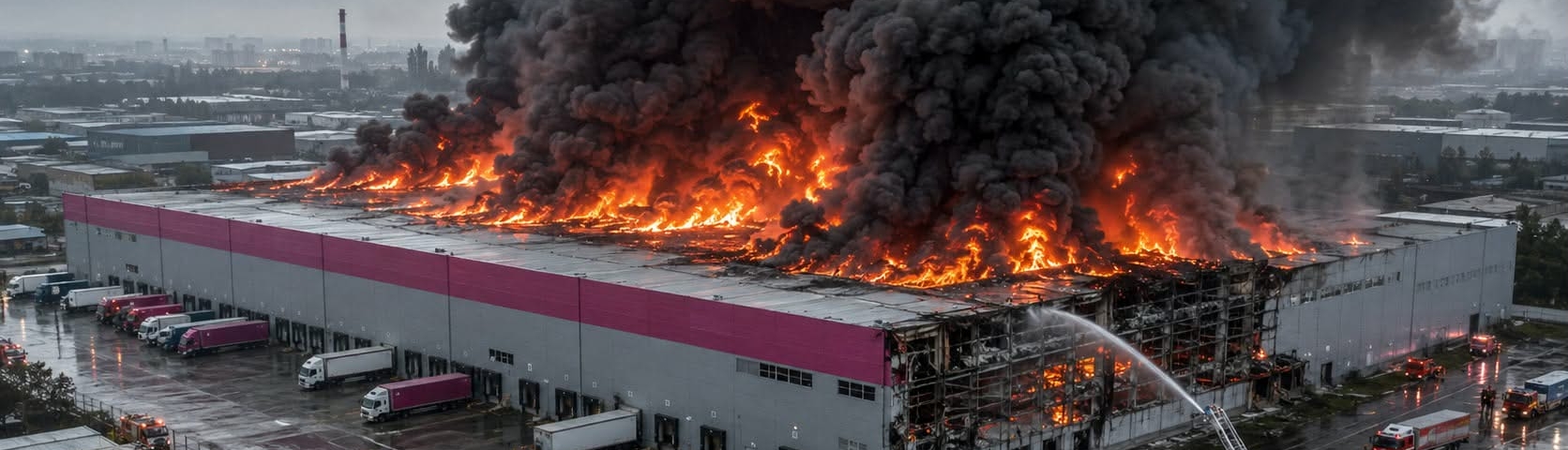
Wildberries attacks had already disrupted a significant part of the company’s logistics network. Since July 18, more than 20 Wildberries sites had been targeted, destroying more than 1.18 million square meters of warehouse space- about a third of its warehouse space. The single largest warehouse space, covering 250,000 square meters, was destroyed by the Ukrainian drone attack on August 16 in Koledino, near Moscow. The company’s sales have fallen, deliveries have been disrupted, and thousands of pickup points have reportedly been put up for sale.
The significance of these attacks extends beyond Wildberries physical warehouses. The company’s logistics network connects small -business sector, manufacturers, transport companies, financial institutions, small businesses, and consumers across Russia. Hundreds of thousands of sellers use the platform, and many have suffered losses because their goods were destroyed or became inaccessible following the attacks. The company and the sellers’ losses, according to various estimates range from USD 7 to 8.5 billion.
For businesses already operating under higher interest rates and difficult economic conditions, the sudden loss of inventory, distribution capacity, and revenue can be severe. Wildberries itself faces the costs of rebuilding warehouses (there are reports it started building warehouses in Belarus, Kazakhstan and Uzbekistan) and rerouting its logistics network, while sellers face additional uncertainty over compensation and insurance.
The company offered limited compensation to some sellers, while the Kremlin has been considering support measures for Wildberries and affected businesses such as loans and tax relief. Russia’s Deputy Prime Minister Alexander Novak instructed ministries to prepare support proposals for Wildberries sellers whose goods were damaged in drone attacks on the company’s logistics hubs. A package of measures was expected to be finalized by 10 August; however, no information has yet been released regarding these proposals.
Economic Attrition as a Strategic Instrument
Ukraine’s campaign against Russia’s wartime economy should not be judged by whether it can cripple the Russian economy. Its objective is more limited but strategically important: to raise the cost of sustaining the war by disrupting logistics, industrial production, and commercial activity.
It is true, however, that Russia’s larger economy, continued energy revenues, and centralized political system provide considerable capacity to absorb losses and finance reconstruction. Since 2022 when the international economic sanctions were introduced and the exodus of most key Western companies started, Russian economy has adapted by reorganizing supply chains, expanding domestic production, and redirecting trade toward alternative markets. These measures reduced vulnerability but did not eliminate it. Adaptation itself carries costs, requiring additional spending on infrastructure, logistics, security, and production.
What is peculiar about the Wildberries attacks, is that they brought war costs directly to the Russian business and hundreds of thousands of ordinary citizens. Some economic experts talk about the ‘domino effect’ that the attacks may have on the Russian economy. The strikes therefore can raise logistics and insurance costs, disrupt cash flows, weaken small businesses, and increase pressure on banks exposed to those companies. Experts highlight the impact that the main creditors of Wildberries, including major Russian banks such as VTB, Alfa-Bank and Sberbank, will suffer. They also highlight the fact that along with long-term liabilities, Wildberries’ total debt may stand at $14 billion, with VTB being its largest creditor.
Ukraine’s expanding target set creates a growing burden for the Russian state. Moscow faces the need of allocating limited air-defense assets among military installations, energy facilities, transport hubs, and increasingly important commercial infrastructure.
The Social Dimension
The social dimension is also becoming increasingly relevant. For many Russians, the war had long remained geographically distant and economically manageable. Attacks on refineries and commercial logistics bring some of its consequences directly into everyday life. Fuel shortages, disrupted deliveries, damaged goods, and financial losses affect ordinary consumers and small entrepreneurs. All this diminishes the acceptance of and appetite for the prolonged war.
There is evidence that the war is already producing a more complicated public mood. Levada Analytical Center’s (designated as a foreign agent by the Russian Ministry of Justice) 2026 polling has consistently shown substantial support for negotiations, even while support for the Russian military remains high. In March, two-thirds of respondents said Russia should move toward peace negotiations, while Ukrainian drone attacks were among the events that attracted notable public attention during the spring.
This does not mean that economic disruption will automatically translate into vocal opposition to the war. The Russian government still has extensive tools of censorship, propaganda, repression, and economic intervention. Nor should isolated expressions of dissatisfaction be interpreted as evidence of imminent political instability. The more important point is that the costs of the war are becoming harder to contain within the military sphere. And more and more ordinary Russians, have a change of heart as far as the “special military operation” by the Kremlin is concerned.
The strategy nevertheless has clear limitations. Drone strikes alone are unlikely to alter Russia’s overall economic trajectory or force a political decision to end the war. Damaged facilities can often be repaired, production can be relocated, and the state retains substantial capacity to support strategically important sectors and suppress dissent to the war. Economic pressure should therefore be understood as a complementary instrument rather than a substitute for battlefield success.
Conclusion
The principal lesson for Ukraine and its Western partners is that military and economic pressure are most effective when applied together. This is particularly pertinent given that Russia is increasing its production of ballistic missiles and jet-powered drones, which Ukrainian air defenses currently struggle to counter.
Long-range precision strikes, intelligence sharing, sanctions, export controls, air defense and financial restrictions can reinforce each other, increasing the overall cost of adaptation. Ukraine’s rapidly expanding domestic drone industry is particularly important because relatively inexpensive systems can force Russia to commit costly resources to air defense, infrastructure protection and reconstruction.
By steadily increasing the financial, administrative and social costs of aggression, Ukraine aims to erode Russia’s ability to wage a prolonged war and to make war unpopular among most Russian citizens. The ultimate effect of this pressure on the Russian economy and society remains to be seen. However, it is increasingly clear that Russia’s wartime economy has itself become an important arena of strategic combat, and that Ukraine is attempting to compensate for its relative weakness in conventional resources and manpower by imposing cumulative economic pressure.