



Author: Khatia Davlianidze, UGSPN Research Fellow
The Significance of the Sarajevo Protests
This article discusses the protests that began following the tragic incident of February 12, which soon evolved into widespread public dissatisfaction directed against corruption, ineffective governance, and systemic problems. It also explains why Bosnia’s political system is inefficient and vulnerable to political crises, and why systemic reforms remain difficult to implement despite large-scale public protests.
It is noteworthy that the protests that began in Sarajevo transcend ethnic issues and are directed against systemic corruption and ineffective governance. In recent years, similar demands have frequently emerged in other Balkan countries, including Serbia, Bulgaria, and North Macedonia, indicating growing public dissatisfaction with socio-economic problems and political elites in the region.
Within the regional context, such demonstrations sometimes serve as a political and social example for societies in neighboring countries, which may indirectly increase the potential for protest.
What Triggered the Protests?
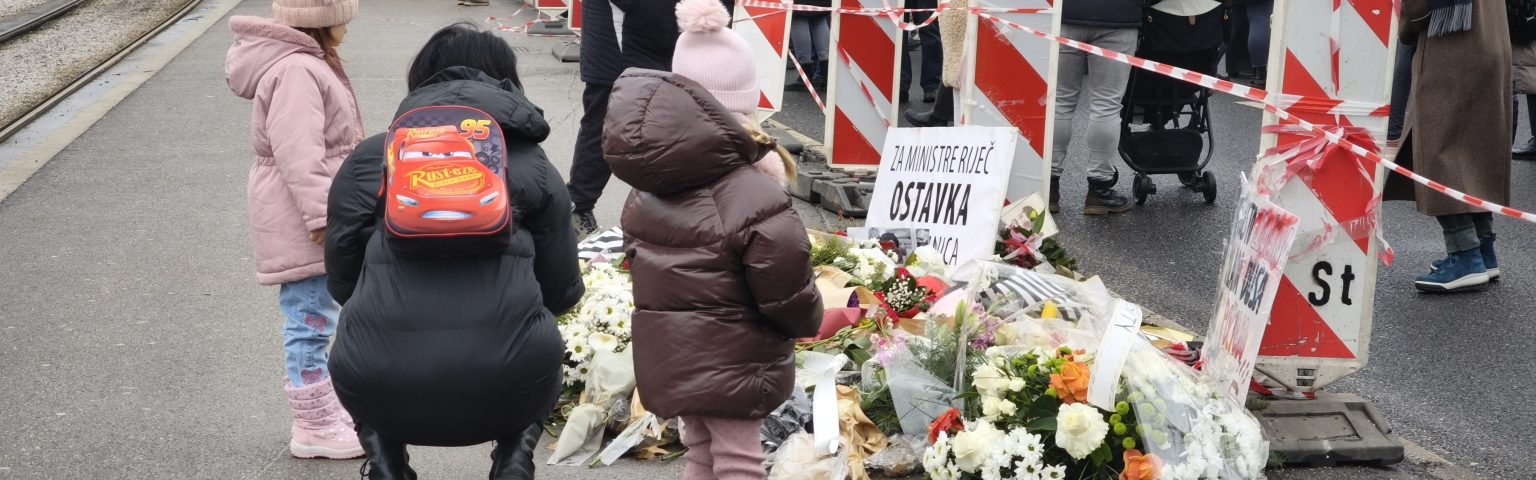
The latest episode of political turmoil began after a tram derailed in the center of the capital, Sarajevo, on February 12 of this year. As a result of the incident, a 23-year-old student died and four others were seriously injured.
Large-scale protests began in Sarajevo on February 13, demanding the launch of an investigation, the publication of relevant documents, and the punishment of those responsible. Soon after, the Balkan Investigative Reporting Network (BIRN) reported that Sarajevo’s public transportation company had signed a contract with a company to replace the braking systems of old trams, despite the fact that the company lacked the necessary license, specific experience, and professional qualifications.
The superficial investigation conducted by the Sarajevo Canton Prosecutor’s Office, along with additional details about the case revealed by BIRN’s investigation, further angered citizens and intensified the protest movement. Ultimately, as a result of the protests, the Prime Minister of Sarajevo Canton, Nihad Uk, and the director of the state-owned company responsible for the tram system, KJKP GRAS, resigned from their positions. In addition, all trams produced in the 1960s or earlier were removed from service.
Following Nihad Uk’s announcement of his resignation, the Sarajevo Canton Assembly convened a session during which lawmakers formally terminated his mandate and dismissed the entire composition of the Sarajevo Canton government. Several scenarios for further political developments are possible: lawmakers may support the current government composition but elect a new leader of the parliamentary majority, or a coalition reshuffle may occur and a new cabinet with an entirely new composition may be approved.
According to the protesters, the February 12 incident was caused by widespread corruption, a lack of transparency, and the malfunctioning of political institutions. Consequently, their current demand is systemic change.
It is noteworthy that the protests are led not by political parties but by young people aged 17-20 who are not affiliated with any political organization.
The protests that began in Sarajevo are also supported by Serbian youth, who since November 2024 have been demanding the end of Aleksandar Vučić’s rule and the implementation of fundamental reforms.
Although large-scale demonstrations are not new for Bosnia, over the past twelve years citizens have not placed systemic change at the center of the political agenda.
It should be recalled that in February 2014 demonstrations demanding the resignation of the government began in the Bosnian city of Tuzla. The protest momentum soon spread across the entire country, including Sarajevo, Zenica, Bihać, Mostar, and Brčko. The protesters’ dissatisfaction was driven by high unemployment, social inequality, and systemic corruption. This was the first time since 1995 that protests were not ethnically driven, and Bosniaks, Serbs, and Croats living in the country shared the same main demand: a change of government. Although the protests did not lead to systemic reform, several cantonal prime ministers resigned.
Bosnia and Herzegovina’s Complex Political Structure
Political crises are nothing new for Bosnia and Herzegovina. The state created by the Dayton Agreement is characterized by a complex territorial arrangement and a fragmented governance system based on ethnic balance, resulting in constant political instability.
Following the 1992-1995 war, a state was established on the territory of Bosnia and Herzegovina that unites the Bosniak-Croat Federation and the Republic Srpska. In addition, Bosnia’s territory includes the Brčko District, a multiethnic self-governing administrative unit.
At the state level, Bosnia and Herzegovina has a parliament, a council of ministers, and a tripartite presidency, in which Serb, Bosniak, and Croat members elected for four-year terms rotate the chairmanship every eight months. Both the Bosniak-Croat Federation and Republic Srpska have their own parliamentary assemblies, governments, and prime ministers. The Bosniak-Croat Federation itself is divided into 10 cantons, each with its own prime minister and cabinet. In total, Bosnia and Herzegovina has 3 presidents, 13 prime ministers, and more than 700 members of parliament.
Republic Srpska – One of the Main Architects of Bosnia’s Instability
In addition to the country’s complex territorial structure and institutional system, Bosnia’s political stability is frequently threatened by the separatist ambitions of one of its entities – Republic Srpska.
For years, the former leader of Republic Srpska, Milorad Dodik, has opposed the Office of the High Representative (OHR), an institution established to oversee the civilian implementation of the Dayton Peace Agreement and empowered to impose or annul laws binding on Bosnia and Herzegovina’s constituent entities.
Beyond attempts to delegitimize and discredit the High Representative, Dodik has also sought to weaken the authority of Bosnia’s central government and create parallel political institutions in Republic Srpska. His declared goal has been the secession of Republic Srpska from Bosnia and the establishment of its independence.
It should be recalled that in February 2025 the Court of Bosnia and Herzegovina sentenced the leader of the Alliance of Independent Social Democrats, Milorad Dodik, to one year of house arrest and banned him from holding public office for six years due to constitutional violations and disobedience toward the High Representative.
Despite stepping down from the presidency, he remains the most influential political figure in Republic Srpska. Moreover, the presidency was again won by a candidate from the same political alliance who fully shares and supports Dodik’s political goals and separatist ambitions.
What are the main obstacles to systemic change?
Due to the multi-layered governance structure created by the Dayton Peace Agreement, it is difficult in Bosnia and Herzegovina to identify the specific decision-makers responsible for political decisions and to hold them accountable. Another serious problem is the overlapping competencies of authorities at different levels of government, which hinders the implementation of nationwide reforms and the effective coordination of policies.
Reforms are further complicated by the fact that several institutional levels possess veto powers intended to protect the interests of Bosnia’s three main ethnic groups – Bosniaks, Croats, and Serbs.
These include:
- Presidential veto – each member of Bosnia and Herzegovina’s Presidency Council can block a decision considered harmful to the national interests of their respective entity and refer it to their entity’s national assembly.
- Upper house veto – in the House of Peoples of the state-level parliament, each ethnic group can exercise a veto to prevent the violation of “vital national interests.”
- Entity veto in the lower house – in the House of Representatives, decisions can be blocked by a majority of representatives from both entities.
Systemic reform usually requires constitutional changes. Any major reform must receive support from all three ethnic groups – Bosniaks, Serbs, and Croats. In addition, both administrative entities must approve the change before it is adopted at the state level. In practice, this means that even relatively minor reforms require broad national consensus.
As for public protests, they can trigger certain changes in the short term, but implementing reforms that would ensure a radical transformation of the system is far more difficult. Achieving such success requires the spread of protest momentum across the entire country and the mobilization of various social groups.
Although Bosniaks, Serbs, and Croats are often united by common socio-economic problems, demands, and grievances, large-scale public mobilization may be hindered by the factor of ethnic identity. In this context, the narratives promoted by political elites become particularly important.
For example, Milorad Dodik has attempted to portray the protests that began in Sarajevo on February 12 through an ethnic lens in order to prevent the spread of the protest wave into Republic Srpska. According to him, the reason people took to the streets is not systemic problems but rather the incompetence of Bosniak and Croat political leaders in Sarajevo.
Ultimately, it can be said that the institutional structure created by the Dayton Agreement played an important role in ending the war and halting severe ethnic confrontation. However, this mechanism significantly limits the ability to implement rapid and large-scale political change. Consequently, even if officials at different levels of government resign, without constitutional reforms the transformation of Bosnia’s political system remains virtually impossible.