



Author: Revaz Topuria, Research Fellow
On June 2, 2026, President Trump signed the executive order titled “Promoting the Development and Security of Artificial Intelligence.” The order requests that leading AI companies voluntarily provide the federal government with early access to their new models up to 30 days before public release, enabling the Department of Defense, the Department of the Treasury, and the Cybersecurity and Infrastructure Security Agency (CISA) to assess them from a national security perspective.
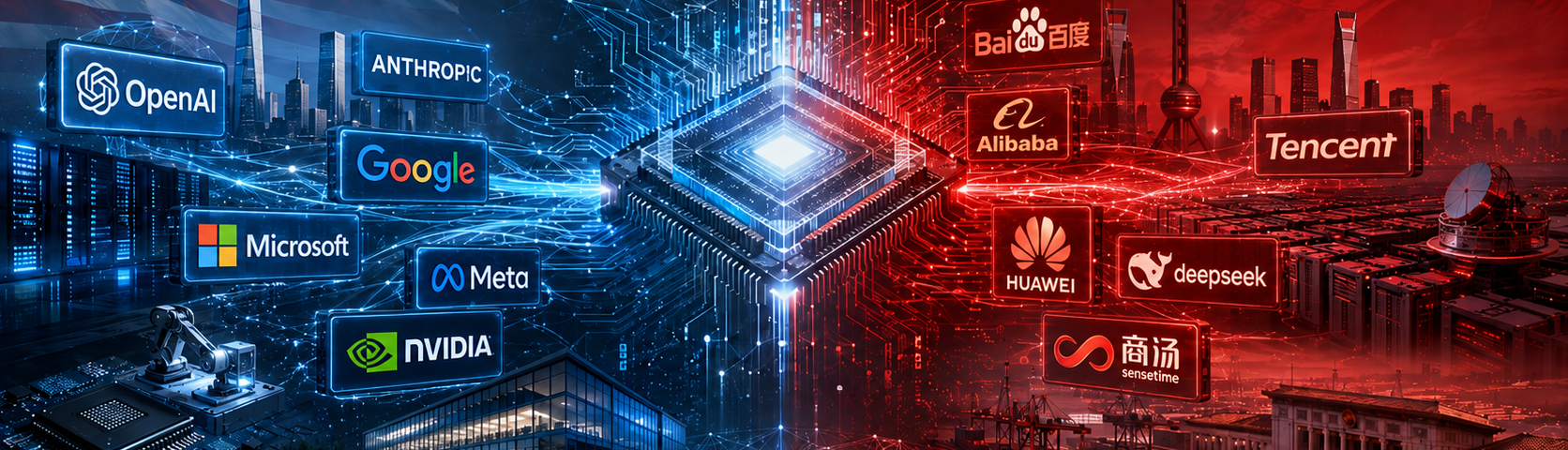
At first glance, there may appear to be nothing particularly remarkable about this executive order. However, when examined within the context of the increasingly intense technological rivalry with China, it reveals a structural logic that illustrates how the United States intends to maintain competitiveness in the AI era—and what China plans to do in response.
The U.S. Approach and the New Executive Order
It is worth noting that the original version of the executive order was considerably stricter. Instead of the current voluntary 30-day provision, the initial draft required AI companies to provide the relevant information to the government 90 days in advance. This stricter approach changed as a result of the involvement of influential representatives of the U.S. technology sector, including Mark Zuckerberg. They argued that such heavy oversight would weaken America’s competitiveness in the field of AI.
As a result, the final order emphasizes voluntary cooperation from companies rather than coercion, while explicitly prohibiting the government from introducing mandatory licensing requirements or prior approval mechanisms for AI models.
The final order clearly demonstrates Washington’s vision regarding AI: a voluntary framework and greater freedom for the private sector. The preamble to the executive order explicitly reflects this framework, asserting that the United States leads in AI precisely because of the “extraordinary talent and innovation of the AI industry, and because we refuse to stifle that innovation through excessive bureaucratic regulation.”
There is a certain strategic logic behind this position. America’s leadership in AI is built upon a model of innovation driven by a competitive private sector, where companies such as Anthropic, OpenAI, Google, and others operate in a market that is less regulated than many other sectors. Critics argue that mandatory advance review periods would impose asymmetric costs, slow down American companies, and conversely grant Chinese firms, operating under different rules, a strategic advantage.
The administration’s decision to retreat from the proposed 90-day requirement and postpone mandatory prior authorization reflects these calculations, even while openly acknowledging that leading AI systems introduce national security risks that can no longer be entirely ignored.
Trump’s executive order reveals America’s broader approach to AI development. The American model is reactive rather than structured, market-oriented rather than state-directed. This approach stands in stark contrast to the one found across the Pacific.
China’s AI Policy
China’s approach to AI can hardly be described as reactive; it is unmistakably planned.
Since 2017, when the State Council published the New Generation Artificial Intelligence Development Plan (NAIDP), Beijing has pursued a clearly defined strategy aimed at making China the world’s dominant power in AI by 2030.
China’s ambitions became particularly evident in the 14th Five-Year Plan (2021–2025), which emphasized AI-driven industrial modernization and technological self-sufficiency. However, export restrictions imposed by Washington on semiconductors between 2022 and 2025 transformed AI into the defining arena of technological competition between the two countries, prompting corresponding adjustments to China’s plans.
Approved in March 2026, the 15th Five-Year Plan (2026–2030) reflects a fundamentally different strategic environment. The document mentions artificial intelligence 52 times, four times more frequently than its predecessor, signaling that AI is no longer simply one priority among many, but rather the central pillar of China’s modernization agenda for the next five years.
The primary vehicle for implementing this vision is the AI+ Initiative, announced in 2025, which aims to embed artificial intelligence into every segment of the real economy. The targets are ambitious even by Chinese planning standards: 70 percent AI adoption across key sectors by 2027, rising to 90 percent by 2030, culminating in a vision of a “fully AI-oriented economy and society” by 2035.
At the same time, China has elevated efforts to reduce dependence on Western technologies, including semiconductors, to an entirely new level. According to the 15th Five-Year Plan, technological autonomy is viewed as a national security imperative rather than merely an industrial challenge.
In response to the so-called “chip war,” China invested heavily in semiconductor manufacturing, alternative computing architectures, and AI model optimization. The effectiveness of this approach became evident with DeepSeek-R1 in early 2025.
The DeepSeek case demonstrated not only that high-level AI models could be developed using less computing power than previously assumed, but also that China is capable of competing even under conditions of restricted access to cutting-edge chips.
Diverging Regulatory Philosophies
Both the United States and China clearly understand the significance of AI and invest heavily in this field. However, the fundamental difference between the two lies in their regulatory philosophies and the methods through which they seek to advance AI development.
China’s regulatory architecture is multilayered and politically integrated.
Since 2021, Beijing has introduced a series of interconnected sector-specific measures: regulations governing algorithmic recommendation systems used by platforms; rules addressing deep synthesis technologies and deepfakes; and the Interim Measures for the Management of Generative AI Services, which entered into force in August 2023 and represented the world’s first comprehensive regulatory framework for generative AI.
The latter framework requires AI service providers to register with the Cyberspace Administration of China (CAC), conduct security assessments of their models, and ensure that their systems reflect the “core values of Chinese socialism.”
Another structural characteristic of China’s AI governance deserving special attention is the doctrine of Military-Civil Fusion (军民融合). Under this policy, which evolved into a national strategy during Xi Jinping’s leadership, the legal distinction between civilian technological development and military application has effectively disappeared. Any AI system, database, or capability developed by a Chinese private company is, in principle, accessible to the People’s Liberation Army (the official name of the armed forces of the People’s Republic of China) as well as to the broader state security apparatus.
This means that China’s expansive civilian AI ecosystem, consumer platforms, industrial automation, and academic research, can simultaneously perform military-technological functions.
Ultimately, what most clearly distinguishes China’s AI approach from America’s is its deep integration into the political-administrative system. In China, AI regulation is inseparable from the Communist Party’s broader objectives: maintaining informational control, shaping public discourse, and extending state visibility into digital life. Requirements such as registration with the CAC or the obligation for social media algorithms to promote “positive energy” are not designed primarily to protect users’ rights. Rather, they are instruments of political governance disguised as regulation.
The United States, of course, also possesses mechanisms through which innovations developed in the private sector can be directed toward state priorities. However, the approach differs radically from China’s. The Defense Advanced Research Projects Agency (DARPA) finances dual-use research, while the Department of Defense maintains AI investment programs aimed at channeling private-sector capabilities toward military applications. The national security provisions of Trump’s June 2026 executive order, which require government agencies to evaluate defense-relevant risks associated with new AI models, reflect the same underlying logic: state access to civilian AI.
Unlike China’s military-civil fusion model, however, these mechanisms function through contracts, voluntary partnerships, and procurement processes, rather than through a legal presumption that civilian innovation inherently belongs to the state. This distinction reflects the fundamentally different understandings of the state’s role and the direction of AI development in the United States and China.
Conclusion
Despite their philosophical differences, Trump’s June 2026 executive order and China’s 15th Five-Year Plan share one common assumption: artificial intelligence is no longer merely a technological sector. It has become a new dimension of state power, one that, in the long run, may prove just as significant as military capabilities, economic scale, or energy independence.
Consequently, competition over AI between the United States and China is not simply a race to obtain a technological prize.
It is a contest between competing models for organizing the relationship between states, markets, and technology. Thus, the most important question is not which country will build the most powerful AI model, but which country will more successfully transform AI capabilities into strategic advantage. The United States possesses enormous advantages in research, private-sector scale, and talent. China, meanwhile, demonstrates clear strengths in state coordination, market scale, and implementation discipline. Only time will tell which country’s model ultimately proves more successful.
This article was translated from the original language with the assistance of AI tools and revised by the author.