



Author: Vazha Sopromadze, UGSPN Administrative Head
Introduction
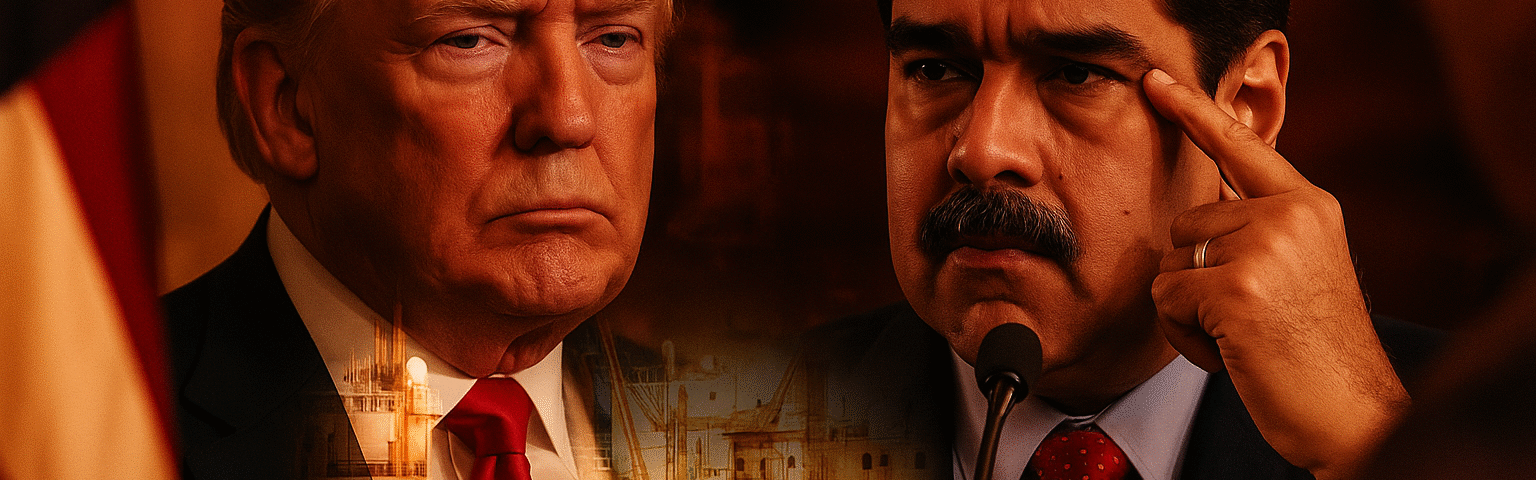
During Donald Trump’s second presidential term, Washington’s foreign policy priorities and strategies have been significantly revised and adjusted across a number of key directions. Among these, the U.S. strategy toward Venezuela has become more complex and more hardline. The initiator of the renewed strategy toward Caracas is considered to be the head of the State Department, Marco Rubio. He is characterized by a particularly hard-line approach, including leaving open the option of using force to change the regime. Both during Trump’s first presidential term and under President Biden, the White House’s policy toward Venezuela proved to be largely unsuccessful. Despite sweeping sanctions and substantial diplomatic pressure, Maduro managed to further consolidate his grip on power. Considering the failure of previous administrations, under the strategy developed by Marco Rubio the White House is now exerting unprecedented pressure on Maduro’s regime. It is important to analyze what components this strategy consists of and what impact a possible escalation in relations between Washington and Caracas may have on regional and global security.
Overview of the Historical Context
In the presidential election held after Hugo Chávez’s death in 2013, his political heir Nicolás Maduro won the presidential election. Under Maduro’s presidency, Venezuela plunged into a deep economic and political crisis, as a result of which millions of people left the country.
In 2018, after leading opposition coalitions were effectively banned and amid accusations of electoral fraud, the Central Election Commission still declared Maduro the winner of the election. Under the existing constitution, he was supposed to take the oath of office before parliament, which at that time was controlled by the opposition. Instead, Maduro took the oath before the Supreme Court, thereby deepening the ongoing political crisis even further. Against the backdrop of Maduro’s démarche, the speaker of parliament, Juan Guaidó, announced that he was assuming the powers of “interim president” until free elections were held in the country. Washington swiftly recognized Guaidó as the legitimate president and intensified its sanctions policy against Caracas. Under the White House’s strategy, the parliament was seen as the only body possessing political legitimacy, and it was expected that, amid diplomatic non-recognition and financial sanctions, Maduro would be forced to make substantial concessions. In response, Maduro severed diplomatic relations with the United States and, through even more extensive use of repressive instruments, managed to retain power.
In the 2024 presidential election, the incumbent president was challenged by the joint opposition candidate, former diplomat Edmundo González. According to pre-election polls, the opposition’s joint candidate had a significant lead. Against this backdrop, the opposition and independent observers focused particular attention on the risk of large-scale electoral fraud. As expected, to preserve its hold on power, Maduro’s regime employed a wide arsenal of authoritarian tools, which included: barring popular candidates from running, arresting political opponents, widespread intimidation of voters, the use of administrative resources, and direct falsification of election results. A few days before the elections, Maduro publicly declared that, if he were to lose, the “country would find itself on the brink of bloody confrontation”. On the day after the vote, Venezuela’s electoral commission declared the incumbent president the winner. The announcement of the results triggered several months of massive protests. Within a few weeks after the protests began, the joint opposition candidate left the country aboard an aircraft of the Spanish Air Force. The results of the presidential election were not recognized by the United States, the European Union, and most states in the region. Amid large-scale opposition protests, U.S. Secretary of State Antony Blinken stated that the announced election results did not reflect the will of the people and that, on the basis of evidence available to Washington, the United States recognized the opposition’s joint candidate as the winner of the elections. In response, official Caracas accused Washington of violating norms of international law and pursuing an imperialist policy. After several months of protest, Maduro’s regime succeeded in regaining control over the situation, and on 10 January 2025, an official inauguration took place. On that same day, the United States, the United Kingdom, and the European Union imposed additional financial sanctions on Maduro and those around him, but these had only a limited impact.
Legal Escalation Phase
The White House began implementing a new approach toward Venezuela from early 2025. In January 2025, the State Department initiated the process of designating drug cartels as terrorist organizations, thereby granting the United States the option of using military measures against them. This decision also had a domestic-political dimension, since the inflow of drugs into U.S. territory is linked precisely to the activities of drug cartels. The so-called “fentanyl epidemic” and, more broadly, the fight against drug trafficking were among Trump’s campaign promises.
In the regional context, the White House formulated the narrative that U.S. national security challenges stem not only from state actors but also from transnational criminal structures. One of the most influential cartels operating in Venezuela, “Tren de Aragua” was the first organization of this kind to be designated as a terrorist organization by Washington. The White House accused the cartel of drug trafficking, human trafficking, and other types of violent crimes committed in various Latin American countries and on U.S. territory. Soon thereafter, President Trump signed an executive order implementing a secondary sanctions regime on official Caracas. Any country that purchases oil from Venezuela would be subject to an additional tariff of at least 25 percent. With this step, Washington moved beyond the classic practice of direct sanctions against Maduro’s regime. The threat of secondary sanctions greatly complicates relations between Caracas and its trading partners. Shortly thereafter, another major cartel, the “Cartel de los Soles”, was designated a terrorist organization by the U.S. According to the official justification, this organization is linked to high-ranking officials within the armed forces of Maduro’s regime, and revenues from its criminal activities help to maintain the regime’s financial stability. Through this decision, Washington has effectively designated a large part of the leadership of Venezuela’s military structures, at a personal level, as leaders of a terrorist organization.
Military Escalation Phase
From August 2025, the United States has sharply increased its naval presence in the Caribbean Sea. According to information from open sources, Washington has deployed to the region various types of warships, submarines, and additional marine contingents. Officially, the Trump administration presents these measures as part of its campaign against drug trafficking, but the concentration in the region of military capabilities and personnel on such a scale can potentially be assessed as a preparatory phase for military operations.
September saw the first major incident, in which several people were killed. U.S. naval forces destroyed a boat that, according to the White House, was involved in drug smuggling. A few weeks later, a similar incident took place, again resulting in casualties. These incidents drew strong criticism from human rights organizations both within the United States and internationally. Questions have been raised about the extent to which such actions are consistent with general legal standards and how precise Washington’s criteria are for identifying targets. Some experts believe that “declaring war” on cartels could be a highly dangerous precedent that other states might also invoke, potentially justifying military aggression against third countries by framing it as counter-terrorism or operations against narco-structures or organized crime in general.
At this stage of escalation, representatives of the Trump administration held a closed briefing in Congress, where they provided members of the relevant committees with detailed information about the goals of the ongoing operation and, among other things, its justification under international law. According to the White House’s position, the United States is engaged in a non-international armed conflict against drug cartels operating in the waters of the Caribbean Sea and regards members of these structures as unlawful combatants. Formally, the United States still maintains that its actions are not directed against the Venezuelan state as such and that their sole aim is the neutralization of the cartels.
Analysis of the Main Components of Washington’s Strategy
Under the White House’s strategy, destroying or at least weakening the cartels is intended to undermine the financial stability of Maduro’s regime. The imposition of secondary sanctions on buyers of Venezuelan oil and the designation of cartels as terrorist organizations are intended, in principle, to significantly reduce the regime’s financial capabilities. At the same time, senior officials in the Trump administration, as well as President Trump himself, frequently emphasize Venezuela’s destructive role in the context of regional security. The White House accuses Caracas of orchestrating irregular migration flows and encouraging organized crime in the region. Moreover, Caracas’s cooperation with the United States’ strategic rivals, such as Iran, China, and Russia, is unacceptable to the White House. By reinforcing its military presence in the Caribbean Sea, the United States is sending a signal primarily to China and Russia that it will not allow the strengthening of an anti-American bridgehead in the Western Hemisphere.
The Venezuelan case also has a domestic political dimension for Trump. He is seeking to capitalize on an agenda focused on opposition to illegal migration, drugs, and crime. High-profile operations by Immigration and Customs Enforcement (ICE) across the country are now supplemented by the component of the fight against cartels. The Trump administration is combating organized crime and physically eliminating those who “poison the American people” before they manage to enter the country illegally. In this context, the Venezuelan case also becomes a source of domestic electoral mobilization, particularly in those states where the problems of migration and general crime are felt most acutely.
Under previous administrations, the White House’s strategy was based on supporting a democratic transition and, more broadly, on changing the very nature of the regime. In conditions of external threat, sectoral sanctions played a negative role and contributed to the consolidation of military and economic elites around Maduro. Taking this into account, the much more complex strategy chosen by the Trump administration is likely to tilt the existing status quo toward escalation.
Maduro’s Regime’s Reaction
Maduro’s regime has rationally assessed the risks posed by the changed strategy of the new U.S. administration and soon decided to make concessions. From March, Venezuela resumed accepting its citizens deported from the United States, something that Maduro’s administration had previously refused to do. Shortly thereafter, an exchange mechanism began operating, within which Caracas released 10 U.S. citizens and some political prisoners (their prison sentences were commuted to alternative forms of punishment). In October 2025, authoritative media outlets reported that Maduro had proposed to Washington a plan for transferring power. Under this plan, Maduro was prepared to leave the presidency within three years, and during the remaining three years of his term Vice President Rodríguez would serve out the mandate on the condition that he would not run as a candidate in the new presidential elections. According to these reports, the White House did not accept Maduro’s proposal. Maduro himself publicly labeled this information as fake. Furthermore, the media reported that Caracas had proposed a so-called package deal to Washington, which envisaged the participation of American companies in the extraction of oil and rare minerals in exchange for a reduction of the sanctions regime and military de-escalation. Although neither side has officially confirmed that such negotiations took place, at precisely the same time President Trump was publicly stating that Maduro was ready to give up “everything.”
During the same period, reports emerged that Maduro had turned to China, Russia, and Iran for assistance. According to information disseminated in the media, official Caracas requested from Russia the transfer of air-defense systems, radar stations, and other types of military equipment. There were also reports that several units of the former Wagner paramilitary group had flown into Caracas, but this information has not been confirmed by reliable sources. During that same period, official Moscow declared its support for Caracas’s sovereignty and criticized U.S. actions in the Caribbean Sea. China made a statement of similar content. At this stage, there is no confirmation of any significant intensification of military cooperation between Iran and Venezuela. Maduro’s regime is objectively vulnerable in the face of potential U.S. military aggression, and it is entirely possible that it has in fact requested some form of military assistance from its allies. For now, however, only the rhetorical support of Russia and China for Maduro’s regime expressed in terms of defending Venezuela’s sovereignty has been confirmed.
Conclusion
We can conclude that, over the course of 2025, the United States’ foreign policy strategy toward Venezuela has changed dramatically. The Trump administration is betting on crisis escalation and is seeking, including through the projection of military force and the use of geo-economic coercive instruments, to drive Maduro’s regime to the highest possible level of dysfunction. The designation of drug cartels as terrorist organizations and the de facto conduct of a military operation in international waters in the immediate vicinity of Venezuela greatly increase the likelihood that the Maduro regime will be changed by military means. By using force in the Caribbean Sea, Washington has significantly disrupted the financial-logistical supply chains that are vital for the survival of Maduro’s regime. Despite this substantial damage, the regime has not collapsed. On the one hand, Maduro is sending signals of readiness for negotiations to Trump, while on the other hand, he is appealing to China and Russia for assistance.
At this stage, a large-scale military intervention by the Trump administration appears unlikely. In the next phase of escalation, it is more probable that we will either see the imposition of some form of economic blockade or the targeted limited strikes on Venezuelan territory (under the pretext of the fight against drug cartels).
The trend toward escalation on Washington’s part will likely persist, ultimately leading to some type of “package agreement” that will provide both for a transition of power and for preferential access for American companies to oil and other natural resources in Venezuela.