



Author: Giorgi Bilanishvili
The Munich Security Conference, launched in 1963 and once known as a gathering of the transatlantic family, remains one of the most significant forums for discussions on international politics and security. The participation of heads of state and senior politicians from numerous countries further enhances the importance of this conference and lends it considerable political weight.
The annual Security Report, published since 2015 ahead of the conference, largely determines its central topic. This year’s report, titled “Under Destruction,” focused on the rapid erosion of the post-Cold War order that has been unfolding in recent years. Notably, the report highlights that President Trump’s administration key role in the dismantling of this post-Cold War order.
The tensions within the transatlantic partnership were reflected at the Munich Security Conference held on February 13–15, 2026. Although the tone of U.S. Secretary of State Marco Rubio’s address was softer and more cooperative toward Europe compared to last year’s speech by Vice President J.D. Vance, the core message remained unchanged. That message emphasizes that Europe must assume greater responsibility for overcoming its challenges and ensuring its own defense and security.
To better understand the current state of transatlantic unity, approaches toward Russia, and support for Ukraine, the following sections review the speeches delivered at the Munich Security Conference by the leaders of Germany, France, and the United Kingdom, as well as by the U.S. Secretary of State. The review highlights the key messages conveyed on partnership, foreign policy, security, and the Russia–Ukraine topic.
German Chancellor Friedrich Merz
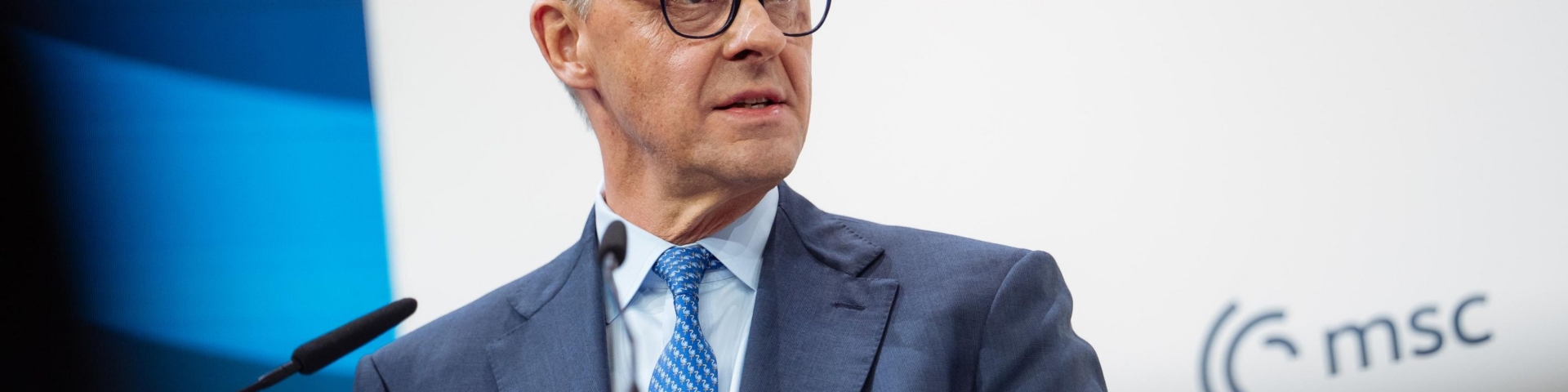
At the Munich Security Conference, German Chancellor Friedrich Merz focused on the changes taking place in the modern and dynamic world, which pose new and grave challenges to Europe’s security. In his assessment, the international order – which was never perfect – no longer exists , and in an era dominated by big powers, freedom is no longer guaranteed. According to Merz, in such circumstances, European unity and efforts to strengthen security have become especially important. In this regard, he emphasized NATO and Germany’s plans to reinforce its military capabilities and enhance the resilience of critical infrastructure. He also mentioned initiating dialogue with the French President on the issue of Europe’s nuclear deterrence.
The Chancellor also spoke about the necessity of dialogue and compromise among partners, despite differing positions. As an example, he cited the issue of Greenland’s transfer to the United States, which the Trump administration recently revived, provoking negative reactions and opposition in Denmark and other European countries. Merz noted that the Greenland issue clearly demonstrated European solidarity. The United States featured in his speech in other respects as well. Specifically, Merz argued that America’s pursuit of global leadership faces obstacles. He also addressed U.S.-China competition, including in the military sphere. On this topic, his main message was that not only does Europe need partnership with the United States, but the same necessity exists for the other side as well.
Merz was particularly explicit when speaking about Ukraine. He equated Russia’s aggression in February 2022 with the beginning of a new phase of wars and open conflicts that are reshaping the world. He stressed Europe’s and Germany’s role in providing political, diplomatic, economic, and military support to Ukraine. Importantly, his terminology was also very clear and deliberate. In his speech, alongside references to Russian aggression and the brutal war in Ukraine, he used broader political terms such as Russian revisionism and imperialism, as well as war crimes committed by Russia in Ukraine.
Merz’s address largely reflected the difficulties within the transatlantic partnership and the challenges facing European security under the reshaped priorities of the Trump administration. Against this backdrop, his central message should be understood as Germany’s declaration of its leading role in ensuring Europe’s security and supporting Ukraine.
President of France Emmanuel Macron
In his address at the Munich Security Conference, French President Emmanuel Macron struck a more positive tone when assessing Europe’s current state, particularly in the economic and social spheres. Yet alongside these achievements, Macron also stressed the necessity for Europe to strengthen its own power. Unlike Chancellor Merz, he focused not on NATO but on the need to establish a new security architecture for Europe, emphasizing that Europe must succeed in becoming a geopolitical actor. He underlined that a stronger Europe would be a better partner for its allies, especially the United States.
Macron spoke extensively on the Russia-Ukraine issue. He highlighted the importance of European unity in supporting Ukraine and countering Russia. He condemned the strikes carried out against Ukraine’s civilian population and energy infrastructure during the peace negotiations, noting that the response should not be concessions but increased pressure on Russia. Politically, it was significant that Macron directly linked Russia’s military aggression against Ukraine to the European security, identifying Putin’s goal as the expansion of Russia’s sphere of influence at Europe’s expense. He also drew attention to the damage Russia has already suffered – economic isolation, recession, growing dependence on China, and worsening demographic trends. According to Macron, Russia’s plans regarding NATO and Europe have failed: instead of weakening, NATO has expanded with Sweden and Finland joining, and Europe is becoming stronger.
The French President also focused on the peace process. On the one hand, he expressed full support for the Ukraine peace negotiations initiated by President Trump. On the other hand, he underlined that without Europe’s consent, no peace agreement could be reached. In this regard, Macron emphasized Europe’s role in deciding issues such as Ukraine’s security guarantees, aid packages, the relief of sanctions on Russia, and Ukraine’s European future. He noted that the conflict must be resolved in a way that protects Ukraine, preserves Europe’s security, and deters Russia and other states from attempting similar actions in the future.
Macron’s speech largely addressed the new realities of European security. It implicitly conveyed France’s readiness to assume leadership in ensuring Europe’s security under these new conditions, a stance that has been consistent with France’s traditional foreign policy agenda.
UK Prime Minister Keir Starmer
At the Munich Security Conference, UK Prime Minister Keir Starmer devoted a significant portion of his speech to the future prospects of European security. He emphasized that no Britain’s security is without Europe, just as Europe’s security cannot be achieved without Britain. Similar to Chancellor Merz, Starmer highlighted NATO’s role and importance, and also cited the Greenland issue as an example of European solidarity. He stressed the need to increase bilateral cooperation and coordination among European countries, specifically noting the intensification of UK-France cooperation in the nuclear field. Starmer also underlined the importance of U.S. involvement in European security, while acknowledging that under the Trump administration’s approach, Europe must be prepared to take responsibility for its own defense.
The Prime Minister devoted considerable attention to Ukraine. He discussed both the significance of the support that has been provided to Ukraine, as well as outlined future readiness and plans. At the same time, Starmer examined the broader, long‑term threats emanating from Russia. He noted that even during wartime, Russia is managing to rearm, modernize its armed forces, and renew its military industry. In his assessment, this process would accelerate further in the event of a peace agreement on Ukraine. Alongside the military threat, Starmer also highlighted other dangers originating from Russia, such as attacks on European values, sabotage and cyberattacks, support for populism, attempts to undermine social order, and efforts to divide societies.
The central message of Starmer’s speech should be understood as the identification of Britain’s security with that of Europe. Accordingly, despite no longer being a member of the European Union, it is significant that the UK stands ready to make a substantial contribution to the European security.
U.S. Secretary of State Marco Rubio
At the Munich Security Conference, U.S. Secretary of State Marco Rubio’s remarks were largely abstract and generalized in the context of partnership with Europe. He placed particular emphasis on Europe’s historical and cultural role in the modern world, especially for the United States. Rubio spoke at length about the civilizational unity of the U.S. and Europe, and the importance of close military, political, and economic cooperation during the Cold War. In general terms, he stressed the need to preserve U.S.-European unity in the present era. Within this framework, he also mentioned the importance of international cooperation and the need to reform international institutions.
Rubio was more specific when addressing the problems facing the West, linking them to mistakes made after the Cold War and to Western illusions. Among these, he identified deindustrialization and migration as major challenges – points that align with the Trump administration’s priorities. He also stated unequivocally that the global order can no longer stand above the vital interests of individual states, a message that can be interpreted as a credo for unilateral action in Trump’s foreign policy approach.
Notably, Rubio did not mention Russia at all in his speech. Ukraine was referenced only once, and in a secondary context. Specifically, he focused on the United Nations’ inability to stop the war in Ukraine, contrasting this with the United States’ capacity to initiate peace negotiations on the issue. Alongside Ukraine, Rubio drew similar parallels between the UN and U.S. when discussing Gaza, Iran, and Venezuela.
As noted at the outset, Rubio’s tone was softer and more cooperative compared to last year’s speech by Vice President J.D. Vance, which contributed to a more positive emotion at the conference. However, Rubio did not address specifically strengthening transatlantic cooperation within NATO or other mechanisms, nor did he speak about shared security challenges. Accordingly, the core message in the context of European security remained essentially unchanged: unlike the Biden administration, the Trump administration places less priority on the transatlantic dimension. Instead, it expects Europe to assume greater responsibility for its own security, while the U.S. reduces its expenditures for this purpose.
Conclusion
The Munich Security Conference once again underscored the differences between the Trump administration and European countries in their perceptions of security and foreign policy. For European states, partnership with the United States remains a priority, while for the Trump administration it is less so. Washington’s current leadership believes it should focus more on pursuing its own foreign policy objectives and reduce expenditures on European partners’ security and defense. European countries, fully aware of this new reality, are already actively working to strengthen their own security and defense capabilities.
The divergence in approaches is even more pronounced in the Ukraine-Russia issue. For European countries, Russia continues to represent the principal military threat. Accordingly, they insist that the war in Ukraine must not end on Russia’s terms, and that both Ukraine’s and Europe’s security must be protected in the future. The Trump administration, however, does not perceive Russia in the same way. Politically, it places greater importance on achieving a peace agreement between Ukraine and Russia even if this requires concessions from Ukraine (more on this topic is available here). This creates the risk that Russia’s ambitions and drive toward revisionism will only grow, leaving Ukraine, other European states, and post-Soviet countries even more vulnerable.
This article was translated from the original language with the assistance of AI tools and revised by the author.