



Author: Nata Koridze, UGSPN Senior Research Fellow
From June 3–6, St. Petersburg hosted the 29th St. Petersburg International Economic Forum (SPIEF) (Петербургский международный экономический форум, ПМЭФ), held under the theme “Pragmatic Dialogue: The Path to a Stable Future.” The forum is traditionally organized under the patronage of, and with the participation of, the President of the Russian Federation, Vladimir Putin.
Often described as Russia’s own “Davos forum,” SPIEF is presented on its official website as a “unique platform for dialogue and the development of business relationships,” offering opportunities to find partners, expand business networks, connect with decision-makers, and attract investors and media attention. The forum is also intended to showcase Russia’s role in shaping what Moscow describes as an emerging multipolar international order. However, rather than demonstrating expanded influence, the 2026 forum illustrated the narrowing geographical base of Russia’s international partnerships and the unavoidable impact of war on its economy.
Participant Composition: A Forum Increasingly Oriented Toward the Global South
In previous decades, SPIEF served as one of Russia’s principal venues for courting Western investors, multinational corporations, and political leaders. However, Western participation has steadily declined since the annexation of Crimea in 2014 and, especially, following Russia’s full-scale invasion of Ukraine in 2022.
The 2026 edition reflected this shift. Instead of prominent Western political and business figures, the Kremlin welcomed a range of regional partners and Global South representatives, including the presidents of Uzbekistan and Tanzania, Chinese Vice President Han Zheng, and representatives at ministerial level from Saudi Arabia, Belarus, and Cuba. The forum emphasized partnerships with Asia, the Middle East, Africa, BRICS states, and other Global South actors while promoting alternatives to Western-led economic institutions.
Some Western participants nevertheless attended. Among them was Rodney Mims Cook Jr., Chairman of the U.S. Commission of Fine Arts, who oversaw the extension of the White House ballroom during Donald Trump’s presidency. Cook told Russian state media that he had received permission from both Trump and the U.S. State Department to visit Russia. However, U.S. Secretary of State Marco Rubio later stated before a Senate committee that he was unaware of any official U.S. delegation attending the event, despite Moscow’s suggestions to the contrary.
The forum was also attended by right-wing commentator Candace Owens, actor Steven Seagal, and a controversial internet personality Andrew Tate. According to the Kremlin, this was the first Russian investment forum to feature U.S. participation since 2017–2018.
The composition of participants reflected a broader trend. The 2025 and 2026 editions continued Moscow’s emphasis on the Global South, highlighting partnerships with Asia, Africa, the Middle East, BRICS countries, and other non-Western actors. While Russian officials present this as evidence of a successful “pivot to the Global South,” the shift can be interpreted as a consequence of Russia’s diminished access to Western capital, technology, and markets.
The forum has showcased Russia’s role in shaping a supposedly emerging multipolar international order. The 2025 and 2026 editions continued this theme, emphasizing partnerships with Asia, the Middle East, Africa, BRICS states, and other Global South actors while promoting alternatives to Western-led economic institutions.
Notably, Elvira Nabiullina, head of the Central Bank and Russia’s most influential economic policymaker, was absent from SPIEF for the first time in a decade (excluding the 2020 cancellation due to COVID-19). Her absence sparked speculation that she sought to avoid discussing Central Bank policy and fueled rumors of a possible early departure. The Kremlin and the Central Bank dismissed these claims, citing illness. Nabiullina is serving the final stage of her third and legally last term, which ends in June 2027. Her eventual departure will be significant because she reportedly enjoys Putin’s full trust and has remained in office at his request since the 2022 invasion of Ukraine. Moreover, unlike in most developed countries, Russia’s Central Bank is responsible for both monetary policy and financial supervision, concentrating substantial authority in a single institution.
The Shadow of War Over SPIEF
The war in Ukraine remained the unavoidable backdrop to the forum. Shortly before SPIEF opened, Ukrainian President Volodymyr Zelenskyy published an open letter addressed to Vladimir Putin proposing direct talks in a third country. Putin dismissed the proposal, stating that he saw “no point” in negotiating directly with Zelenskyy. Throughout the forum, Putin praised Russian troops fighting in Ukraine and called for continued military efforts while emphasizing the resilience of the Russian economy despite years of Western sanctions. Putin reiterated Russia’s determination to achieve its military objectives, rejected calls for temporary ceasefires, and stressed the need to strengthen Russian air defenses in response to increasingly sophisticated Ukrainian long-range drone operations.
Yet developments on the ground complicated the image of confidence Moscow sought to project. Only hours before the forum opened on June 3, Ukraine carried out long-range drone strikes against targets in and around St. Petersburg, hitting energy and military facilities.
These strikes carried considerable symbolic weight. By demonstrating the ability to reach strategic targets near Russia’s flagship economic event, Kyiv challenged the central message SPIEF was designed to convey: that Russia remains secure, stable, and firmly in control of events. The attacks underscored the continuing costs of the war and highlighted the limits of Russia’s ability to insulate its premier economic showcase from battlefield realities.
The drone strikes accompanied the closure of the forum as well, on June 6. According to Ukraine’s Special Operations Forces (SOF), several drones “successfully hit their targets” at the Kronstadt naval base of Russia’s Baltic Fleet, and a fire was reported following the strike. Units from the SOF, the Security Service of Ukraine (SBU), and the State Security Service (SBS) participated in the operation.
“Kronstadt is a symbol of Russia’s naval forces and a strategic element of the enemy’s military machine. The base houses warships, submarines, training centers, repair docks, and shipbuilding facilities,” the statement noted.
To prevent foreign guests from being taken aback by the Russia of 2026 that they would experience during their visit, the event planners made advance arrangements regarding internet access. For several months now, the Russian government has been blocking the internet, which has led to discontent in society. Reportedly, the organizers of the forum were tasked with ensuring that foreign guests could access WhatsApp, Instagram and other services. To achieve this, they had to set up SIM cards and purchase VPN subscriptions.
Putin’s Speech: Brave Face vs Unforgiving Reality
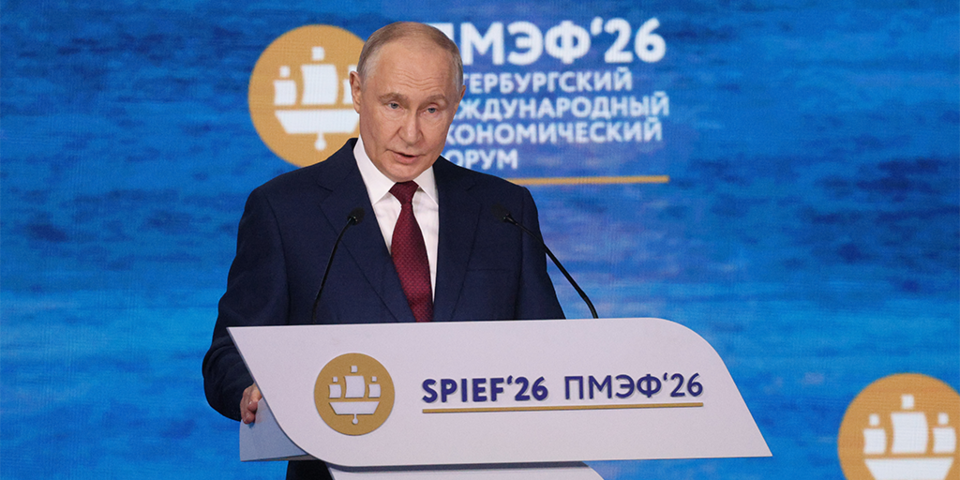
While comments from Russia’s top business leaders and officials indicate growing concern about the state of the economy, Putin’s anticipated speech at the forum brushed off economic concerns. In his plenary address, Vladimir Putin presented a familiar narrative of resilience. He emphasized technological sovereignty, artificial intelligence, digital platforms, industrial modernization, and Russia’s adaptation to sanctions. He argued that the Russian economy continues to grow despite external pressure and portrayed the country as a leader in building a more balanced and fair international economic order.
He devoted a significant portion of his speech not to Russia’s domestic challenges but to criticizing the West, particularly the European Union, which he accused of undermining global security and economic stability. In contrast, he highlighted the economic achievements of non-Western states such as India, Tanzania, and Uzbekistan.
Putin stressed the global confrontation, juxtaposing the West- primarily the G7 countries – as one side and, as he put it, “our BRICS alliance” as the other. According to Putin, the West is gradually losing influence in the global landscape, while BRICS is growing stronger year by year.
To support his arguments, the Kremlin leader cited numerous expert assessments, but without taking into account relevant context. He, for instance, noted that the BRICS countries had contributed 49% to global GDP growth over the past five years, compared to 18% for the G7 countries. He also stressed, that by the end of the decade, growth rates in the G7 countries are expected to reach “at best” 1.5% per year, whereas BRICS countries are projected to average 4%. BRICS members are indeed outpacing G7 members in terms of their contribution to global economic growth. However, it is common knowledge that rates in mature economies, commonly referred to as developed economies, are bound to be lower than in developing economies as the latter simply have more room for growth.
Putin argued that many countries are reducing their exposure to Western financial systems and shifting to national currencies out of fear of sanctions and asset freezes similar to those imposed on Russia. While BRICS countries have indeed expanded the use of national currencies in trade with one another, the broader global picture remains very different: the U.S. dollar continues to dominate international payments, accounting for more than half of global transactions by the end of 2025 according to SWIFT data, far ahead of the euro, pound, yen, and Chinese yuan. In this context, Russia’s push for settlements in rubles and its growing reliance on the yuan seem less like leadership of a global trend and more like a pragmatic adjustment to the constraints imposed by Western sanctions.
The central theme of Putin’s address was sovereignty- political, economic, technological, and financial. Putin referred to what he described as a global “race for sovereignty,” arguing that Russia continues to strengthen its position despite external pressure.
The address largely avoided a serious discussion of Russia’s structural economic challenges. Putin cited Russia’s GDP performance relative to Europe and its low unemployment rate of 2.2% as favorable indicators. While he acknowledged that economic growth has become “moderate”, he underscored that Russia merely came down to the EU level: “‘…We have now reached the level at which many eurozone countries have been living for years.” In 2026, the European Commission expects growth of 1.1%, following growth of 1.5% in 2025. In Russia, however, growth will be weaker. Not to mention that, again, comparable growth rates for the developed EU economy and the developing Russian economy are no cause for optimism. As for the unemployment, Putin’s narrative omitted the fact that it was the huge losses (around half a million killed and the emigration of hundreds of thousands of Russians due to the war (including many young, highly educated professionals, particularly those in technical fields) that caused labor shortages.
Against this backdrop, Putin’s remarks underlying the importance of education, knowledge, and skilled labor sounded particularly contradictory. They came amid an ongoing campaign at Russian universities and colleges as students are being recruited to fight in the war in Ukraine and amid persistent reports of deceptive recruitment practices, both in Russia and abroad. Equally ironic was Putin’s assertion that business requires predictability and a stable investment climate while he also made it abundantly clear that he’s set on continuing the war during his speech.
Putin also highlighted increasing federal transfers to Russia’s regions while omitting the extent to which many regional budgets have been burdened by hefty compensation payments related to military casualties, which they finance.
Putin’s address sought to reassure both domestic and foreign audiences that Russia has successfully adapted to sanctions and remains capable of long-term development. References to artificial intelligence, autonomous systems, infrastructure, and innovation formed part of a broader message that Russia is not merely enduring external pressure but positioning itself for future technological competition.
Yet many external observers point to a significant discrepancy between this narrative and underlying economic realities amidst the 5th year of the war with Ukraine. Russia’s recent growth has been heavily driven by military spending and defense production, while inflationary pressures, labor shortages, technological restrictions, and dependence on wartime fiscal stimulus continue to create structural vulnerabilities (read more here). For many analysts, the Kremlin’s messaging therefore appears less a reflection of economic strength than an effort to project confidence despite mounting challenges.
Conclusion
SPIEF continues to function as a major diplomatic and economic spectacle through which Moscow seeks to demonstrate resilience, leadership of a multipolar order, and attractiveness to non-Western partners. Yet the 2026 forum exposed the contradictions facing contemporary Russia.
The event showcased a country eager to present itself as an indispensable global power, but one whose international audience is increasingly concentrated in the Global South; a state proclaiming economic strength while confronting sanctions, inflation, labor shortages, serious demographic problems, and wartime distortions; and a government projecting strategic confidence even as Ukrainian drones reached the vicinity of its most important international gathering.
In this sense, SPIEF 2026, which took place against the background of Ukrainian drone attacks, may be understood less as evidence of Russia’s rising influence than as a carefully staged effort to manage perceptions of decline, vulnerability, and international isolation.