



Author: Khatia Davlianidze, UGSPN Research Fellow
Winners & Losers
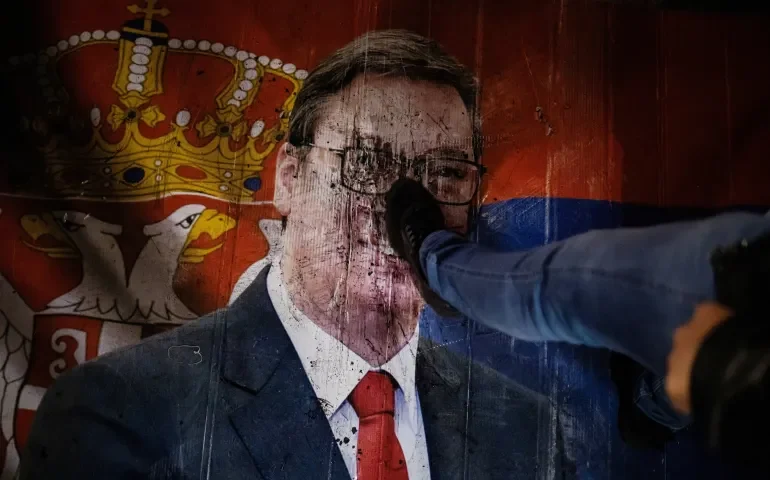
Following the October 25 parliamentary elections in Serbia, Aleksandar Vučić’s 14-year rule has come to an end. The opposition “Student List” won 53% of the vote (2 354 417 votes), while the ruling “Progressive Party” received 39% (1 731 323 votes).
For details on the pre-election environment, main political alliances, and campaign, see “Serbia’s Historic Parliamentary Elections – The End of Vučić?“
Ivica Dačić’s “Socialist Party” suffered a collapse in the elections. Founded in 1990 by Slobodan Milošević, the alliance failed to cross the 3% electoral threshold and remains outside the legislature for the first time in modern Serbian history.
It is worth noting that pro-European, left-green, and conservative groups, along with some ethnic minority factions, refused to run independently and openly supported the “Student List.” Opposition forces that refused to unite also found themselves outside the legislature. Among them were the “Authentic Rightists” coalition (whose leader resigned after receiving less than 1% of the vote) and the pro-European block “Platform for a European Serbia” (Dragan Đilas’s “Party of Freedom and Justice” + Zdravko Ponoš’s “Serbia Center” + Goran Ješić’s “Solidarity”).
Ultimately, parliamentary mandates were secured by only two political alliances: the “Student List” and the “Progressive Party”, as well as national minority lists. It is worth noting that minority lists are exempt from the standard 3% electoral threshold and manage to secure 1 mandate under “natural threshold” conditions (approximately 0.4%-0.5% of the vote under the D’Hondt system).
As a result of the October 25 elections, it can be said that the “Student List” not only defeated the ruling party but also relegated Serbia’s obsolete opposition flank to the past.
Who will lead the new government?
Following the announcement of the official results of the October 25 parliamentary elections, the newly elected MPs have 30 days to form a government (if necessary, this period may be extended up to 90 days). The movement must select a candidate from its own ranks who will become Prime Minister and assemble the cabinet of ministers. Notably, more than half of the movement’s 250-candidate list comes from the academic sphere and, consequently, lacks political experience.
Unlike Hungary’s “Tisza,” where Péter Magyar was the clear leader, the “Student List” conducted its pre-election campaign without a central figure; therefore, there is no pre-designated candidate for the head of government post.
Currently, two main figures are being considered for the Prime Minister’s post: Ilija Srdanović – a cardiologist, professor at the University of Novi Sad, and top candidate on the “Student List”, and Dejan Šoškić, former governor of the National Bank of Serbia and professor of economics at the University of Belgrade (as an alternative to the premiership, he is considered the main favorite for the post of Minister of Finance due to his extensive experience working in international financial institutions). Reports in the media also point to a third figure – basketball legend and current EuroLeague president Dejan Bodiroga; however, due to existing commitments in sports management and a lack of political experience, his appointment as Prime Minister is unlikely.
According to Ilija Srdanović, the most realistic candidate for the premiership, the new government will not deviate from its course of European integration and will fully align domestic policy with the European Union’s standards for the rule of law and human rights. Srdanović states that the “Student List” unconditionally supports constructive dialogue with Kosovo and respect for international obligations. At the same time, the movement considers Kosovo an integral part of Serbia and rules out the recognition of its independence. Speaking on the principles of assembling the cabinet of ministers, Srdanović explains that the process will be carried out entirely within the legal framework, and key positions will be chosen collectively by the majority of MPs.
What processes are currently taking place in Serbia?
Currently, the political transformation is most clearly reflected in the Serbian media landscape. Media outlets that served as Aleksandar Vučić’s propaganda base for years have sharply altered their editorial policy. The changes have also affected the Serbian public broadcaster, which issued an official apology to viewers for years of biased coverage, and the channel’s general director resigned from his post.
According to reports, the “Student List” has maintained communication for some time with individuals working in the police and public administration who opposed the Vučić regime. The new political force calls on law enforcement officers and judges to act strictly within the framework of the law or leave their positions. In addition, an appeal was made to whistleblowers to immediately publicize violations if the former government attempts to “destroy documentation” during the transfer of political power.
Law enforcement officers have already arrested Davor Macura, the owner of the private financial institution Alta Bank and an individual closely connected to the “Progressive Party.” He is charged with abuse of authority. Macura was detained while attempting to illegally transfer millions of dollars of capital out of the country (the bank’s supervisory license has also been revoked). Additionally, Vučić’s former head of the criminal police, Marko Kričak, and the head of the Anti-Crime Service, Boško Sekulović, were arrested on charges of abuse of official power; Kričak’s name is also linked to high-profile individual cases, including a scandal involving threats of rape against a female student during protests. Furthermore, a Belgrade court remanded into 30-day pretrial detention nine active and one former employee of the Ministry of Internal Affairs (including the commander of the Special Anti-Terrorist Unit, Igor Zmirić, and acting detention center director Milan Vuković), whom the prosecution accuses of premeditated violence, torture, and abuse of power committed against students and other individuals in a government building following the August 2025 protests.
The public focus is on cases of elite corruption that were “shelved” by the “Progressive Party,” including the investigation into the tragedy at the Novi Sad railway station on November 1, 2024. Currently, Serbian society awaits the reopening of these frozen cases and the punishment of those responsible. Concurrently, an unprecedented number of complaints are being submitted to the prosecutor’s office. These cases pertain to both electoral manipulations and the persecution of and pressure exerted on demonstrators, journalists, and activists.
Vučić’s Plans
Despite his defeat in the October 25 parliamentary elections, Aleksandar Vučić – now referred to as the opposition leader, actively continues to appear in media outlets still loyal to the “Progressive Party,” where he accuses the student movement of “revolutionary terror” and vows political revenge.
Speaking on the TV Pink channel, he stated that the current situation is quite difficult for his family and supporters, but noted that he is ready for any difficulties and will endure everything. Vučić categorically denies any connection to criminal groups and declares that he is not afraid of a potential investigation and possible arrest. He claims that law enforcement will find nothing against him because he never signed illegal documents and no evidence exists against him.
Although Ilija Srdanović, the top candidate of the “Student List,” assesses that Aleksandar Vučić’s era has ended and he has passed into history following the election defeat, the ex-president does not plan to leave the political arena. He openly stated that he intends to return to power, though he acknowledged right away that this will be impossible in the near future. Vučić still retains a key role in the “Serbian Progressive Party” and, parallel to transitioning into an opposition regime, announces the complete renewal and restructuring of party structures. The former president and his comrades claim that they will establish themselves as a strong opposition and attempt to quickly regain power after the new rulers “destroy the country.”
At the same time, expectations are growing in society that legal processes will soon begin directly against Vučić as the chief architect of Serbian autocracy. However, a particular challenge is gathering sufficient evidence on specific charges, especially given that the ex-president will attempt to exploit every possible flaw or legal loophole in the Serbian justice system.
A further serious blow for Aleksandar Vučić and the “Progressive Party” will be the presidential elections scheduled for December of this year. Following the convincing success achieved in the parliamentary elections, the “Student List” plans to offer society a unified and highly authoritative presidential candidate, with Dejan Bodiroga considered the main favorite. For its part, the “Serbian Progressive Party” is in a deep political crisis, constitutional restrictions do not allow Vučić to run for a third term, and amidst internal party disintegration and the loss of electoral support, the party has no chance of winning. Therefore, expectations are high that the “Progressive Party” will boycott the December presidential elections.
Conclusion
The October 25 parliamentary elections brought Aleksandar Vučić’s 14-year rule to an end, yet the victory of the “Student List” is merely the first step on a path fraught with challenges.
Vučić’s network of “loyal servants” remains deeply entrenched in state institutions and at every level of the system, making its dismantlement a complex and lengthy process, especially considering the lack of political experience among the members of the “Student List.”
Despite the anticipated difficulties and obstacles, the fact remains that following the opposition’s victory, Serbia holds a unique opportunity for democratic reset, fundamental change, and political transformation.
This article was translated from the original language with the assistance of AI tools and revised by the author.