



Author: Khatia Davlianidze, UGSPN Research Fellow
(The original version in Georgian was published on October 22)
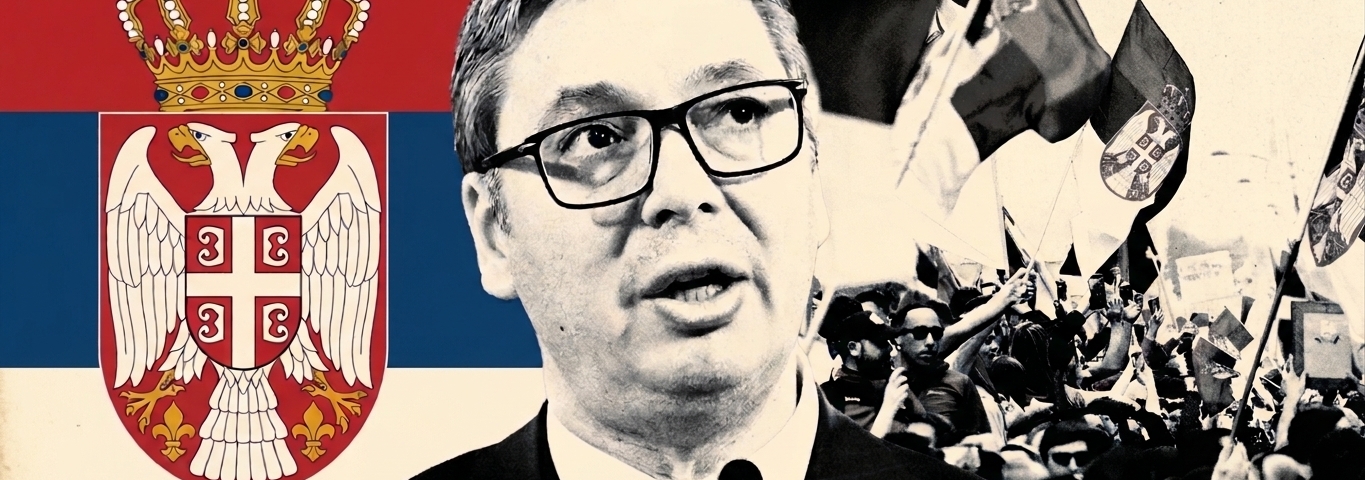
In September of this year, President Aleksandar Vučić dissolved the National Assembly and scheduled early parliamentary elections for October 25.
According to the Constitution of Serbia, holding the office of the president for a third term is not permitted, therefore, Vučić will no longer be able to run in the 2027 presidential elections. To maintain political power, he voluntarily stepped down from the presidency and began his campaign to become Prime Minister.
Beginning of the Political Crisis and Student Protests
The scheduling of early parliamentary elections occurred against the backdrop of the largest political crisis in Serbia’s recent history.
The protests followed the collapse of a concrete structure at the Novi Sad railway station on November 1, 2024, which claimed the lives of 16 people. Demonstrations initially began in the city of Novi Sad, but soon engulfed the entire country.
Students represented the main driving force behind the protests, initially demanding the public release of the station’s rehabilitation documentation, an objective investigation, and the punishment of those responsible for the tragedy. However, after the authorities initiated legal prosecution and used forceful methods against the demonstrators, the movement demanded the resignation of Aleksandar Vučić and the scheduling of early parliamentary elections.
To diffuse the situation, President Vučić put forward the idea of holding an advisory referendum on his governance, but the students rejected the offer. Amid rising tensions, Prime Minister Miloš Vučević resigned in January 2025, and a new cabinet led by Đuro Macut was approved in April.
Snap Elections as the Ruling Party’s Key Tactic and the Opposition Flank Prior to the Student Movement
Since the Serbian Progressive Party came to power in 2012, the country has been engulfed by several large-scale waves of protests. Despite this, the ruling force always managed to defuse crises successfully by scheduling early parliamentary elections.
Over its 14-year rule, the Progressive Party established full control over political institutions, the media, and administrative resources, eliminating the regime’s fear of electoral defeat. In the absence of a serious rival, early elections became the primary tool for re-consolidating power.
This systemic advantage was further reinforced by the chronic weakness and fragmentation of Serbia’s traditional opposition. Since 2018, the opposition attempted to unite against Vučić several times, but coalitions quickly collapsed due to ideological disagreements and personal interests.
The 2023 parliamentary elections demonstrated that a party alliance alone is not enough. Tired of the promises of existing political parties, voters are searching for a completely new alternative.
Structure and Vision of the Student List
On September 15, 2026, after the Electoral Commission officially registered the “Student List – Students Win” (with 69,099 valid signatures and 250 candidates), the movement that had emerged from street protests and university blockades officially became an electoral entity.
The idea of creating the movement arose in May 2025, when students demanded early elections due to the authorities ignoring the protesters’ demands. The “Student List” is based on the principles of direct democracy (university plenums), and its main goal is to defeat the authoritarian regime and liberate the state captured by Vučić. This is not a classic opposition alliance, as their priority is not to seize political power, but to restore the normal functioning of institutions, implement fundamental legal reforms, and establish a competitive political environment. The 11-point electoral program of the “Student List” covers three main areas: fighting corruption and ensuring judicial independence, fundamental reform of the education system, and social policy.
By decision of the students, neither students themselves nor professional politicians were included on the list. It was composed of rigorously selected domain experts, members of academia, civil society activists, and medical doctors. The list is headed by Ilija Srdanović, a prominent cardiologist and professor at the Faculty of Medicine at the University of Novi Sad. The main condition for candidacy was that the individual must not have been a representative of the ruling party or a leader of any opposition alliance.
It is worth noting that unprecedented consolidation was achieved around the students – pro-European, left-wing green, and conservative parties (both parliamentary and non-parliamentary), as well as associations of ethnic minorities (Hungarians, Romanians, Montenegrins), refrained from running independently and declared their open support for the “Student List.”
Pre–Election Environment
The October 25 parliamentary elections are conducted under a proportional representation system (with a 3% threshold and closed lists), where seats will be allocated using the D’Hondt method. According to assessments by local and international observers (including CRTA), the pre-election environment is unfair and sharply polarized. The ruling Serbian Progressive Party completely controls financial, media, and administrative resources (its 2025 revenue exceeded €9.8 million), while the crowdfunding-dependent “Student List” operates under severe constraints.
According to CRTA monitoring, every third activity of the government’s campaign involves elements of manipulation and violations of law, including signature forgery, abuse of state apparatus, and voter buying (including offers of money or employment), confirming that the line between the ruling party and the state has effectively been erased.
In addition to institutional advantages, there is a media blockade and disinformation. The ruling force dominates public broadcaster RTS and national television stations, whereas the opposition receives half as much airtime (only 15% on RTS).
According to information published in pro-government online media, political unrest and escalation of the situation are expected on election day. Furthermore, the opposition is portrayed as the organizer of a “color revolution” and the overthrow of the state’s constitutional order.
Concurrently, the government refers to independent monitoring organizations (including CRTA) as foreign intelligence projects and actors of influence. In addition, the pre-election period is characterized by digital repression and electoral engineering of unprecedented scale. CRTA, Citizen Lab, and the SHARE Foundation confirmed that Serbian security services used Israeli-made Pegasus spyware against opposition members and student movement activists, prompting criminal lawsuits.
By decision of the Serbian Electoral Commission, voters living abroad must vote according to Central European Time (CET), shifting voting hours to nighttime locally (e.g., in the US and Australia). Beyond moving voting hours to the night, polling stations were not opened at all in many places with sufficient numbers of registered voters. This step was evaluated as discrimination against Serbian citizens living abroad and an artificial neutralization of diaspora votes supporting the “Student List.”
In response to government pressure, the media blockade, and digital manipulation, the “Student List” launched a completely unique campaign. Students walked more than 1,000 kilometers on foot and went door-to-door through Serbia’s regions, small towns, and villages, places that were never previously targeted by election campaigns. The movement devoted special effort to direct communication with older generations of voters who lack access to alternative information.
Moreover, to prevent anticipated large-scale fraud, the students built a robust monitoring network by mobilizing citizens and training observers to cover every polling station in the country.
Expectations and Post-Election Perspectives
Serbia approaches the October 25, 2026 parliamentary elections amid unprecedented political mobilization and extreme polarization. Following nearly two years of continuous protests, the authoritarian regime and the student movement will face off directly.
For the first time since 2012, the regime faces a real and formidable alternative in the form of the “Student List.” According to pre-election polls, parliamentary seats are likely to be secured by three political forces: the ruling coalition “United Serbia,” the “Student List,” and Ivica Dačić’s “Socialist Party.” As for other opposition lists – Dragan Đilas and Zdravko Ponoš’s “European Serbia” and the “National Democratic Alternative” – they will most likely fail to cross the 3% threshold.
According to data from NSPM and CRTA, the rating of the “Student List” ranges between 39% and 44%, which often equals or even exceeds that of the “Progressive Party” (35%-45%). Even in data from pro-government agencies (e.g., Faktor Plus), where the ruling force maintains 47%-48%, the Student List enjoys remarkably high support (37%).
In none of the parliamentary elections held so far has there been a real chance for political change. In the 14-year rule of the “Progressive Party,” this will be the first parliamentary election where the regime faces a powerful competitor, creating a real prospect for its defeat.
What Will the Opposition’s Victory Change?
The opposition’s victory will give Serbia a real chance for institutional democratization. With the end of the Progressive Party’s 14-year rule, the likelihood will increase that state-captured political institutions will gradually be liberated from governmental pressure, and the media landscape will become more pluralistic and depoliticized. Furthermore, the country will have the opportunity to begin combating systemic corruption and put an end to the multi-year practice of intimidating and persecuting journalists, civil activists, and members of the opposition.
Given the systemic problems existing in Serbia, a pro-European government will face a number of serious challenges, and implementing fundamental reforms will not be easy. However, a change in government will give the country a chance to initiate these reforms, a prospect that certainly does not exist under Vučić’s rule.
A change in power will directly impact the consolidation of the country’s pro-Western course. Serbia has held EU candidate status since 2012, and accession negotiations formally began in 2014. Despite this, out of 35 chapters, only 22 have been opened to date, of which only two have been successfully closed. Due to state capture and divergence from foreign and security policy, European integration is effectively frozen, however, in the event of a government change and the approval of a pro-European government, the process will resume and move into an active phase.
The main prerequisite for EU accession is reaching a comprehensive agreement with Kosovo and the normalization of relations. EU-mediated negotiations have been ongoing since 2011, but due to domestic political crises and failure to fulfill undertaken obligations, the Belgrade-Pristina dialogue has failed to achieve tangible progress. An opposition victory will significantly increase the prospect of normalizing relations with Kosovo.
In addition to ending years of autocratic rule in the country, a change in power will also put an end to the Progressive Party’s multi-vector foreign policy, which involves strategic maneuvering between the West and Russia-China. By ending political flirting with Vladimir Putin and Xi Jinping and shifting to a clear pro-Western course, the Kremlin will lose Serbia as an instrument for expanding its political influence in the Balkan region, which would be a serious geopolitical blow to Russia.
This article was translated from the original language with the assistance of AI tools and revised by the author.