



Author: Revaz Topuria, Research Fellow
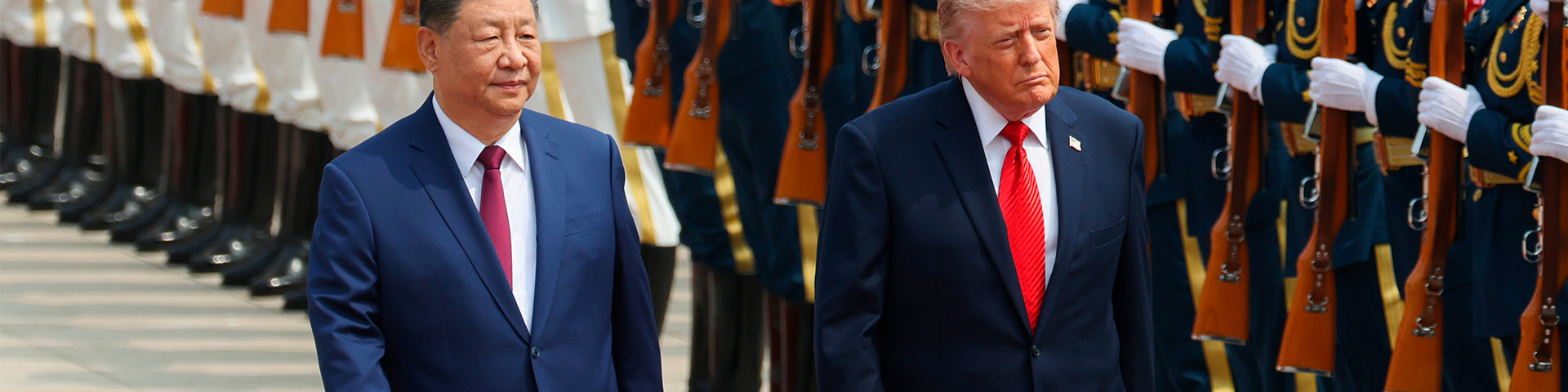
On the morning of May 14, 2026, Air Force One landed at Beijing International Airport. Chinese President Xi Jinpingwelcomed the American guest with an honor guard and a level of ceremonial grandeur that Beijing usually reserves only for moments destined for history books. For his part, Donald Trump did not hold back on respect either, spending the first moments lavishly praising Xi, even telling Fox News that Xi is such an impressive figure that even Hollywood would struggle to find someone worthy of portraying the Chinese leader. However, behind this diplomatic exchange, many significant details emerged during the summit.
First of all, the composition of the American delegation was particularly noteworthy. Alongside senior administration officials such as Secretary of State Marco Rubio (whose name Chinese bureaucrats slightly altered so that he could enter Beijing despite a previously imposed ban), Defense Secretary Pete Hegseth, Treasury Secretary Scott Bessent, and Trade Representative Jamieson Greer, Trump brought an unusual lineup of corporate America to China. The summit was attended by Elon Musk together with his child; Jensen Huang was added to Xi’s meeting at the last moment after a personal phone call from Trump; the delegation also included Tim Cook, as well as Cristiano Amon of Qualcomm, Sanjay Mehrotra of Micron, Kelly Ortberg of Boeing, Larry Culp of GE Aerospace, and altogether seventeen business leaders. The delegation was intentionally assembled to send a specific signal — the United States arrived in China not only as a government, but also as an economic superpower.
Sixty-three hours later, Trump and his delegation departed for Washington. While the ceremonial side of the visit was indeed exceptional, its tangible results for the United States were considerably more modest.
What was on the negotiating table and what did the sides achieve?
Trade: The Three Bs and Tariffs
One of the summit’s central issues was clearly trade. The abbreviated formula for U.S. trade priorities was the “three Bs”: Boeings (aircraft), beef, and (soy)beans. Trump claimed success in all three areas, asserting that China agreed to purchase at least 200 Boeing passenger aircraft (during Trump’s 2017 Beijing visit, China had agreed to buy 300 Boeing planes, although that agreement later collapsed amid deteriorating bilateral relations). Trump additionally announced that China would buy large quantities of American agricultural products, including soybeans. On this issue, Trade Representative Greer added that he expected Beijing would soon undertake commitments worth several billion dollars to purchase American agricultural goods.
However, despite Trump’s statements, communiqués released by the Chinese authorities did not confirm the Boeing purchases. At the same time, Treasury Secretary Bessent acknowledged that soybean purchase commitments were largely already included in the previous Busan truce, under which China had already pledged to buy no less than 25 million metric tons of American grain over three years beginning in 2026.
It had been expected that, at minimum, the parties would discuss revising the tariff architecture in order to extend the Busan truce. However, the summit produced no progress in this regard. The sides noted that a plan was being discussed for the gradual reduction of tariffs on approximately thirty billion dollars’ worth of Chinese goods from non-critical industries, but a final agreement would likely require several months of administrative work.
Taiwan
Perhaps one of the summit’s most important issues is precisely the one the American side officially speaks about the least. According to Chinese state media, Xi directly told Trump that Taiwan is the most important issue in U.S.-China relations and warned that if mishandled, the two countries could end up in conflict. Xi added that Taiwanese independence is fundamentally incompatible with peace in the Taiwan Strait. This statement is significantly sharper than Beijing’s standard wording.
Notably, the White House communiqué does not mention Taiwan at all. Rubio, seeking to reduce concerns in Taipei and among American allies, told NBC News that “America’s Taiwan policy remains unchanged today.” But the real dynamics became apparent only after boarding Air Force One. The president stated that Xi had directly asked him whether the United States would defend Taiwan during a military conflict, to which Trump responded that he “doesn’t talk about that subject.” The U.S. president also confirmed that he is still considering whether to proceed with the planned $14 billion arms package for Taiwan. This package includes advanced air defense systems and missile sales to Taiwan, which China strongly opposes, arguing that American arms deliveries to Taiwan violate Beijing’s “One China” principle and increase the risk of military confrontation. Taiwan itself, meanwhile, views the package as a critically important deterrent factor, especially amid China’s growing military activity around the island. According to Trump, he made no commitments to Xi on this issue. However, in a Friday interview with Fox News, he also stated that Taiwan should refrain from officially declaring independence.
It is difficult to determine precisely how U.S.-Taiwan relations will continue, but it is clear that Beijing now felt confident enough to speak to the United States about Taiwan in a much more aggressive tone, while receiving only ambiguity in response from Trump. This undoubtedly works in Xi Jinping’s favor.
Iran and the Strait of Hormuz
The Iran conflict was one of the topics discussed at the summit, though it produced little substantive outcome. Trump confirmed that the Iran issue had been discussed and stated that both leaders equally desire the end of the conflict and the reopening of the Strait of Hormuz. Beyond this, no significant statements regarding Iran were made. At the same time, Rubio told NBC that “the United States is not asking for Beijing’s assistance on the Iran issue.” Before the summit, reports had circulated that one of Trump’s priorities would be to pressure Beijing to exert influence on Iran; Rubio’s statement seems aimed at dispelling that earlier narrative after an unsuccessful attempt.
On this issue, China’s Foreign Ministry stated that “the conflict should never have happened,” referenced Xi’s four-point peace proposal, and portrayed Beijing as a responsible actor without taking any concrete commitments. As a result, it is unsurprising that no statement was made regarding the removal of sanctions on Chinese companies purchasing Iranian oil — something Trump had hinted at before the summit.
Artificial Intelligence
One genuinely new issue on the agenda was artificial intelligence (AI). Bessent noted that both sides discussed creating emergency communication protocols to ensure that non-state actors would not be able to use powerful AI systems for harmful purposes. This is an important, though small, first step: AI had never previously been officially discussed at U.S.-China presidential summits. No formal agreement was announced this time either, but the signal that the two superpowers view AI not only through the lens of competition, but also as an area requiring safeguards against potential risks, is clearly positive and represents a highly important message.
The Summit’s Results – Who Benefited More?
Evaluating the summit’s results requires looking beyond official statements and the hyperbole characteristic of the U.S. president, and instead analyzing the broader picture. Although Trump describes the visit as historic, it is evident that Xi Jinping emerged from the summit in a far stronger position than before it began.
The Chinese leadership has repeatedly spoken about the need to transform the unipolar world order and expand China’s role within a new global system. Amid the new U.S. administration’s isolationist policies and strained relations with European allies, Xi seized the moment to demonstrate that China no longer needs validation from the United States. More than that, China is now trying to establish itself not only as a manufacturing superpower, but also as a technological and scientific superpower. One analyst from Foreign Policy even argues that, for the first time in meetings between the two sides, it was not China but Trump personally who was seeking validation, hoping to present the meeting with Xi as a major success for his domestic audience.
To understand the summit’s significance for China’s global image, it must be placed in a broader context. During the current year alone, Xi has already hosted the President of France, the prime ministers of Canada and Britain, and the Chancellor of Germany in Beijing. Each visit reinforced the same signal: the global order is in the process of shifting, and Beijing is increasingly occupying a central position within it. Trump’s arrival in China, accompanied by a delegation composed of Silicon Valley and corporate America’s most recognizable figures, fit organically into this broader narrative. Whatever Trump intended by bringing Musk, Huang, and Cook to Beijing, for Chinese audiences it was perceived as confirmation of Beijing’s central role in the global economic order.
Beyond the visual effect, Xi also emphasized China’s expanded role through terminology. The Chinese president first employed new and harsher language regarding Taiwan, and then introduced the term “constructive strategic stability” to describe a new framework for U.S.-China relations. According to analysts, this underscored that China now views itself as an equal player to the United States.
Ultimately, it can be said that the summit was successful for China. Xi secured his propaganda victory: the sitting American president traveled to Beijing, generously praised him, did not publicly criticize China over Taiwan or human rights, China did not have to undertake any new obligations, and Beijing introduced the new framework of “constructive strategic stability” to present itself as America’s equal within the global order. The United States, meanwhile, received a friendly atmosphere, promises regarding Boeing aircraft purchases (on terms slightly worse than those of 2017), and an agreement on AI risk protocols, whose full scope remains difficult to assess for now.
Xi will visit the United States in the autumn with a noticeable advantage, while the American side will require greater effort to achieve better results during the next meeting.
This article was translated from the original language with the assistance of AI tools and revised by the author.