



Author: Nata Koridze, UGSPN Senior Research Fellow
The Black Sea has become one of the most dangerous maritime regions in the world. Alongside sustained Russian attacks on Ukrainian ports, attacks on commercial shipping have increasingly extended to waters near the coasts of NATO and EU members Romania and Bulgaria. On September 16, the entire Black Sea basin, excluding the territorial waters of Turkey, Romania, Bulgaria and Georgia, has been designated a high-risk area by the Joint War Committee. Yet, on October 14, a Comoros-flagged tanker, Yara J, was attacked by drones in Romanian territorial waters off the country’s Black Sea coast. That same night, fires broke out aboard two other vessels in Romanian territorial waters, reportedly caused by drone strikes. Early on 15 October, the San Marino-flagged chemical tanker Wine Trader while being near Romania’s territorial waters, requested assistance after a fire broke out on board. Seven of its 12 crew members remain missing. In total, seven ships have been hit along the same coastline in October alone, with 27 crew members confirmed dead or missing at sea.
The attacks are widely believed to have been carried out by Russia, and the vessels targeted appear to have been engaged in trade with Ukraine. Their apparent objective is to disrupt Ukraine’s maritime exports, particularly grain and other agricultural products. Bulgaria, too, has not been spared, despite its Prime Minister’s calls for the restoration of economic ties with Russia and the country’s withdrawal from the Coalition of the Willing supporting Ukraine.
The consequences extend well beyond the immediate damage to vessels and the loss of human life. Maritime insurance rates have soared, while seafarers are increasingly reluctant to enter the Black Sea basin. This has contributed to a sharp decline in the number of ships visiting Ukrainian ports, including vessels that do not have Ukraine as their final destination. More broadly, since the beginning of Russia’s full-scale invasion of Ukraine in 2022, more than 60 seafarers have lost their lives in attacks on commercial shipping. The majority of these incidents occurring over the past year.
Russia’s justification for these attacks, based on alleged arms shipments to Ukraine through the Black Sea, lacks credibility, as there is no publicly available, independently verified evidence establishing that Western military assistance is being delivered directly to Ukrainian Black Sea ports by sea.
Why is Russia targeting civilian vessels in the Black Sea?
The attacks serve several interconnected strategic purposes. First, they undermine Ukraine’s ability to export agricultural products and maintain access to international markets, adding further pressure on an already war-strained economy. By threatening commercial shipping and the maritime routes on which Ukrainian exports depend, Moscow can weaken an important source of revenue and impose economic costs on Kyiv beyond the battlefield.
Second, the attacks extend the economic consequences of the war beyond Ukraine. Disruptions to Ukrainian grain exports or even a heightened perception of risk to commercial shipping can unsettle international supply chains and aggravate food insecurity, particularly in countries heavily dependent on imports from the Black Sea region. In this way, maritime insecurity becomes a means of putting pressure not only on Kyiv but also on its international partners and other countries with a direct stake in the continuity of Black Sea trade.
Third, the attacks near the coasts of Romania and Bulgaria carry a strategic message to NATO and EU members. By bringing the consequences of its war closer to the territorial waters of NATO member states, Moscow tests their capacity and willingness to respond, while exposing the limitations of existing regional security arrangements. The incidents also serve as an instrument of hybrid warfare against these states, creating uncertainty, raising the economic costs of maritime trade and undermining confidence in the safety of commercial navigation. This maritime pressure should be viewed within the wider regional context of Russia’s military and hybrid activities across the Black Sea region. These include its 2008 invasion of Georgia and continued occupation of Georgian territories, including Abkhazia on the Black Sea coast, as well as its interference and influence activities in the region.
Finally, the deteriorating security environment provides Russia with a potential instrument of geopolitical leverage over European states, all of which have a stake in freedom of navigation and stability in the Black Sea. By raising the costs and risks of maritime trade, Russia may seek to influence European responses to the war and shape the conditions of any future negotiations over Ukraine and the wider regional security order.
The cumulative effect is particularly significant: it is not only the sheer number of attacks, but also the emerging pattern of targeting civilian merchant vessels that raises serious concerns under international law and increasingly resembles a campaign of maritime intimidation, making the commercial navigation in the Black Sea more costly and dangerous.
The attacks have prompted strong reactions within the OSCE, EU and NATO have fueled public concern in the region. On 20 October, protesters gathered in Sofia, under the slogan “Your peace is capitulation!” and demanding clarification over the recent maritime incidents. Bulgarian Prime Minister Rumen Radev called on the EU and NATO to support efforts to ensure security in the Black Sea.
NATO, EU and the Black Sea
Both the EU and NATO have a direct stake in Black Sea security. Yet, for decades, both organizations were slow to articulate a coherent vision or strategy for the region, which remained relatively low on their respective agendas. It took Russia’s full-scale invasion of Ukraine in 2022 for both organizations to fully recognize the Black Sea’s significance within the broader European security architecture.
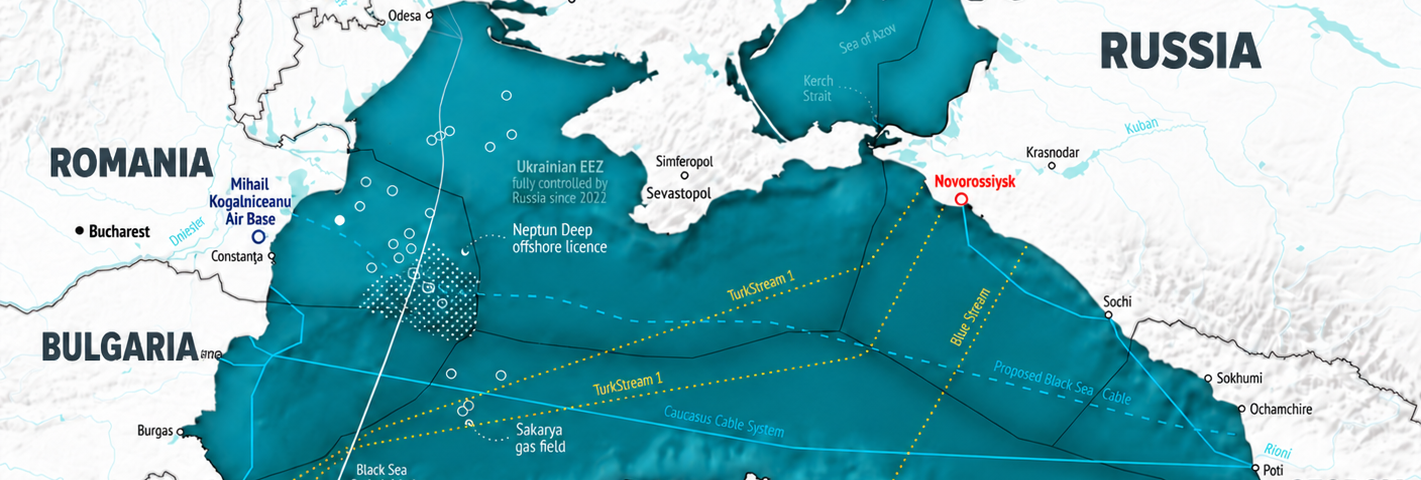
In addition to the hard security dimension, the Black Sea region is important for the EU’s energy security and connectivity. For example, the Black Sea Submarine Cable is a planned high-voltage connection within the EU’s Global Gateway initiative that would link Azerbaijan’s renewable energy sector to the EU via Georgia and Romania. The Black Sea also hosts Romanian offshore gas fields and significant offshore wind potential. Furthermore, the Black Sea remains critical to the economies of EU members Romania and Bulgaria, as well as candidate states Ukraine, Moldova and Georgia.
Despite its growing ambitions, however, the EU lacks the naval capabilities necessary to ensure maritime security in the basin and continues to rely on NATO in this area. Turkey, an indispensable regional partner, is not an EU member and has its own strategic sensitivities regarding the Black Sea, adding another layer of complexity to the Union’s engagement.
Following Russia’s invasion of Ukraine, the Union has increasingly come to view the region as a vital strategic frontier. Nevertheless, while the EU’s 2025 Black Sea strategy finally acknowledged its strategic importance, it fell short of establishing an operational security framework. Instead, it placed greater emphasis on societal resilience, combating disinformation and countering hybrid threats. The war, the deteriorating security environment and, in particular, the recent Russian drone and missile strikes against commercial shipping near and within Romanian and Bulgarian territorial waters have further heightened security concerns across the bloc.
On 20 October, addressing the European Parliament in Strasbourg, EU foreign policy chief Kaja Kallas stated that intensified attacks by Russia on Ukrainian export routes, targeting Black Sea and Danube ports, vessels, agricultural infrastructure, border crossings and grain storage facilities are a “dangerous escalation”. She identified three priorities for the EU response: maintaining Ukraine’s access to international markets, strengthening maritime security and increasing diplomatic pressure to ensure freedom of navigation.
On 22 October, in the aftermath of the multiple deadly attacks against civilian merchant vessels, the European Parliament called on the EU to consider deploying a dedicated naval operation in the Black Sea. The EP resolution (passed with 432 votes in favor, 52 against and 88 abstentions) stressed that freedom of navigation and maritime security are essential not only for the Black Sea region and the Danube Delta, but also for the security of NATO’s eastern flank. It urged the EU to help Romania and Bulgaria track hostile drones using unspent funds from the SAFE instrument. It also called on NATO to consider a dedicated Black Sea initiative, emphasizing the need for both organizations to support Bulgaria and Romania and to accelerate the implementation of the EU’s Black Sea Maritime Security Hubs in Varna and Constanta. The European Parliament also criticized Bulgaria for its handling of the” Russian threat” urging Sofia to stop delaying its participation in NATO’s anti-drone initiative.
It is clear, that concerns over the deteriorating security environment extend beyond the immediate security of the littoral states. They also encompass critical undersea and energy infrastructure, including data cables, electricity transmission lines and submarine telecommunications networks. In response, Bulgaria, Romania and Turkey have stepped up practical cooperation, including through the Mine Countermeasures Black Sea Task Group. Its mandate was extended this year to include the protection of critical undersea infrastructure, including Romania’s Neptun Deep offshore gas field and Turkey’s Sakarya field. The European Defense Agency’s Maritime Surveillance (MARSUR) network plays an important role in facilitating the exchange of surveillance information among EU member states. Meanwhile, to improve coordination with NATO, the EU is advancing an Emergency Protocol, which also facilitates immediate political consultations with the Alliance, especially in case of so-called “gray-zone attacks”. These initiatives should complement the recently approved EU’s Eastern Flank Watch, aimed at strengthening the Union’s defense and security efforts.
As for NATO, the security of the Alliance’s eastern flank is increasingly exposed as the effect of Russia’s war in Ukraine spills over into the territorial waters of Alliance members Romania and Bulgaria. Following the latest incidents, the NATO Secretary General met with Bulgarian Prime Minister Radev and Romanian President Dan to discuss regional security, promising closer cooperation with the Black Sea allies and adjustments to NATO’s deterrence and defense posture.
NATO, in its 2022 Strategic Concept for the first time stated, that the Black Sea region is of the strategic importance to the Alliance. Since then the security environment in the sea has further deteriorated. Against the background of the intensified Russian attacks near Romania and Bulgaria, NATO announced on October 20 its intention to deploy additional maritime patrol aircraft, radar systems and drones to the Black Sea. Member states will also deploy intelligence personnel and expert teams to conduct forensic examinations of explosives used in the attacks.
The situation raises difficult questions about the implications for NATO’s collective defense commitments, including Article 5, particularly if attacks on civilian shipping result in further escalation or direct harm to the territory and security of allied states. Russia meanwhile is taking advantage of the relatively slow decision-making procedures within both organizations. Meanwhile, Ukraine, the actor with the greatest operational experience in countering Russian maritime and drone threats, has faced constraints resulting from temporarily restricted US access to early-warning intelligence and disruptions to its Starlink and Starshield satellite access. This further complicates the regional security picture and limits the capacity for an effective response.
Turkey’s Significance
Turkey occupies a particularly important, yet delicate, position in the Black Sea security equation. As a NATO member but not an EU member, it guards its role as the region’s principal gatekeeper, exercising authority under the 1936 Montreux Convention over the passage of warships through the Turkish Straits. Its policy combines a commitment to regional stability with pragmatic relations with Moscow and continued diplomatic engagement with Kyiv. Although relations between Moscow and Ankara have experienced serious tensions in recent years, including the 2015 downing of a Russian military aircraft by Turkey near the Syrian border and their differences over Russia’s treatment of the Crimean Tatars following the 2014 annexation of Crimea, Turkey has generally sought to manage its relationship with Russia rather than confront it directly. Having played a central role alongside the UN in brokering the 2022 Black Sea Grain Initiative, Ankara is again seeking to prevent escalation. It has called on both Russia and Ukraine to stop attacking commercial shipping and has warned that it reserves the right to take legal action if Turkish-flagged or Turkish-owned vessels are targeted. This reflects Turkey’s broader aim of preventing the conflict from destabilizing Black Sea trade while preserving its influence over the region’s security arrangements.
The Middle Corridor Factor
The deteriorating security environment in the Black Sea poses a potential challenge to the Middle Corridor project, whose strategic importance has grown since Russia’s full-scale invasion of Ukraine. The route provides an alternative to traditional trade routes running through Russia, connecting Central Asia with European markets through the Caspian Sea and the South Caucasus. However, its viability depends not only on infrastructure development and improved logistical coordination, but also on the security of the entire transit network, including its maritime component. The Middle Corridor remains exposed to external military threats, hybrid attacks and disruptions at critical transport nodes, yet the security aspect of its development has not received sufficient attention. The recent escalation of Russian drone and missile attacks in the Black Sea further exposes these vulnerabilities. Such attacks increase maritime risks and insurance costs, undermining the safety and predictability of shipping and threatening the reliability of the Corridor’s western connections, consequently undermining its competitiveness. As the Middle Corridor becomes increasingly important for European economic security and connectivity with Central Asia, safeguarding its maritime links and critical infrastructure must become an integral part of its development.
Conclusion
Recent drone attacks against shipping in the Black Sea pertinently demonstrate that its security is a key concern for Europe. Russia’s attacks are not just a threat to Ukraine’s exports; they also undermine freedom of navigation, endanger NATO’s eastern flank, and disrupt global trade, energy and connectivity. It demonstrates, how maritime infrastructure and commercial shipping can be used as instruments of hybrid warfare, allowing Russia to pressure European states while exploiting gaps in security.
A more coordinated response by the EU and NATO is needed. Firstly, the EU should take on more responsibility for Black Sea security, especially as the US rethinks its NATO role. This requires a more unified and security-oriented EU and NATO, able to move beyond declarations and engage in practical operations. The EU’s growing defense instruments and regional initiatives provide a basis for such engagement, but their effectiveness depends on implementation, resources and a clear strategic vision. Secondly, the EU and NATO should strengthen their complementarity through clearly defined responsibilities, effective information-sharing and mechanisms for rapid consultation and response. The recent attacks demonstrate that the current arrangements are inadequate to address emerging maritime and hybrid threats. Regional surveillance, drone detection and protection must be strengthened. Thirdly, Turkey should be involved in major multilateral efforts to enhance security in the Black Sea region, in both military and diplomatic spheres. The country’s strategic importance stems from its control over the passage through the Turkish Straits under the Montreux Convention, its substantial naval capabilities, and its considerable political influence in the region. Furthermore, as a NATO member but not an EU member, Turkey is essential in ensuring alignment between the two organizations. However, Ankara’s participation cannot be taken for granted. Given its pragmatic relationship with Moscow and its emphasis on maintaining the existing legal framework governing the Straits, sustained political engagement is particularly important. Fourthly, Ukraine must be included as a key security partner in Black Sea security efforts. Having accumulated extensive operational experience in countering Russian maritime threats, Ukraine possesses capabilities and expertise that are indispensable to any meaningful regional security framework. Excluding or limiting Ukraine’s role would weaken the effectiveness of the response, particularly given that the country remains the primary target of Russia’s attacks and has a direct stake in maintaining freedom of navigation and the security of maritime trade.
Ultimately, securing the Black Sea requires a coherent regional approach combining military deterrence and maritime surveillance with the protection of civilian shipping, critical infrastructure and freedom of navigation, as well as ensuring regional connectivity. This cannot be achieved without stronger European engagement, closer EU–NATO coordination and meaningful participation from both Turkey and Ukraine. Failure to address existing security gaps will give Russia more opportunity to intimidate commercial shipping, disrupt regional trade, and undermine security far beyond the Black Sea.