



Author: Giorgi Bilanishvili, Senior Fellow at UGSPN
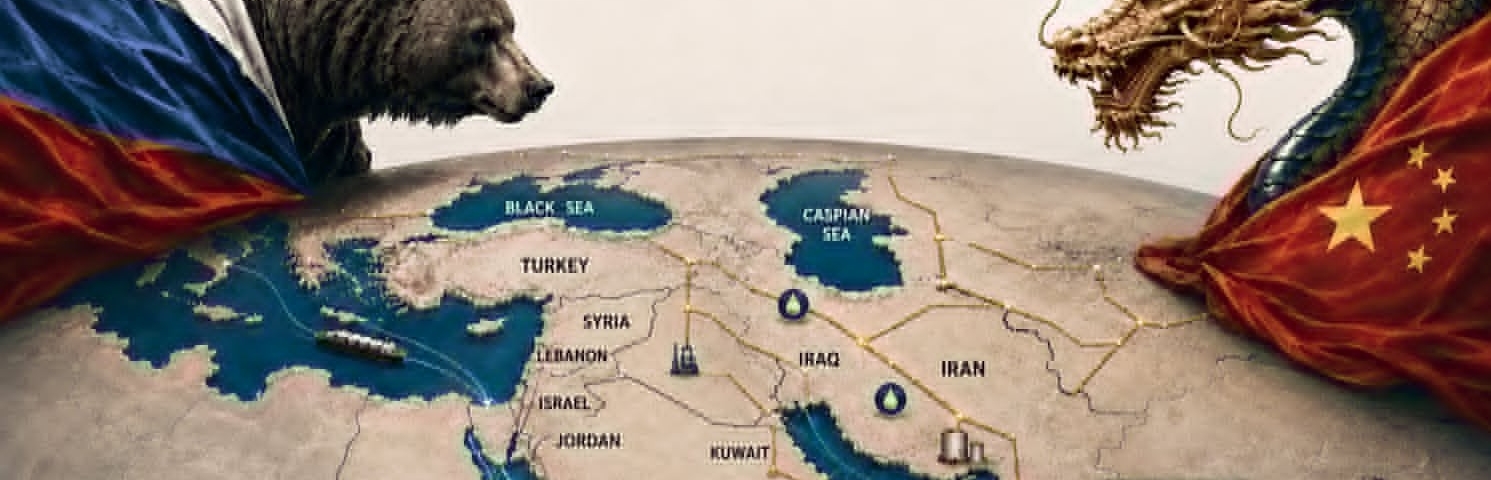
The military operation launched by the United States and Israel against Iran since February 28, which subsequently has transformed into a low-intensity conflict and converted into the blockade of the Strait of Hormuz, has the potential to significantly affect the balance of power not only in the Middle East but also globally. Moscow and Beijing have long cooperated closely to weaken the West and reshape the international order in line with their own interests. It is evident that these two countries, with a “no-limits” partnership, have their own approaches and policies toward the Middle East crisis. Moreover, their positions largely coincide, and the crisis itself appears to be fostering even closer ties between them.
Russia and China’s Political Positioning Toward Iran
Iran represents an important partner for both Russia and China, as demonstrated by their bilateral relations and the strategic partnership agreements signed between China and Iran in 2021 and between Russia and Iran in 2025. Both Moscow and Beijing view the U.S.-Iran conflict as an opportunity to weaken Washington’s influence in the Middle East and undermine its leadership in the contemporary world order.
Nevertheless, neither Beijing nor Moscow has provided Iran with particularly active political support. Instead, they maintain a more moderate stance toward the crisis. According to experts on China, Beijing’s restrained rhetoric is shaped, on the one hand, by its close political and economic ties with Arab states, and on the other, by its desire to balance relations with the United Statesб especially in the run-up to the Xi–Trump summit scheduled for May 14–15 in Beijing. Shaped by similar reasons, Moscow’s position, like that of China, remains moderate, though its foreign ministry statements are more critical and confrontational toward Washington (more on this topic is available here).
Russia and China’s balanced political stance and their high-level coordination are also evident in their actions within the UN Security Council. Specifically, in March 2026, neither Beijing nor Moscow exercised their veto power to block a resolution condemning Iran’s missile strikes against Arab states. By contrast, in April, both countries vetoed a resolution initiated by Bahrain and supported by the United States, which demanded the immediate reopening of the Strait of Hormuz by Iran. It should be noted that Russia and China have traditionally cooperated within the UN Security Council framework. Over the past twenty years, there has been only one instance when they adopted opposing positions. In November 2024, Russia vetoed a resolution calling for a ceasefire in Sudan’s civil war that China supported.
Military Support
Following the U.S.-Israeli military operation against Iran, open-source information about Russian and Chinese military assistance to Tehran remains limited, suggesting that such support is relatively restrained. From Russia’s side, reports indicate the provision of intelligence data and the sharing of operational experience to improve Iran’s use of drones. By late March, European intelligence services suggested that Russia was preparing for the phased shipment of drones to Iran, though confirmation of delivery has not yet surfaced. On April 30, during hearings in the U.S. Congress, General Dan Caine, Chairman of the Joint Chiefs of Staff, confirmed that Russia was indeed undertaking certain actions and activities to aid Iran against U.S. interests, though he refrained from providing details given the public nature of the hearing.
China’s involvement appears to be primarily through its private companies, which continue supplying Iran with sanctioned dual-use technologies that enhance weapons production and navigation systems. According to the U.S. Defense Intelligence Agency, two Chinese private firms – MizarVision and Empostate provided Iran’s Islamic Revolutionary Guard Corps with high-resolution satellite imagery of U.S. military bases and other facilities in the Middle East. Unconfirmed intelligence also suggests that China has supplied Iran with portable air-defense systems (MANPADS), designed to target low-flying aircraft.
Mediation Effort
Among experts, there is a widespread view that China leverages its ties with Pakistan to monitor negotiations between the United States and Iran, exerting limited influence on the mediation process while avoiding direct intervention. China’s foreign ministry has been active, with the foreign minister engaging in numerous phone calls with counterparts across different countries since the beginning of the military operation on February 28. By mid-April, Xi Jinping’s schedule was overcrowded with high-level meetings, including with Spain’s Prime Minister Pedro Sánchez, UAE President Sheikh Mohammed bin Zayed Al Nahyan, Vietnam’s leader To Lam, and Russian Foreign Minister Sergey Lavrov. This reflects Beijing’s effort to present itself as a stable force on the international stage.
Russia, which is engaged in full-fledged aggression against Ukraine, by contrast, faces constraints in its mediation role due to its isolation from the West and imposed sanctions. Nonetheless, Putin’s direct communication with Trump and Russia’s close ties with Iran provide some room for maneuver. In late April, a second phone call between Putin and Trump took place, initiated by Moscow shortly after Iranian Foreign Minister Abbas Araghchi visited Russia and met with Putin. Thus, it is quite possible that Putin’s initiative to arrange a telephone call with Trump was motivated precisely by his desire to discuss the issue of Iran. According to Trump’s subsequent comment, as in their first call, Putin likely raised the issue of transferring highly enriched uranium from Iran to Russia, though Trump again rejected the proposal.
The Impact of the Strait of Hormuz Crisis on China and Russia
A crisis in global energy markets and driving oil and gas prices, triggered by the blockade of the Strait of Hormuz, has different implications for China and Russia. China imported roughly half of its oil and one-third of its liquefied natural gas (LNG) from Middle Eastern countries via the Strait of Hormuz. Yet experts argue that the disruption of oil supplies is less problematic for China, given its relatively lower dependence on oil and its substantial reserves accumulated over the years. Along with that, as of March, 46 million barrels of Iranian oil were stored in floating facilities across Asia, with even larger volumes held in China’s two major port cities. The short-term challenge lies in replacing LNG supplies, which are harder to substitute quickly. Analysts suggest that China will need to rely on alternative energy sources to compensate for this shortfall.
Russia, by contrast, benefits from the crisis as an energy exporter. In March, its oil revenues rose by 52%, while oil exports increased by 16%. Revenues from LNG and pipeline gas also grew modestly, by about 5% each. The blockade has direct implications for Russia-China energy relations, as Russia is China’s largest oil supplier and also one of the major gas exporters. In 2025, deliveries through the “Power of Siberia” pipeline reached 38 billion cubic meters, which is its maximum capacity. Negotiations over the “Power of Siberia 2” pipeline are in their final stage, and a new Far Eastern route is scheduled to begin operations in January 2027, with an annual capacity of 12 billion cubic meters. Russia’s LNG export to China is also growing. Meanwhile, at the end of 2025, Russia had become China’s second-largest LNG supplier after Qatar.
The crisis triggered by the blockade of Hormuz Strate provides Moscow with an opportunity to expand energy exports to China and to negotiate more favorable gas prices. Currently, China pays Russia an average of $248.7 per 1,000 cubic meters of gas, which is about 38% lower than the average price paid by European countries such as Turkey, Slovakia, Serbia, and Hungary.
Lavrov’s Visit to China
On April 14–15, Russian Foreign Minister Sergey Lavrov visited China, marking the first high-level meeting between the two countries’ officials in 2026. During the visit, Lavrov met with his counterpart Wang Yi and with President Xi Jinping. Following the meeting, Xi emphasized the need to fully exploit the advantages of geographical proximity and complementarity, deepen comprehensive cooperation, and strengthen mutual sustainable development. At the ministerial level, the two sides compared notes on the preparation for the upcoming meeting between their leaders and discussed key international and regional developments, including the U.S.-Iran conflict, the situation in the Asia-Pacific, and the war in Ukraine.
It is noteworthy that the 2001 Treaty of Good-Neighborliness, Friendship, and Cooperation between China and Russia is set to expire on July 16, 2026. Work appears to be underway on an updated version of the document, which would expand and supplement the provisions of the original treaty, though a final agreement has not yet been reached. If the parties agree to sign the updated treaty, it is expected to more explicitly reflect Russia-China cooperation in the fields of energy and security. Otherwise, the 2001 treaty will be automatically extended for another five years.
At the conclusion of his visit, Sergey Lavrov held a press conference in Beijing, where he summarized the outcomes and addressed several important issues. Lavrov particularly emphasized the significance of Russia and China’s friendship, their strategic partnership, and their readiness to act side by side under contemporary conditions. He also noted that Russia would compensate for the energy shortfalls faced by China and other countries as a result of the Middle East crisis, provided they are willing to cooperate with Russia on equal and mutually beneficial terms.
At the same time, Lavrov was characteristically critical of the West, accusing it of striving to preserve its hegemony, which he described as being driven by a desire to “live at the expense of others” and to subordinate other nations. He identified the main objective of U.S. policy toward Venezuela and Iran as the seizure of these countries’ energy resources. Furthermore, he argued that Washington seeks to shift responsibility for Russia onto Europe in order to concentrate its efforts solely on China.
From the post-Soviet space, Lavrov singled out Central Asia, where, in his view, the West is particularly active in attempting to impose its “rules of the game” and play a leading role in shaping both the domestic and foreign policies of the region’s states. He added that similar, though less vivid, tendencies can also be observed in the South Caucasus as well.
Conclusion
In relation to Iran, Russia and China’s positions are closely aligned. For both, it is important to ensure the survival of their allied regime in Tehran and to weaken U.S. influence and standing on the international stage. However, they pursue these objectives through balanced and moderate actions, so as not to provoke excessive irritation from the United States, Israel, or Arab states. Alongside U.S.-Iran talks, Moscow and Beijing seek to conduct their own negotiations with actors involved in the Middle East conflict, using the situation to strengthen their international positions.
When it comes to mediation in U.S.-Iran negotiations, China’s role appears more solid than Russia’s. Succeeding in mediation wouldn’t lead to a fundamental reset in Beijing-Washington relations, but it would enhance China’s image as a responsible actor on the global stage. Both Moscow and Beijing are likely interested in maintaining a low-intensity conflict in the Middle East, since the current situation surrounding Iran does not strengthen U.S. positions internationally. Instead, it diverts U.S. resources toward the region and gradually depletes them, while also straining relations within the Transatlantic community. However, Russia’s interest is particularly stronger, as it derives direct economic benefits from the blockade of the Strait of Hormuz. Moreover, the Middle East crisis is fostering deeper cooperation between them, thus potentially leading to further tightening of the Moscow-Beijing partnership.
This article was translated from the original language with the assistance of AI tools and revised by the author.