



Author: Revaz Topuria, Research Fellow
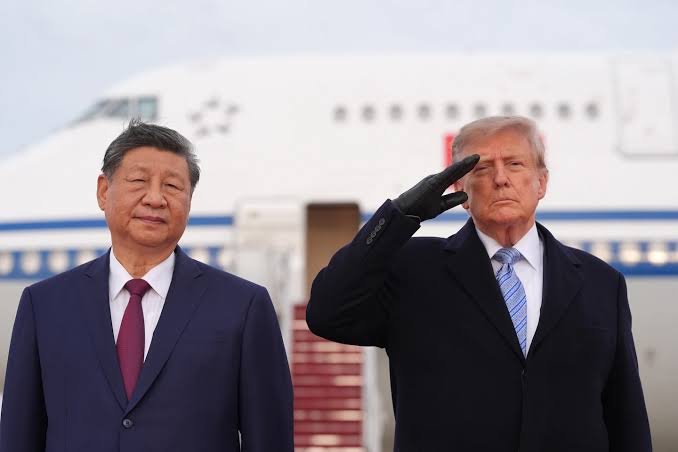
Four months ago, Xi Jinping hosted Donald Trump in Beijing; this time, the two leaders met in Washington, and with considerable pomp. On the evening of September 23, Donald Trump personally welcomed Xi Jinping’s plane at Joint Base Andrews, complete with a red carpet and honor guard. Since 1962, no U.S. president had personally greeted a foreign head of state arriving for a state visit at the tarmac. This gesture was certainly appreciated by many people in the “Middle Kingdom,” and it is a useful indicator of what the September 23–25 summit was actually intended to accomplish.
The summit’s substantive results were fairly limited: the trade truce was extended by only two months, there was no breakthrough on Taiwan, Iran, or artificial intelligence, and panda diplomacy entered a new round.
The Washington summit was largely a symbolic rather than substantive negotiating exercise. Its main function for both leaders was to preserve a fragile truce rather than resolve the disagreements between the two countries.
From Busan to Beijing and Washington
The Washington summit was Trump and Xi Jinping’s third meeting in one year. The two leaders met in South Korea at the Busan Summit on October 30, 2025, where they agreed on a trade truce, a one-year agreement concerning rare minerals, and reciprocal state visits. Trump visited Beijing in May 2026, where Xi Jinping organized a grand reception for him, including an honor guard, a tour of the Forbidden City, and a state banquet. In return, Trump made clearer statements on Taiwan than Washington had previously allowed, while Xi himself made no significant commitments.
As we already noted in our previous analysis of the Beijing summit, Xi Jinping emerged from the meeting in a considerably stronger position than Trump. He hosted the sitting U.S. president, who praised him, while China was not publicly criticized on Taiwan or human rights.
Against this background, the Washington summit was presented as Xi Jinping’s reciprocal visit and his first state visit to the United States in more than a decade. The meeting took place at a tense moment. The U.S.-Israeli war with Iran, which began in February 2026, had resulted in the closure of the Strait of Hormuz and increased global energy prices. This gave Washington an additional reason to seek cooperation with Beijing, while giving Beijing additional leverage over Washington. As a result, both governments had strong incentives to project calm rather than conflict, regardless of the problems that remained beneath the surface.
Trump’s airport welcome can also be viewed within this framework. During the Beijing summit, the U.S. president was welcomed at the airport by Chinese Vice President Han Zheng rather than Xi Jinping. Trump’s decision to personally go to Joint Base Andrews reversed this asymmetry. Through this gesture, Trump gave Xi something he needs greatly for both his domestic and international audiences: the perception that China is being treated and recognized as an equal to the United States.
It is worth noting, however, that this was not the first such occasion for Trump. In August 2025, he also personally welcomed Vladimir Putin at the airport in Anchorage. Therefore, this step can also be understood as part of Trump’s broader “airport diplomacy,” suggesting that through such symbolism Trump seeks to create a favorable foundation for negotiations.
The rest of the visit followed the same logic. Xi Jinping received the full ceremonial treatment associated with a state visit: a ceremony in the White House Cross Hall, a state dinner, and a military band. The last Chinese leader to receive a reception of similar scale in the United States was Xi himself under Barack Obama in 2015. Trump described their relationship as a “really great friendship,” saying that it was “built on real mutual respect.” Xi Jinping, meanwhile, called on the two countries to avoid the “Thucydides Trap” and described their relationship as “a race to lift each other up, rather than a struggle in which one side must win and the other lose.”
At the conclusion of the visit, Xi also renewed China’s “panda diplomacy,” announcing that two giant pandas would be sent to the National Zoo in Washington. A new program for American students to study in China was also announced. Clearly, none of these announcements changed the fundamentals of the key issues, particularly Taiwan or the South China Sea. Instead, they created a favorable backdrop for presenting cooperation between the two sides.
What Was Actually on the Agenda
Behind the ceremony, the substantive agenda included trade, Taiwan, Iran, and artificial intelligence or “superintelligence,” as President Trump now calls it and the results on all of these issues were limited.
On trade, Treasury Secretary Scott Bessent announced before Xi Jinping arrived in Washington that Washington and Beijing had agreed to extend the tariff truce, moving the original November 10 deadline to January 10 – only two months, rather than the one year reportedly sought by Beijing. Bessent also said that the two sides had discussed a broader agreement, although he acknowledged that he did not know “whether it will be possible to reach one.”
It is worth noting that in the days following Xi Jinping’s departure, both governments further expanded the scope of the agreement and announced an eight-point consensus. This included a $30 billion reciprocal tariff-reduction arrangement, as well as a standing dialogue on artificial intelligence, with the first round scheduled for November. The short extension of the truce and the eight-point consensus can therefore be considered the summit’s most significant achievements. However, it is important to note that the extension of the truce had already been agreed before the Trump-Xi meeting, while the details of the consensus still need to be clarified, since neither side discussed them during the visit itself.
On Taiwan, Xi Jinping used the summit to publicly call on Trump, for the first time, to “uphold the correct position against Taiwan independence” and to manage the issue “carefully.” Trump did not respond publicly, nor did he repeat the “unchanged” Taiwan policy that his administration had used to reassure Taipei following the May meeting in Beijing. At the same time, the fate of a $14 billion arms package for Taiwan remains uncertain. Trump described the package as “a very good bargaining chip.” The United States does not officially recognize Taiwan, but Xi’s demand that Trump oppose Taiwan independence clearly indicates Beijing’s increased appetite for concessions on the issue.
Regarding Iran, Xi Jinping said that he supported restoring the interim agreement between the United States and Iran. However, Beijing, Tehran’s largest trading partner, gave no indication that it would use its influence to pressure Iran or help ease tensions surrounding the Strait of Hormuz.
On artificial intelligence, the leaders discussed the importance of keeping advanced AI “under human control” a phrase Xi also used publicly—but they did not agree on any formal framework or safety protocol. Later reports indicated that the two sides had agreed to establish a dialogue on AI, with the first meeting scheduled for November. Despite these announcements, AI remains one of the central issues in the U.S.-China strategic rivalry, and it had been expected that the leaders would devote more time to it at the summit. The AI dialogue format is a step forward, but it is a relatively limited one. Time will tell how effectively this mechanism can place relations between the two sides within a more constructive framework.
The Summit’s Real Results
The Trump-Xi Washington summit did not generate particularly high expectations; in some ways, expectations appeared to have been managed in advance. In its pre-summit assessment, CSIS anticipated that the visit would be “focused on optics and symbolism, but lacking substantive progress.” Indeed, the summit’s function was more about demonstrating that both leaders could engage in constructive dialogue, maintaining the existing, albeit fragile, truce, and preventing a crisis. Regular, high-visibility meetings of this kind reduce the possibility of miscalculation between two nuclear powers whose militaries operate in close proximity to one another in the Indo-Pacific region.
Thus, the summit did not fundamentally alter the existing contentious issues, but both leaders used it for their own symbolic purposes. Trump received a friendly photo opportunity, two pandas, and at the same time sent markets a signal that there would be no new crisis between the two sides. Xi, meanwhile, demonstrated to domestic and international audiences that China is now acting from a position of equality with the United States.
Beyond the symbolism, it remains unclear how the two sides will address the Taiwan issue, whether China will play any role in the conflict with Iran, whether the two countries will continue the trade truce in the future, and how they will cooperate on AI. The main conclusion we can draw from the summit is that both sides are attempting to buy time and preserve the existing fragile truce. At the same time, Xi and Trump agreed to meet twice more this year: Trump will travel to Shenzhen for the APEC summit, while Xi will visit Florida for the G20 summit. As a result, this will be the first time in history that a U.S. president visits China twice in a single calendar year, while the Chinese president visits the United States twice.
In short, the Xi-Trump meetings will continue and, for the time being, so will the truce.
This article was translated from the original language with the assistance of AI tools and revised by the author.