



Author: Giorgi Bilanishvili, Senior Fellow at UGSPN
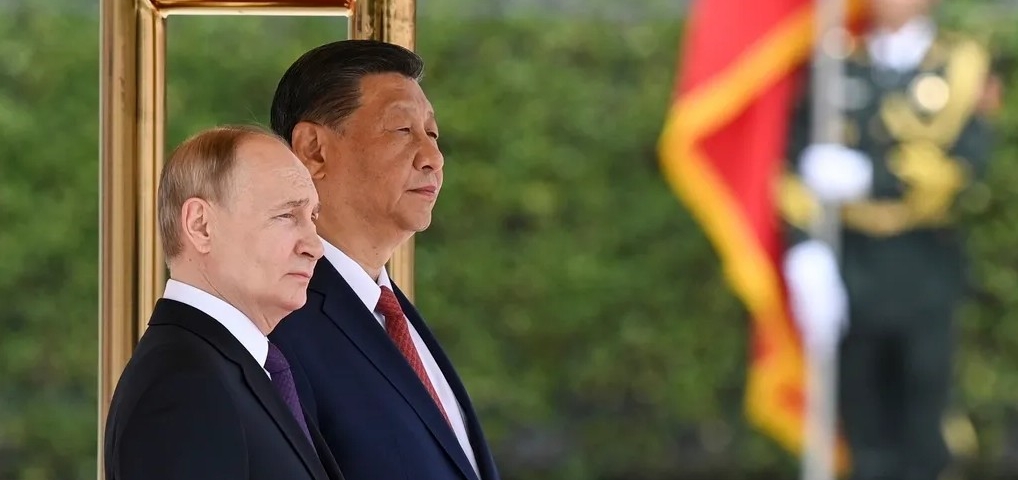
On May 19–20, only a few days after President Trump’s visit, President Putin traveled to China. The coincidence in timing further heightened international attention toward the event. The program of the visit was deliberately structured to emphasize both its significance and the cordial atmosphere that has gradually developed between the Russian and Chinese leadership over the years. Much like the U.S. delegation, Russia’s delegation was highly representative, including five deputy prime ministers, eight ministers, the governor of the Central Bank of Russia, as well as heads of major energy and financial corporations.
It was announced in advance that the visit would result in the signing of approximately forty documents, alongside the adoption of a joint declaration and statement. Additionally, it was also known in advance that Russia attached particular importance to reaching a final agreement on the new gas pipeline project, “Power of Siberia 2”, which had failed several times in the past. Moscow hoped that the crisis in the Middle East, which had complicated China’s energy supply, would make Beijing’s position more flexible. However, Moscow’s optimistic expectations failed once again as no final agreement on “Power of Siberia 2” was reached in Beijing.
Beyond this issue, numerous documents were indeed signed, though none proved to be of major significance. Additionally, the 2001 Treaty of “Good-Neighborliness, Friendship, and Cooperation” between Russia and China was automatically extended for another five years, although there were certain expectations within Russia’s expert community that amendments would be introduced in the treaty to clarify and strengthen the partnership. In sum, the principal outcome of the visit was the joint declaration and statement adopted by Russia and China that underscored the importance of their bilateral relations and reflected their shared perspectives on the global order and other key issues.
Joint Declaration on the Establishment of a Multipolar World and a New Type of International Relations
The joint declaration is a relatively concise document, yet it has substantial political implications. Its primary purpose is to demonstrate a unified vision by Russia and China regarding the establishment of a multipolar world order. Several points within the text merit particular attention:
- Attempts by several states to unilaterally manage global affairs, impose their interests on the entire world, and limit the sovereign development of other countries, in the spirit of the colonial era, have failed.
- In the twenty-first century, the system of international relations is undergoing profound transformation. Through an evolutionary process, it is shifting toward a long-term multipolar configuration and giving rise to a new type of international relations.
- At the same time, the global situation is becoming more complex. Neo-colonial tendencies are intensifying, including unilateral coercive approaches, hegemonism, and practices of bloc confrontation.
- It is essential to prioritize cooperation on security issues, reject strategies of bloc confrontation and “zero-sum games,” and oppose the expansion of military alliances, the conduct of “hybrid” wars, and proxy wars.
The document concludes by affirming that Russia and China will continue to develop a shared vision for shaping a multipolar world and establishing a new, more equitable system of international relations.
The content of the declaration does not introduce any novelty, as the perspectives expressed therein have already been articulated by both Moscow and Beijing at the highest political levels. As noted, the principal political significance of the declaration lies in the fact that it formally codifies the convergence of Russian and Chinese positions.
Joint Statement on Further Strengthening Comprehensive Partnership and Strategic Interaction, and Deepening Relations of Good-Neighbourliness, Friendship and Cooperation
The joint statement is a more extensive document, the content of which reveals that both sides aspire to deepen their cooperation across various fields. They express support for each other’s international initiatives, reiterate mutually beneficial formulations, and place particular emphasis on the importance of the Shanghai Cooperation Organization and BRICS, in both of which Russia and China play leading roles. Against the backdrop of President Donald Trump’s recent visit to China, the positions articulated in the joint statement regarding the United States deserve special attention.
From the bilateral cooperation outlined in the statement, several domains stand out, such as military affairs, artificial intelligence, energy, transportation, and the information sphere. Regarding these domains, Russia and China articulate the following positions:
- The parties will strengthen traditional cooperation between their armed forces, deepen mutual trust in the military sphere, and expand the existing practices of joint exercises, as well as air and naval patrols.
- The parties reaffirm their readiness to develop cooperation concerning the military applications of artificial intelligence.
- The parties highly value Russia-China cooperation in the energy sector, pledge to deepen this collaboration further, and support mutually beneficial interaction in oil, gas, coal, civil nuclear energy, and renewable energy.
- The parties will continue to develop transit shipments from China to Europe through Russian territory.
- The parties support exchanges between internet media and prominent bloggers in Russia and China, with the aim of producing joint content and training personnel.
It should be noted that Russia and China, in most cases, speak of expanding and deepening already existing cooperation. While this is significant in itself, it does not constitute a substantive novelty. Alongside traditional areas, emphasis is placed on cooperation in the information sphere, which is not accidental, as both countries actively and effectively employ propaganda for domestic and foreign purposes.
In light of Russia’s particular interests in the post-Soviet space, attention should also be drawn to the context in which the Eurasian Economic Union is mentioned in the joint statement. Specifically, it states that the parties have agreed on practical cooperation between the Eurasian Economic Union and China, and will continue aligning the initiatives of the Eurasian Economic Union with the Belt and Road Initiative. This context reveals the asymmetry in economic capabilities between Russia and China, to the latter’s advantage. Although Russia views the Eurasian Economic Union as an organization created to project its influence within the post-Soviet space, it is compelled to accommodate China’s growing economic presence in the region, as a reality that has been evident for years.
In the joint statement, Russia expresses support for China’s conceptual visions, such as the Global Civilization Initiative, while China highly values Russia’s proposal to establish an equal and indivisible architecture of Eurasian security. Among the politically significant formulations, the following stand out:
- The parties support cultural and civilizational diversity, as well as each other’s efforts aimed at preserving cultural-historical identity and traditional spiritual and moral values.
- The parties categorically oppose hegemonism, unilateralism, and any return to a world order governed solely by the principle of force.
- The parties categorically oppose the practice of imposing unilateral sanctions and secondary restrictions.
- The parties will continue to strengthen cooperation against the glorification of Nazism, fascism, and militarism.
From China’s perspective, it is particularly important that the joint statement firmly records Russia’s support for the One-China principle, recognizing Taiwan as an inseparable part of China and opposing any form of its independence. It is also noteworthy that Russia, while not explicitly endorsing, nonetheless respects China’s negative stance toward potential negotiations on nuclear arms control involving China, the United States, and Russia. This initiative had been advanced by President Trump, but China has made clear its refusal to participate.
From Russia’s perspective, it is significant that the statement partially reiterates its position regarding Ukraine. Specifically, it declares that both parties are convinced of the necessity of addressing the root causes of the Ukrainian crisis. Yet the text continues by stating that this must be done based on the UN Charter and linked to the creation of solid foundations for peace and the pursuit of mutual security. It is noteworthy that Moscow frequently speaks of the need to eliminate the root causes of the conflict, but does not usually elaborate in the way reflected in the joint statement. Moscow identifies various factors as root causes, including NATO enlargement. Importantly, prior to Russia’s invasion of Ukraine, on February 4, 2022, the joint statement issued by Russia and China explicitly recorded their shared opposition to NATO expansion. In the current statement, however, NATO is not mentioned at all. On the issue of Ukraine, the statement further notes that Russia appreciates China’s objective and impartial position and welcomes its aspiration to play a constructive role in resolving the crisis.
Even weaker is another formulation of support for Moscow from the Chinese side, which states that China “takes into account” Russia’s concerns regarding the European Union’s course of militarization. The European Union is also mentioned in the joint statement in the context of expressing concern over statements made by some of its member states about the possible development of nuclear weapons. By contrast, comparatively stronger formulations are employed with respect to Japan. Specifically, serious concern is expressed about Japan’s long-term accumulation of nuclear materials, and Japan’s accelerated course of remilitarization is regarded as a grave threat to global and regional stability. This contrast is likely explained by the fact that Russia and China’s positions coincide regarding Japan, whereas they diverge concerning the European Union. Unlike China, Russia is in direct confrontation with EU member states due to its aggression in Ukraine. Overall, both the context of Ukraine and the contrast in the formulations concerning the EU and Japan create the impression that Beijing has not fully embraced Moscow’s positions on certain issues.
The joint statement also contains messages directed against the United States, expressed in indirect, balanced, and direct forms. Indirect messages include the passage stating that actions such as the treacherous execution of military strikes, the use of deceptive negotiations as cover for preparing such strikes, the assassination of representatives of sovereign governments, and the destabilization of domestic political situations constitute gross violations of the principles and purposes of the UN Charter and of international law. Although the United States is not explicitly mentioned, it is evident that these passages refer to recent actions undertaken by the U.S. and Israel against Iran. The same category of indirect messaging includes the negative position expressed by Russia and China regarding the deployment of weapons in outer space.
On the issue of Iran, the joint statement reflects a more balanced message toward the United States. It declares that U.S.-Israeli military strikes against Iran violate international law and significantly undermine stability in the Middle East. At the same time, Russia and China call upon the parties involved in the conflict to return to dialogue and negotiations. It is noteworthy that in this case the parties refrain from using harsher terminology, such as “military aggression against Iran.” Instead, they speak more generally of instability in the Middle East and issue a non-specific appeal for a peaceful resolution of the conflict. By way of contrast, the statement articulates Russia and China’s positions more explicitly in support of North Korea. It states that the parties oppose foreign political isolation, economic sanctions, coercive pressure, and other actions that threaten the security of the Democratic People’s Republic of Korea. Overall, the balanced tone of the section concerning Iran is unsurprising. Despite their strategic partnership with Iran, both Russia and China have maintained a cautious and balanced approach toward the Middle East crisis since its inception (more on this topic is available here).
Direct messages against the United States include the section of the joint statement addressing the “Golden Dome” project (more on this topic is available here). It declares that the “Golden Dome” poses a clear threat to strategic stability. The statement further highlights the potential negative consequences of this project in terms of the development and deployment of space-based missile defense systems. In addition, the U.S. position following the expiration of the 2010 agreement with Russia on the further reduction of strategic offensive arms is assessed negatively, as Washington declined to renew the agreement in its previous format.
Conclusion
Following President Trump’s visit (more on this topic is available here), President Putin’s subsequent trip to Beijing highlighted, first and foremost, the contrast between China-U.S. and China-Russia relations. In the former case, the parties issued separate statements. Moreover, the U.S. statement did not mention Taiwan but referred to Iran and the Strait of Hormuz, whereas China’s official statement did the opposite. By contrast, during Putin’s visit, the parties issued not only a joint statement but also a joint declaration. This circumstance clearly reflects the reality that has long been established: China and Russia are strategic partners, whereas China and the United States are not.
At the same time, and more importantly, a certain contrast emerged in China’s attitude toward the United States and Russia. From the overall context of Trump’s visit, experts concluded that China perceives itself as an equal to the United States. This was particularly evident in President Xi’s emphasis on the “Thucydides Trap” and the necessity of constructive China-U.S. relations for strategic stability. With regard to Russia, however, most experts agree that China still regards itself as the senior partner. Putin’s visit reinforces this assessment for two main reasons. First, Moscow once again failed to secure the agreement it desired with Beijing. Second, as reflected in the joint statement, Russia’s positions on several important issues were, in all likelihood, not fully embraced by China.
This article was translated from the original language with the assistance of AI tools and revised by the author.